


The Qatar World Cup: Dreaming of Bridging the Gulf Rift
Error: Contact form not found.

 by James M. Dorsey

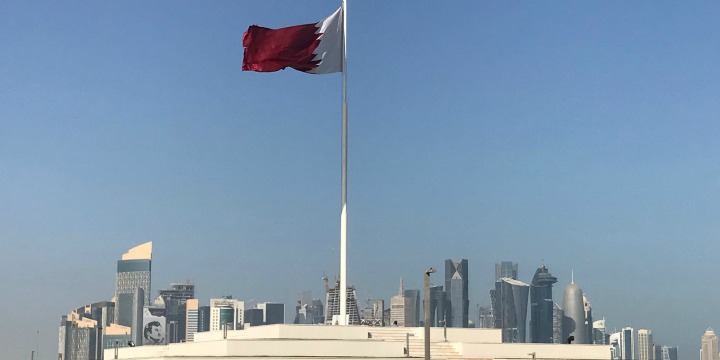
A Qatari flag is seen at a park near the Doha Corniche, in Doha, Qatar, Feb. 17, 2018. Photo: Reuters / Ibraheem al Omari.
The idea of the 2022 World Cup in Qatar mending fences in the Gulf is grounded in the longstanding illusion that soccer can drive events and in and of itself build bridges, even if the parties are unwilling or unable to negotiate a resolution of their differences.
Sports in general and soccer in particular have only been able to build political bridges in environments where sports is just one node in a far broader and more politically-enabled process that is already seeking to engineer a rapprochement. Perhaps the most obvious example is the US-Chinese ping pong diplomacy of the early 1970s, which helped engineer a thaw in relations between Washington and Beijing.
What more typically happens is that soccer creates a fleeting sense of unity and warmth that quickly dissipates when situations revert to the status ante quo of confrontation, violence, and war. This is what happened in December 1914 when Germany and Britain declared a local ceasefire to play a soccer match (the “Christmas Truce”) and then went back to fighting a world war for four more years.
It is also the story of Iraqis of all stripes rejoicing on the streets of Baghdad in 2007 after their country won the AFC Asian Cup only to revert days later to sectarian infighting that would go on for years.
Fueling the illusion that the World Cup is potentially a central factor is the fact that the UAE has for the past decade sought to engineer a withdrawal of Qatar’s World Cup hosting rights. As the UAE stepped up its campaign, some prominent Emiratis suggested that a surrender or sharing of those rights with other Gulf states could put an end to the economic and diplomatic boycott of Qatar imposed by its detractors in 2017.
“If the World Cup leaves Qatar, Qatar’s crisis will be over … because the crisis is created to get away from it,” said former top UAE security official, Lt. Gen. Dhahi Khalfan.
Any mitigating impact the World Cup might have on the Gulf rift would at best amount to a Gulf equivalent of the 1914 World War I ceasefire or the temporary sense of unity in Iraq.
The World Cup would hardly help Saudi Arabia and the UAE save face, given that the rift was designed to force Qatar to subjugate itself to the dictates of the two states. Nor would it solve or contain what UAE Crown Prince Muhammad bin Zayed sees as an existential threat: Qatar’s support for political Islam, its alliance with Turkey, and the existence of Al Jazeera as a free-wheeling television network.
The joker in the pack could be Joe Biden. As president, Biden is likely to be less protective and more critical of Saudi Crown Prince Muhammad bin Salman, as well as Emirati Prince Muhammad’s military interventions and politically repressive rule at home. Biden may also be more inclined to manage the use by Saudi Arabia, and to a lesser extent the UAE, of US-made weaponry in the Yemen war.
The World Cup could play a role in an environment in which the two crown princes seek to accommodate a Biden administration. That would reinforce the notion that sports and soccer are useful bridge builders only when circumstances and political will are inclined in that direction.
Dr. James M. Dorsey, a non-resident Senior Associate at the BESA Center, is a senior fellow at the S. Rajaratnam School of International Studies at Singapore’s Nanyang Technological University and co-director of the University of Würzburg’s Institute for Fan Culture.
A version of this article was originally published by Georgetown University‘s Qatar Center for Regional and International Studies and the BESA Center.


