


Stop Playing Down the Significance of Morocco and Sudan Normalization Deals
Error: Contact form not found.

 by Hadar Sela

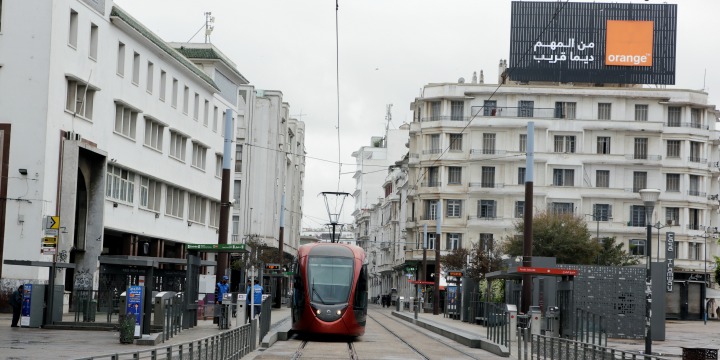
A general view shows an empty street following the outbreak of the coronavirus disease (COVID-19) in Casablanca, Morocco, March 20, 2020. Photo: Reuters / Youssef Boudlal.
The December 10th edition of the BBC World Service radio program Newshour included an item (from 26:36 here) introduced by presenter Tim Franks as follows:
Franks: The overwhelming majority of Donald Trump’s Twitter feed is filled with his unsubstantiated claims about election fraud. But a few hours ago the subject changed. “Another historic breakthrough,” he announced. “Our two great friends, Israel and the Kingdom of Morocco, have agreed to full diplomatic relations.” Moments before, Mr Trump has also Tweeted that he was also recognizing Moroccan sovereignty in the long-running territorial dispute over the Western Sahara. Our Arab affairs editor is Sebastian Usher.
Usher: Well it’s significant on two fronts, isn’t it? I mean one obviously is in relation to Israel. It’s now the fourth Arab country to normalize relations with Israel. This has been something the Trump administration has been promising and talking about for a long time over skepticism but we have seen since August these deals done.
Now it’s important obviously to say that all the countries so far — the UAE, Bahrain, Sudan and now Morocco — are all countries that have never really been overtly at war with Israel, not involved in wars and are quite far, obviously, from the battle ground such as it is: Israel and the Palestinian… ahm… territories.
And also they’re all countries which have had relationships either openly or covertly with Israel for some time, where their interests have coincided. Now Morocco did have direct diplomatic relations to a limited extent until about 20 years ago so under this deal those would be reopened. So it’s not — in terms of the Israeli question — a seismic change but it is… it is significant, it is again historic, it is a breakthrough. But we’re still waiting on that issue for what happens with, you know, the countries which really matter which would be particularly Saudi Arabia and that’s still very much an open question and unlikely to happen during the last days of the Trump administration.
[emphasis in italics in the original, emphasis in bold added]
That highlighted claim from Sebastian Usher is not accurate.
In his book 1948: A History of the First Arab-Israeli War, historian Benny Morris notes that (p. 230 Hebrew version) “units from Yemen, from Morocco, from Saudi Arabia, and from Sudan” joined the Arab forces during Israel’s War of Independence. He then goes on to document battles in which the six companies of Sudanese forces fighting with the Egyptian army participated.
Arab affairs analyst and WINEP fellow Ehud Ya’ari notes that:
Khartoum’s decision differs from the Emirati and Bahraini normalization moves in another notable respect: Sudan and Israel have a history of past military clashes and other hostile behavior. For example, Sudanese companies fought alongside the Egyptian army in the 1948 and 1967 wars. Shortly after the latter conflict, Khartoum hosted the summit at which the Arab League adopted its infamous “three no’s” policy — no peace, no negotiations, no recognition of Israel. And during the 1973 war, Sudan sent an expeditionary force to the Suez front, though only after a ceasefire had been reached, rendering the deployment largely symbolic.
On October 11 1973, Reuters reported on a reception for Moroccan soldiers about to depart for the Egyptian front, noting that:
It was the second time in four months that an expedition of the Moroccan Army was leaving the western-most part of the Arab world for the Middle East. Three thousand Moroccan troops and an armored unit have already been reported in action on the Golan Heights.
During the 1973 Yom Kippur War, six Moroccan soldiers were taken prisoner by Israel. In July 1974, the AP agency reported on “Moroccan and Syrian troops parading before King Hassan of Morocco, after fighting alongside the Syrians on the Golan Heights.”
Sebastian Usher’s attempt to downplay the significance of the normalization agreements by means of the inaccurate claim that Sudan and Morocco “have never really been overtly at war with Israel, not involved in wars” is clearly and materially misleading to audiences.
Hadar Sela is the co-editor of CAMERA UK — an affiliate of the Committee for Accuracy in Middle East Reporting in America (CAMERA), where a version of this article first appeared.