


Questions for Incoming National Security Advisor Jake Sullivan
Error: Contact form not found.

 by Yoram Ettinger

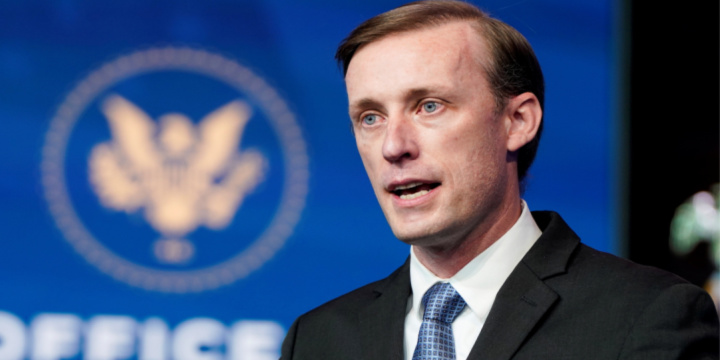
FILE PHOTO: Jake Sullivan, US President-elect Joe Biden’s choice to be his national security adviser, speaks as President-elect Biden announces his national security nominees and appointees at his transition headquarters in Wilmington, Delaware, US, November 24, 2020. REUTERS/Joshua Roberts
After watching a 2019 discussion with Jake Sullivan, I came away with these takeaways about his worldview (in the past, Sullivan served as a key advisor to Secretary of State Hillary Clinton and President-elect Biden):
- Attachment to Europe’s culture, history, and geo-strategic thinking;
- Support for multilateralism through expanded national security collaboration with Europe, the UN, and international alliances and organizations, rather than unilateralism;
- Democracy and human rights-driven foreign policy (however, in the Middle East, Arab regimes do not lend themselves to human rights and consider democracy an existential threat);
- The reassertion of the worldview of many in the State Department crowd (despite their systematic blunders in the Middle East); and
- The restructuring of the defense budget by expanding “civilian tools” and reducing “military tools” of national security (this would occur in a stormy world, which requires an enhanced, not reduced, US posture of deterrence).
Iran
Jake Sullivan played a key role in negotiating the 2015 Iran nuclear accord (JCPOA). He opposes a regime-change policy because he thinks it is unrealistic and prefers to try to work with and around Tehran. He supports returning to the Iran deal under the right conditions — but it’s unclear what those will be.
The JCPOA was rejected by all pro-US Arab states, as articulated on December 28, 2020, by the Riyadh-based Arab News: “We should insist on focusing on the nuclear deal’s original end … integrating Iran into the international community and turning it into a normal state that does not pose a threat to the security and safety” of other states.
In fact, the JCPOA (a model of multilateralism) has not diverted Iran’s ayatollahs from their fanatic, megalomaniacal strategic goal to control the Persian Gulf, the Middle East, the Muslim world, and beyond. The JCPOA generated a financial and political tailwind to the ayatollahs, and bolstered Iran’s systematic subversion, terrorism, and wars in the Middle East, Central Asia, Africa, and Latin America.
Sullivan has said he will stand up to Iran’s abuses, but his record doesn’t suggest that he can be trusted.
Saudi Arabia
Sullivan lumps together the pro-US Crown Prince Mohammed Bin Salman and Egypt’s General el-Sisi with other human rights abusers, such as arch rivals of the US Kim Jong-un of North Korea, China’s Xi Jinping, Russia’s Vladimir Putin, and Turkey’s Recep Tayyip Erdogan.
He criticizes Saudi violations of human rights and lack of democracy, while playing down, or avoiding, criticism of Iran’s hate education and ruthless repression of its population, including hanging and stoning dissidents, gay people, and adulterous women, in addition to the oppression of religious and ethnic minorities.
He sidesteps Middle Eastern Arab reality, where the choice is often between pro-US or anti-US human rights violating Arab regimes.
Sullivan may recommend the suspension of the supply of advanced US military systems to Saudi Arabia as a means of pressuring Riyadh, which may force the Saudis to seek similar systems from Russia, China, or Europe.
Egypt
The pro-US President Sisi is likely troubled by Sullivan‘s human rights criticism of Egypt. Sullivan served as an advisor to then-Secretary of State Hillary Clinton during the Arab Spring, in which the Muslim Brotherhood was elected to power after the fall of President Hosni Mubarak.
Among some allies, this was seen as an erosion of US reliability; the unrest fueled violence in Egypt, which led to General Sisi’s military takeover of the country. Just like Saudi Arabia, an antagonistic US policy toward Egypt may push General Sisi towards Russia, which has maintained commercial and military contacts with Egypt since the 1950s.
Libya
Sullivan, like Secretary Clinton, played a pivotal role in shaping the 2011 US-led NATO military offensive against Muammar Gaddafi, which was aimed at stopping his ruthless war on his domestic opponents. However, the offensive disintegrated Libya and triggered civil wars, which have drawn foreign involvement, such as from Turkey, Russia, Qatar, France, Italy, the UAE, and Greece.
Libya became a major platform of Islamic terrorism, haunting North, West, and Central Africa, Egypt, Syria, Iraq, Yemen, and Europe.
Israel
During Sullivan’s time at the State Department, the Obama administration subscribed to the erroneous assumption that the Palestinians are a major issue on the Arab agenda, a core cause of regional turbulence, and the crux of the Arab-Israeli conflict. This was never the case — and the Abraham Accords have exposed it as untrue. Although Sullivan praised the peace deals, we don’t know how he will approach Israel and the Palestinian issue once Biden takes office.
Will Sullivan learn the proper lessons from the litany of failed Israel-Palestinian peace initiatives, which focused on the Palestinian issue, according the Palestinians veto power over peace?
Is Sullivan aware of Arab opposition to the proposed Palestinian state, which all pro-US Arab regimes consider added fuel to the Middle East fire?
Is Sullivan aware of the intrinsic Palestinian strategic goal, which does not tolerate Jewish sovereignty west of the Jordan River, as reflected by the Palestinian Authority school curriculum and the systematic Palestinian track record?
Will Sullivan adopt the approach of bypassing the Palestinian issue, and focus on Israel-Arab and US interests, which produced the recent peace and normalization accords between Israel and the UAE, Bahrain, Sudan, and Morocco, thus further expanding the circle of Israel-Arab peace? All of this remains to be seen.
Yoram Ettinger is a former ambassador and head of Second Thought: a US-Israel Initiative.


