


Settlements Are Not the Obstacle to Peace, Just a Two-State Solution
Error: Contact form not found.

 by Mitchell Bard

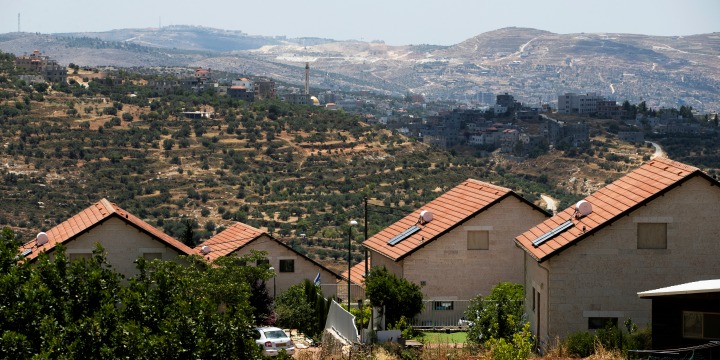
Houses are seen in the Israeli settlement of Itamar, near Nablus, in the West Bank, June 15, 2020. Photo: Reuters / Ronen Zvulun.
Shany Mor wrote a useful if not very original article in Mosaic on the history and failure of peace processors and the implications for their return under the Biden administration. What was more striking was that while arguing that settlements are not the obstacle to peace, Mor distorts the facts and denies the reality of the demographic, geographic, and political changes that make a two-state solution impossible.
According to Mor’s analysis, the question of whether a two-state solution is possible was settled by Israel’s offers in 2000, 2001, and 2008 to withdraw from more than 90% of the West Bank and evacuate most settlements. He correctly states that the failure of those proposals was due to Palestinian rejection.
He then dismisses the idea that “time is running out” for a two-state solution and strangely claims that “all the dramatic changes happened well before Oslo and very little … has happened since.” Mor argues the “land built up by settlements” and the “number of settlements” changed most dramatically between 1967 and 1993; therefore, if it was possible to offer the Palestinians a state then it is still possible today.
He concludes that if there really was a concern that the point of no return was approaching, it is the Palestinians, not the Israelis, who should be pressured to compromise. He is correct that failure to understand this is a historic failing of the peace processors.
The Palestinians should have recognized on their own that time was running out. I would argue that this was the reason they agreed to the Oslo Accords. They were never prepared, however, to abandon their dream of a state from the river to the sea. So long as they refused to give up that fantasy, their only hope for stopping the growth of settlements was pressure from the United States or Europe. The former was unwilling and the latter unable to deliver.
Mor asserts that the number of settlers is irrelevant; “it is the number of settlements, the demographic balance between Israelis and Palestinians in the territories,” and “the percentage of built-up land” that really matters. He is wrong. It is the number of settlers and where they live that is most important to the demise of the two-state formula of the peace processors.
It is true that the number of settlers and settlements increased most dramatically from 1967 to 1993, which is not surprising given that the starting point was zero. By the time of the 1993 Oslo agreement, roughly 130,000 Jews lived in more than 100 settlements in the West Bank. Nevertheless, it was Palestinian terrorism, not settlements, that scuttled the peace process.
By Camp David in 2000, the number of settlers had jumped to 200,000. Israel insisted that 80% of the Jews in Judea and Samaria should live in the “consensus” settlement blocs near the Green Line, which even the Palestinians were prepared to see Israel annex. The assumption, which was unreasonable even then, was that the other 20% — 40,000 people — would move to the blocs or inside the current borders for the chance to have peace. Of course, the Palestinians rejected the deal, so the issue was moot.
The situation grew worse for the Palestinians by 2008 when Abbas also rejected a deal for a Palestinian state in nearly the entire West Bank with most settlements evacuated. At that time, the number of settlers was 275,000.
Just three years earlier, Israel evacuated all 9,000 Jews from the Gaza Strip, which was one of the most emotionally gut-wrenching events in Israel’s history. Though some analysts had warned of a civil war, the disengagement was completed more easily than expected; nevertheless, it gave a preview of the difficulty of removing Jews from the West Bank.
For Mor to suggest that nothing has dramatically changed since then ignores the dramatic increase in the settlement population. True, relatively few new settlements have been built, but the number today is 131 with a population of 475,000. It is incredulous to think that a two-state solution is no more difficult today than it was 12 years ago when the number of settlers was less than half what it is today.
Mor is correct that it matters where the settlements are as well, but he only thinks about the land area of those communities rather than their location. All you have to do is look at a map to see how settlements scattered throughout the West Bank and surrounding the Palestinian areas make it impossible to create the Palestinian state envisioned by the peace processors.
Moreover, instead of 80% of the settlers living in the five “consensus blocs,” today that figure is closer to 70%. This means that an agreement to dismantle the settlements outside the blocs would require the relocation of roughly 140,000 people.
Hence, contrary to Mor’s assertion, the settlements have grown to the point of no return — at least to satisfy the pre-Trump peace proposals. The Trump plan offered the Palestinians a state and Israel would not have had to evacuate a single settlement, but if the Palestinians were not prepared to accept a state in 97% of the West Bank as Ehud Barak offered, there was no chance they would accept one in 70%.
I have said many times that Arafat and Abbas are the real fathers of the settlements. Their growth would not be possible without Palestinian irredentism. The Palestinians have not changed their position that a Jewish state cannot exist in “Palestine” since they rejected Peel’s partition plan in 1937. Meanwhile, the number of settlers grows.
Mor is happy to acknowledge the Palestinian responsibility for the absence of peace but ignores the changes in the Israeli mindset caused by the disengagement or, more accurately, the perception of its failure. Israeli attitudes have hardened and today there is a greater demand for ironclad security guarantees to prevent the creation of Hamastan, less faith in the Palestinians accepting any peace agreement, little support for a mass evacuation of settlements, and more acceptance of the status quo.
Perhaps the best indication of the shift is the near total absence of any discussion of the Palestinian issue in this or the past three elections. This does not mean Israelis do not want peace but, combined with the settlement population, it does mean the possibility of a two-state solution is at or near zero.
Mitchell Bard is a foreign-policy analyst and an authority on US-Israel relations who has written and edited 22 books, including “The Arab Lobby,” “Death to the Infidels: Radical Islam’s War Against the Jews,” and “After Anatevka: Tevye in Palestine.”


