








Israeli Envoy in Ukraine Slams Naming of Soccer Stadium in Honor of Nazi Ally Roman Shukhevych
Error: Contact form not found.

 by Ben Cohen



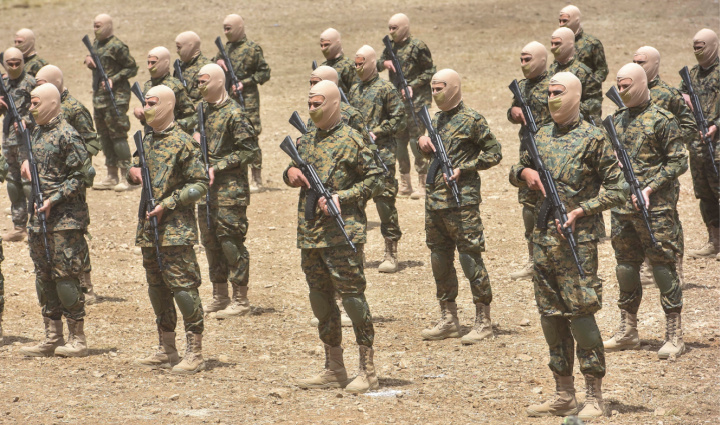
Far right extremists in Ukraine march in honor of Roman Shukhevych in 2017. Photo: Screenshot
Israel’s Ambassador to Ukraine on Tuesday lambasted the city of Ternopil after its council named a rebuilt soccer stadium after Roman Shukhevych, the leader of a Ukrainian nationalist brigade created by the occupying Germans during World War II.
“We strongly condemn the decision of Ternopil city council to name the City Stadium after the infamous Hauptman of the SS Schutzmannschaft 201 Roman Shukhevych and demand the immediate cancellation of this decision,” the Israeli envoy in Kiev, Joel Lion, stated on Twitter.
The newly-reconstructed stadium holds just over 15,000 spectators and will host the final of the Ukrainian Soccer Cup later this year. Confirmation that the stadium would be named in honor of Shukhevych came following a meeting of the Ternopil city council on March 5 — the 71st anniversary of Shukhevych’s death during a shoot-out with Soviet intelligence agents who raided his hiding place in the western Ukrainian city of Lviv.
A committed Ukrainian nationalist from his days as a student, in 1940 Shukhevych commanded a military unit of the Organization of Ukrainian Nationalists (OUN) that actively collaborated with the Nazis. Following the German invasion of the Soviet Union in 1941, Shukhevych became the commander of the Ukrainian “Nachtigall” battalion under the ultimate command of the Germans.
Shukhevych is regarded as a hero by post-war Ukrainian nationalists both inside the country and in the diaspora. Many of his defenders angrily deny that the “Nachtigall” battalion was involved in the widely-documented slaughter of Jews in Lviv in 1941.
However, according to Per Anders Rudling — a Swedish academic who has published extensively on World War II in Eastern Europe — “Roman Shukhevych personally helped set up the Ukrainian nationalist militia, which played a key role in the L’viv pogrom. Soldiers of Nachtigall partook in the July 1, 1941 L’viv pogrom, as well as massacres of Jews in the vicinity of Vinnytsia.”
Shukhevych subsequently became the commander of the Schutzmannschaft Battalion 201, which fought anti-Nazi partisans in Belarus. Having survived the war, he went into hiding following the defeat of the Nazi regime, meeting his death in 1950 when the Soviet authorities attempted to arrest him.