







In Leaked Recording, Iran’s Zarif Criticizes Guards’ Influence in Diplomacy
Error: Contact form not found.

 by Reuters and Algemeiner Staff

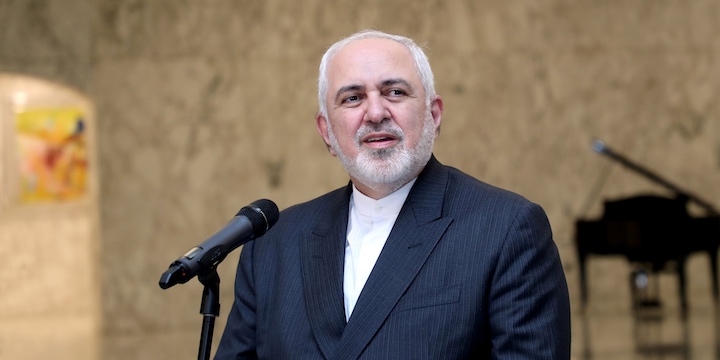
Iran’s Foreign Minister Mohammad Javad Zarif speaks at the presidential palace in Baabda, Lebanon August 14, 2020. Photo: Dalati Nohra/Handout via REUTERS/File Photo
Iran’s top diplomat complained in a leaked recording that the elite Revolutionary Guards had more influence in foreign affairs and the country’s nuclear dossier than him, in remarks that shine a light on ties between the government and the powerful force.
Relations between pragmatist President Hassan Rouhani’s government and the Guards are important because the influence of the hardline paramilitary force is so great that it can disrupt any rapprochement with the West if it feels this would endanger its economic and political interests.
The Guard’s traditional skepticism about any cultivation of detente with Washington may become relevant if talks between Iran and world powers advance efforts to revive a 2015 nuclear deal abandoned by President Donald Trump three years ago.
In the interview, aired by the London-based Iran International Persian-language satellite news channel late on Sunday, Foreign Minister Mohammad Javad Zarif said he had “zero” influence over Iran’s foreign policy.
“I have never been able to tell a military commander to do something in order to aid diplomacy,” Zarif said.
Without disputing the audio’s authenticity, the foreign ministry spokesman on Monday said that the news channel only published excerpts of the seven-hour interview with the foreign minister.
Using language rarely heard in politics in Iran, Zarif complained about the extent of influence the late IRGC commander Qassem Soleimani had over foreign policy, hinting that Soleimani tried to spoil Iran’s 2015 nuclear deal by colluding with Russia.
“He (Soleimani) asked me to make this or that concession or point almost every time I went to negotiate (with world powers),” Zarif said in the recording, that was aired on the TV’s Clubhouse channel on late Sunday.
“The (military) field’s success was more important than diplomacy’s success. I was negotiating for the (military) field’s success.”
Leader of the Guards’ clandestine overseas Quds Force, Soleimani was a pivotal figure who built up Iran’s network of proxy armies across the Middle East. He was killed in a US drone attack in Iraq last year.
Iran retaliated with a rocket attack on an Iraqi air base where US forces were stationed. Hours later, Iranian forces shot down a Ukrainian passenger airliner taking off from Tehran. Days later, Iran’s Guards admitted that the plane had been shot “mistakenly.”
“I said (at the Supreme National Security meeting) that the world is saying the plane was hit with missiles. If the plane was really hit with missiles, tell us so we can see how we can fix it,” Zarif said in the recording.
“They told me: ‘no, go, go tweet and deny it.'”
Although Zarif said he had no intention of running in Iran’s June 18 presidential election, some critics said Zarif’s comments were aimed at gaining votes from Iranians disillusioned by a stalled economy and lack of political and social freedoms.
His name has been suggested by prominent moderates as a possible candidate for the election, in which several prominent commanders of the Guards are also running for the top executive post.
The Islamic Revolutionary Guards Corps (IRGC) was set up after the 1979 Islamic Revolution to protect the Shi’ite clerical ruling system and revolutionary values. It answers to Supreme Leader Ayatollah Ali Khamenei.