








Remembering a Crusader of Justice for Both Blacks and Jews
Error: Contact form not found.

 by Abraham Cooper and Harold Brackman


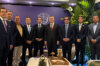
Bayard Rustin (left) and Dr. Eugene Reed. Photo: Wiki Commons.
In 1979, the Simon Wiesenthal Center organized a Mission to Germany — starting with a ceremony with Simon Wiesenthal at the Dachau concentration camp, then onto meetings in Munich, and then to the then-capital Bonn to lobby the West German government to rescind a statute of limitations on prosecuting Nazi murderers.
Bayard Rustin, a brilliant but mostly behind-the-scenes African-American civil rights leader, emerged as our group’s most passionate and eloquent participant. The grandson of slaves, Rustin grew up in a segregated Pennsylvania community where his Quaker grandmother “was thoroughly convinced we had more to learn from the Jewish experience than we had to learn out of Matthew, Mark, Luke, and John.”
In New York City during the Great Depression, Bayard joined a communist youth group but left after the betrayal of the Hitler-Stalin Pact.
He became a union organizer, and then a conscientious objector turned anti-Nazi activist during World War II. A precocious champion of civil rights, he served as deputy in 1941 to Black labor leader A. Philip Randolph, whose plan for a March on Washington forced President Roosevelt to issue an executive order banning discrimination in defense hiring.
In 1942, Bayard helped launch the Congress of Racial Equality (CORE) which in 1946 organized the first “Freedom Ride” to integrate interstate transportation. He also worked with the Quaker civil rights organization the Fellowship of Reconciliation, which peacefully protested segregation during and after the war.
Rustin was also a gay man at a time when being gay was a crime.
After the war, Rustin said that had he understood earlier the full extent of the evil of Nazism — he would have found a way to fight the Nazis, even as a pacifist.
A key planner of Reverend Martin Luther King, Jr.’s 1963 March on Washington, Rustin earlier had encouraged Reverend King “to accept pacifism as a way of life,” and helped King found the Southern Christian Leadership Conference (SCLC). He worked closely with King’s Jewish associates, including Stanley Levinson.
After the Black Power movement emerged in 1965, Rustin reaffirmed his commitment to coalition politics over the new militant emphasis on African roots, “identity politics,” and even violence. Following Israel’s victory in the 1967 Six-Day War, Black militants like Rustin’s protégé, Stokely Carmichael, began denouncing the Jewish state as an evil “new Goliath,” but Rustin and King would have none of this.
To Rustin, antisemitism was history’s “oldest and most shameful witch hunt.” He insisted that “Zionism is not racism, but the legitimate expression of the Jewish people’s self-determination.”
During the 1970s, Rustin made repeated visits to Israel, where he met Golda Meir, and founded Black Americans in Support of Israel (BASIC). He visited Le Chambon sur Lignon, the French village that had harbored Jews from the Nazis during World War II. In 1979, President Carter appointed him to the Holocaust Memorial Council.
Rustin even visited the Soviet Union to lobby for the freedom of Soviet Jews, a cause Reverend King had embraced as early as 1966. In 2013, President Barack Obama posthumously awarded him the Presidential Medal of Freedom.
Rabbi Abraham Cooper is Associate Dean of the Simon Wiesenthal Center. Historian Harold Brackman is a longtime consultant.


