Wednesday, July 15th | 1 Av 5786

Subscribe

Hakeem Jeffries Announces He Will Not House Minority Leader Hakeem Jeffries (D-NY) has come out against a bid to cut off US military aid to Israel, while calling for a “major reset” of Washington’s relationship with the Jewish state. In a “Dear Colleague” letter to fellow Democrats on Tuesday, Jeffries said he would vote against an amendment led by Rep. Thomas Massie (R-KY), and co-sponsored by Rep. Ro Khanna (D-CA), that would strip roughly $3.3 billion in annual military financing for Israel — while preserving $500 million for missile-defense programs such as Iron Dome — from the fiscal 2027 National Security, Department of State, and Related Programs Appropriations Act. The House could vote on the measure as early as this week. Aligning himself with the ranking Democrats on the Appropriations and Foreign Affairs committees, Reps. Rosa DeLauro (D-CT) and Gregory Meeks (D-NY), as well as the advocacy group J Street, Jeffries called the proposal too sweeping. “As written, it is overly broad in that it prohibits or would limit the use of funds for longstanding initiatives related to humanitarian aid, refugee resettlement, peace-building and US Embassy operations,” he wrote, adding that the “so-called Massie amendment” would restrict US efforts to confront Hamas, Hezbollah “and other terrorist organizations in the region who are sworn enemies of both the United States and Israel.” Citing deep divisions within the party over Israel, Jeffries said leadership would not pressure members to follow his lead. “There are good faith reasons that will result in Members voting in a variety of different ways with respect to the amendment,” he wrote, noting that the caucus was not whipping the vote. At the same time, Jeffries argued that US policy toward the region “must change,” tying his call for a “major reset” to criticism of what he termed the “far-right Netanyahu government.” He wrote that America’s commitment to “Israel’s right to exist as a Jewish and democratic state and homeland for the Jewish people must remain ironclad,” while urging strong US support for the creation of an independent Palestinian state. Israeli governments have long rejected the establishment of a Palestinian state along Israel’s borders, warning that it would pose an existential security threat and leave major population centers exposed to attack. Jeffries also said Gaza must undergo “complete reconstruction and modernization” and that “Hamas must be disarmed and removed from power.” Jeffries further signaled that the next US-Israel aid agreement should require Israel to cover more of its own defense costs. The current 10-year memorandum of understanding, signed under President Barack Obama in 2016, provides Israel about $3.8 billion annually — $3.3 billion in military financing and $500 million for missile defense — and expires in 2028. “Israel has an advanced economy and is capable of paying for its own sophisticated weapons, as the Prime Minister recently acknowledged,” Jeffries wrote, adding that any future arrangement should mirror US defense agreements with other Western allies and “strictly adhere to our human rights laws and values.” His stance placed him between the two poles of a party increasingly split over Israel. Hours after his letter circulated, the chair of the Congressional Progressive Caucus, Rep. Greg Casar (D-TX), sent a competing letter urging Democrats to back the Massie amendment, and progressives including Rep. Alexandria Ocasio-Cortez (D-NY) said they would vote to cut the aid. Support for Israel among Democratic voters has fallen sharply during the war in Gaza. An Associated Press-NORC poll conducted in June found that 52 percent of Democrats say Israel has committed genocide against Palestinians, while a Pew Research Center survey found that roughly 80 percent of Democrats hold a negative view of Israel. In April, a majority of Senate Democrats — 40 of the caucus’s 47 members — voted for at least one of two resolutions to block certain arms sales to Israel, though the measures failed. Supporters of continued assistance say it preserves Israel’s qualitative military edge and bolsters a key US partner against Iran-backed groups, while critics want aid conditioned on Israeli policy changes, particularly over the conduct of the war in Gaza. The upcoming vote is expected to underscore the widening gap between the party’s pro-Israel wing and its growing bloc of aid critics. for Amendment to Strip Israel Aid

August 16, 2021 10:00 am

Afghanistan: Chronicle of a Failure Foretold

×

Error: Contact form not found.

avatar by Eyal Zisser / Israel Hayom / JNS.org

Opinion

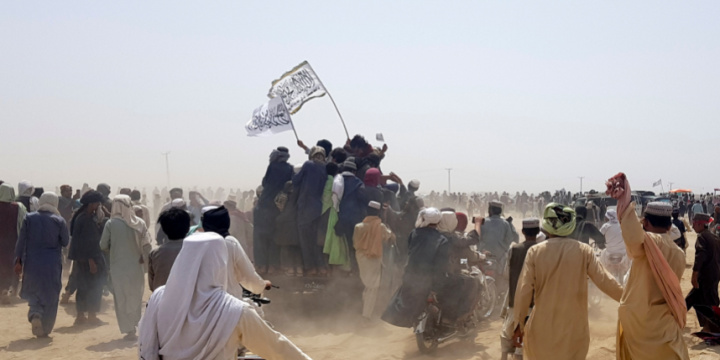
People standing on a vehicle hold Taliban flags as people gather near the Friendship Gate crossing point in the Pakistan-Afghanistan border town of Chaman, Pakistan July 14, 2021. REUTERS/Abdul Khaliq Achakzai

JNS.org – The last American soldiers are only supposed to leave Afghanistan a month from now, but the Taliban has already reached the capital, Kabul. It is true that the Biden administration thought that, with the withdrawal of US forces, the Taliban would take control of the country within a few months, but they never thought it would happen within a few days.

The sight of the hurried evacuation of the Americans from Saigon, Vietnam, in April 1975, as well as the frenzied flight of thousands of refugees in the face of the advancing Vietcong troops, is now repeating itself in a major way all over Afghanistan, as around a thousand witnesses testify. In Washington, they have not learned anything from history.

There was no more just war than the one American embarked on towards the end of 2001, with the goal of destroying the Taliban regime in Afghanistan. This regime had provided refuge and assistance to Al-Qaeda leader Osama bin Laden, the man behind the Sept. 11, 2001, attacks, which led to thousands of deaths in New York, Washington and Pennsylvania.

The Taliban regime in Afghanistan was oppressive, exactly like that of the Islamic State, which is nourished by the same sources of inspiration. The Taliban jailed women in their homes, banned Western culture and technology, as well as non-religious education, and even barbarically destroyed archaeological treasures from the country’s pre-Islamic history. But there are oppressive regimes in many countries, and the international community does nothing to overthrow them.

But in Afghanistan, and two years later also in Iraq, American ambition knew no bounds. Washington sought not only to punish the Taliban but also to build an Afghan nation, in a place where the people’s allegiances are to their families or tribes and definitely not to an imaginary nation.

The Americans brought success to Afghanistan, paved roads and developed the economy. They brought the winds of change to many Afghanis, before whom now lay open the possibility of education and employment. But nations are not built, but rather develop and grow organically, and definitely not as a response to foreign dictates. The American experience in Japan and in Germany after World War II is not relevant in the Afghan case, which involves a traditional population, backward and lacking in national identity.

Many Afghans were rewarded by the American presence, but many more were left behind, choosing to prioritize tradition over a foreign and threatening world of Western values and culture.

Above all this, the government that the Americans installed was rotten and corrupt, maintained by dollars and reliant on American bayonets. And all too predictably, the moment the Americans announced their intention to withdraw from the country, the regime collapsed like a house of cards. If the United States had simply struck a blow against the Taliban in 2001 and left the country, two decades of bloodshed might have been avoided.

The United States doesn’t have to worry. It remains a strong and secure power, which at the end of the day is looking to cut its losses. It will continue to thrive even without Afghanistan; North Vietnam went on to become an ally of America, economically reliant upon it (out of fear of China of course).

But one’s heart goes out to the Afghan people, who have fallen to a brutal regime determined to set the country and its people back a thousand years. In any case, no one asks for their opinion, and anyway, they have neither the desire nor the strength to oppose the Taliban.

One can only hope that the 2021 Taliban has learned the lessons of both the 2001 Taliban and ISIS. And who knows? Maybe in the future, it will become an ally of Washington, because of its hostility towards Iran and Russia.

Either way, the lesson is clear: In world politics, there are no friends, only interests, and nobody will volunteer to protect someone who is not capable of defending themselves.

Eyal Zisser is a lecturer in the Middle East History Department at Tel Aviv University.

This article first appeared in Israel Hayom.

The opinions presented by Algemeiner bloggers are solely theirs and do not represent those of The Algemeiner, its publishers or editors. If you would like to share your views with a blog post on The Algemeiner, please be in touch through our Contact page.

Share this Story: Share On Facebook Share On Twitter

Let your voice be heard!

Join the Algemeiner

Algemeiner.com

This field is for validation purposes and should be left unchanged.
Email a copy of to a friend
This field is hidden when viewing the form
This site is protected by reCAPTCHA and the Google Privacy Policy and Terms of Service apply.