





Blinken Talks of How Stepfather Took on Soviet Denial of Babi Yar Massacre
Error: Contact form not found.

 by i24 News

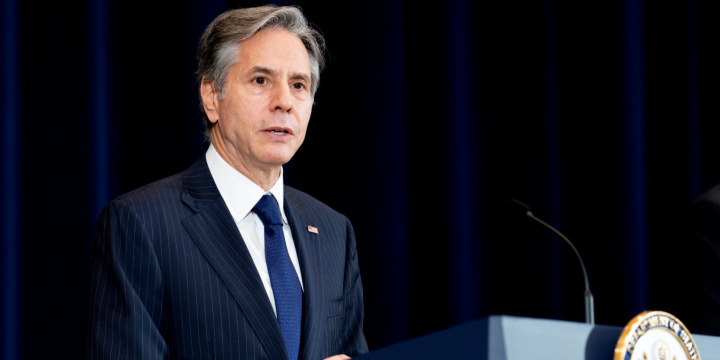
U.S Secretary of State Antony Blinken speaks during a news conference with Australian Minister of Defense Peter Dutton, Australian Foreign Minister Marise Payne and U.S. Secretary of Defense Lloyd Austin (not pictured) at the State Department in Washington, U.S., September 16, 2021. Andrew Harnik/Pool via REUTERS
i24 News – US Secretary of State Antony Blinken told a personal story of how his stepfather challenged Holocaust denial by the Soviet Union in a video message Wednesday commemorating the 80th anniversary of the Babi Yar massacre.
Between 1941 and 1943, the German Nazis shot between 70,000 to 100,000 people at a ravine near the Ukrainian capital Kyiv, including 33,771 Jews over two days in September 1941.
Israeli President Isaac Herzog on Wednesday joined his counterparts Volodymyr Zelensky of Ukraine and Frank-Walter Steinmeier of Germany for a ceremony at the site to remember the victims of the atrocity.
In a video statement posted to the Twitter page of the US Embassy in Kyiv, the top US diplomat said that the Soviets for decades attempted to cover up the crimes of the Nazis and denied that Jews were the primary victims.
"So on this anniversary, we honor the memory of all those lost at Babyn Yar, recommit ourselves ensuring that their full history is told, and pledge to act, every day, so that history is not repeated.” @SecBlinken Full remarks here: https://t.co/1M2LpslAHX pic.twitter.com/kCk0ZO7zQl
— U.S. Embassy Kyiv (@USEmbassyKyiv) October 6, 2021
“For much of the last eight decades, the world did not remember what happened at Babi Yar. That was by design. The Nazis were not alone in trying to bury what had happened. For decades, Soviet history omitted that the 33,771 victims of those first two days – and tens of thousands more executed later – were Jews. And that they were killed because they were Jews,” Blinken said.
He then went on to tell the story of how his Jewish stepfather Samuel Pisar, who survived the Shoah, took part in an American delegation that participated in an off-the-record dialogue with Soviet leaders in 1971 at a conference in Kyiv.
The Soviet delegation displayed hostility and made antisemitic remarks, which prompted Pisar to begin a dialogue on the dangers of antisemitism and ethnic and racial hatred and invited the Soviets to visit Babi Yar.
Blinken described how on the same day the American delegation decided to pay a visit to Babi Yar.
“Then another bus arrived. The Soviet delegation descended and quietly joined the visit,” Blinken said. “After that visit, my stepfather said, the tone of the dialogue softened considerably.”
Pisar, a prominent lawyer who was the co-founder of Yad Vashem-France, died in 2015 at the age of 86.
Pisar “knew that one of the most powerful ways to conquer hatred is to show people where it leads — its human consequences. He made those delegates see that he could just as easily have been one of the people buried in that ravine,” Blinken said.
“He knew that when we fail to remember, or when we intentionally erase parts of our history, we further dehumanize the victims. And we deprive ourselves — and future generations — of the lessons we must learn, and act on.”