


Expanding the Abraham Accords Requires a US-Saudi Reset
Error: Contact form not found.

 by Irit Tratt

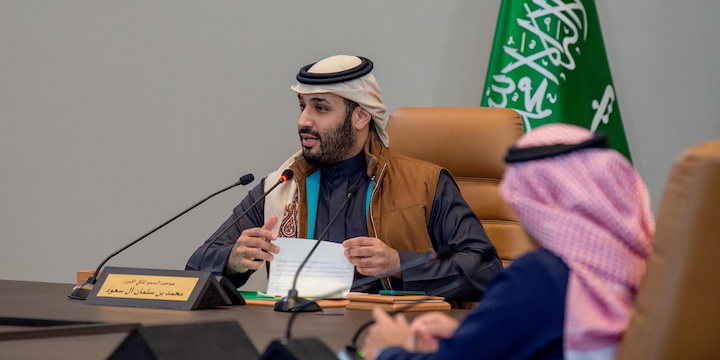
FILE PHOTO: Saudi Crown Prince Mohammed bin Salman speaks during a meeting to Launch Public Investment Fund Strategy 2021-2025, in Riyadh, Saudi Arabia, January 24, 2021. Photo: Saudi Press Agency/Handout via REUTERS
On September 23, the kingdom of Saudi Arabia celebrated its 91st National Day, which the UAE commemorated under the banner of “#Together Forever KSA- UAE.”
While visiting the UAE, I was struck by the frequency with which I came across the popular slogan displayed throughout the country’s commercial districts. As someone who cares about expanding peace in the region, I was moved by the significance of observing the festival of Sukkot in an Arab country, whose warmth was palpable from the moment my family arrived.
The unifying message of “#Together Forever KSA-UAE” was also a stark reminder of how recently some hoped that Saudi Arabia would follow the UAE’s lead, and normalize its relations with Israel. Last November, an Israel-Saudi rapprochement seemed possible when reports emerged detailing former Israeli Prime Minister Benjamin Netanyahu’s secret trip to Saudi Arabia to visit Crown Prince Mohammed bin Salman (MBS).
President Donald Trump helped foster the Abraham Accords, which was abetted by the desire of the Gulf states to band together (with each other and Israel) to stop Iran from obtaining a nuclear weapon. Trump’s efforts to establish a warm relationship with the Saudis reflected the knowledge that advancing peace in the Middle East requires the support of Saudi Arabia, which serves as a steward over two of Islam’s holiest cities and is regarded as a leader within the Arab world.
Yet almost immediately upon taking office, US President Joe Biden made clear his intention to “recalibrate” relations with the Saudis. In February, Biden released a classified report implicating the kingdom’s top leaders in the gruesome killing of Saudi journalist Jamal Khashoggi. And last September, well-timed to distract from the botched US withdrawal from Afghanistan, Biden ordered the FBI to declassify a memo involving allegations that Saudi Arabia was complicit in the 9/11 attacks. While the released document highlighted an association between the hijackers and Saudi associates, it failed to prove any direct governmental link between Saudi rulers and the horrific 9/11 terrorist attacks.
Further downgrading relations, the US State Department announced in February that it was pulling its support for the Saudi-led effort in Yemen by removing the terrorist designation of Ansarallah, known as the Houthis. The Iranian proxy, whose missiles are decorated with “Allahu Akbar, death to the United States, death to Israel, curse the Jews and victory for Islam,” have intensified their strikes against Saudi-backed targets in recent months, including an August attack against a Saudi airbase, resulting in over 30 soldiers killed.
US attempts to revive the Joint Comprehensive Plan of Action (JCPOA), also known as the Iran nuclear deal, also made the Saudis uneasy about the unfolding diplomatic and security paradigm in the region.
Yet highlighting a potential and encouraging shift, US Secretary of State Antony Blinken has indicated as of late that the US is losing patience with Iran’s refusal to resume negotiations while simultaneously fast-tracking its uranium enrichment program. Standing alongside Israeli Foreign Minister Yair Lapid and UAE Foreign Minister Sheikh Abdullah bin Zayed al-Nahyan, Blinken stated on October 13 that “the US will look at every option to deal with the challenge posed by Iran.”
US assertions of disapproval concerning Iran should be received as welcome news in Saudi Arabia, which objects to the Iran nuclear deal. Yet these assurances follow months of the US appeasing Iran. The Saudis are likely looking elsewhere to satisfy their security needs. To the delight of US officials, who welcomed “the news of direct talks,” Saudi Foreign Minister Prince Faisal bin Farhan Al Saud confirmed in late September that the monarchy held its fourth round of meetings with Iran in an “effort to reduce tensions in the region.” And signaling to the US that it may partner with America’s adversaries to bolster its deterrence, the Saudis inked a military agreement with Russia. The defense deal, totaling $110 billion, was signed in August and is aimed at “developing joint military coordination between the two countries.” It should be noted, however, that Russia is one of Iran’s foremost sponsors and backers on the international stage, aside from China.
For its part, the Biden’s administration’s initiatives that have led to greater dissonance between the US and Saudi Arabia, reveal a failure to appreciate the sweeping reforms instituted by MBS. Aside from economic initiatives, advancements have also been made in women’s rights. In 2018, women were finally granted the right to drive, and by law, females are now required to hold at least 20% of government seats. In 2019, Her Royal Highness Princess Reema bint Bandar bin Sultan was appointed as Saudi Arabia’s ambassador to the United States. Princess Reema is the first female to hold the ambassador role and has stated that one of her goals is promoting a “healthier nation.”
The Crown Prince also opposes radical Islam, and stated in April on Saudi Television that “extremism in all forms is wrong,” and that “any person that adopts an extremist approach, even if he was not a terrorist, is a criminal and will face the full force of the law.” Simply put, the Saudis are taking their role in cracking down on extremism seriously. In August, a Saudi court found guilty 69 Hamas operatives living in Saudi Arabia and Jordan. According to a video released by the Jerusalem Center for Public Affairs (JCPA), not a single dime flows from the Saudi government to any terrorist organization.
The swiftness and clarity with which President Biden cooled relations with the Saudis have effectively paused any momentum towards developing stronger ties between the two nations, as well as with Israel and the monarchy. While Saudi Arabia is far from perfect, MBS is propelling his country towards greater liberalization and reformation. Rather than drift away from the kingdom, Biden must seize the opportunity to expand upon the peace possibilities he inherited.
Irit Tratt is a writer and pro-Israel advocate. Her work has appeared in The Algemeiner, JNS, The Jerusalem Post, and Israel Hayom.