



Does Hanukkah Make You Uncomfortable? This Year Ask Why
Error: Contact form not found.
 by Joshua Blustein


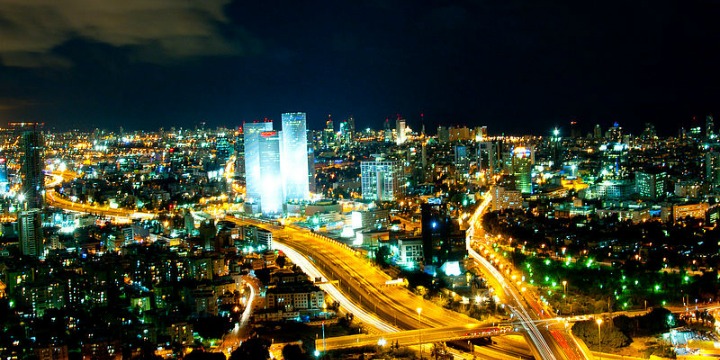
A giant menorah is lit up to celebrate Hanukkah, the Jewish festival of lights, in Dubai, United Arab Emirates, Dec. 10, 2020. Photo: Reuters / Christopher Pike.
The Festival of Lights has long caused confusion. The Talmud in “Tractate Shabbat” asks bluntly: “What is Hanukkah?”
The always reliable New York Times published an op-ed in 2018 that said, “Hanukkah, in essence, commemorates the triumph of fundamentalism.”
Though tinged with its quotidian antisemitism, the Times’ article isn’t far off. Hanukkah is not a fun-filled story of latkes, presents, and Adam Sandler. It is a story of a traditionalist family putting its foot down against an overbearing government and society that sought to compel adherence to an ideology believed to be the most enlightened of its day.
When we first meet Mattathias in the Book of Maccabees, he is boiling with rage that Israel, once “a free woman [has] become a bondslave.” Mattathias kills a Jew and then a government official for following idolatrous commands. Join or die, he says.
According to Josephus, Judah Maccabee roused his troops by roaring: “O my fellow-soldiers! If you now fight manfully, you may recover your liberty. … besides such glorious rewards as those of the liberty of your country, of your laws, of your religion, you shall then obtain everlasting glory.”
Surprising to many, the miracle of the menorah burning eight days is absent from the Book of Maccabees and Josephus. Ethiopian Jews have their own canonized Books of Maccabees (called Meqabyan) which — despite many differences– are similar in theme to the classic sources. No menorah miracle there either. Instead? God and sword.
Non-Jews also grasped what the Maccabean revolt was all about. In the Middle Ages, Western Christians included Judah Maccabee as one of the “Nine Worthies,” representing the archetype of valiant chivalry. In the “Divine Comedy,” Dante sees “noble Maccabeus” as “one of the heroes of the faith.”
The great composer George Frideric Handel wrote a moving oratio in 1746, later adapted by Beethoven, titled “Judas Maccabeus,” telling the Hanukkah story. Its music is beautiful, and to spotlight only a notable part, listen to how Handel casts Judah, who sings: “Resolve, my sons, on liberty, or death!” The chorus chimes:
Lead on, lead on! Judah disdains
The galling load of hostile chains…
Hail, hail, Judea, happy land!
Salvation prospers in his hand…
We hear, we hear the pleasing dreadful call,
And follow thee to conquest; if to fall,
For laws, religion, liberty, we fall.
In a previous piece, I told the tale embedded in Jewish-American folklore of the Hanukkah story inspiring George Washington during the Revolutionary War. And as President Reagan remarked at a 1983 Hanukkah celebration: “[the holiday] is of great importance to the meaning of America. … Hanukkah is symbolic of the Jewish struggle to resist submission to tyranny and to sustain its spiritual heritage.”
President Obama got it right at the 2013 White House Hanukkah Reception, when he said that Hanukkah is about “a people who surmounted overwhelming odds to reclaim their historic homeland … Jewish communities around the world kept alive a light that would not be extinguished. The hope that freedom would triumph over tyranny.”
The sources above demonstrate that Hanukkah is a tale of unyielding resistance to government despotism, of fighting and dying for freedom, of religious conservatism, of sovereign independence, of civic virtue, of risking everything, of right makes might, of seeing God’s hand in history, and of believing miracles are still possible.
Unfortunately, these ideals have loosened their grip on the hearts of modern man and woman. Some deny them outright. Adam Smith observed that “every faculty in one man is the measure by which he judges the like faculty in another. I judge of your sight by my sight … of your love by my love.”
When the motivations that stirred the Maccabees to battle mean little to us, so does Hanukkah. Can we be inspired by martyrs for a cause we hold in ambivalence?
However, if this brand of Hanukkah feels uncomfortable, this year, ask yourself why.
Joshua Blustein is a University of Chicago Law School student and a Krauthammer Fellow at the Tikvah Fund.