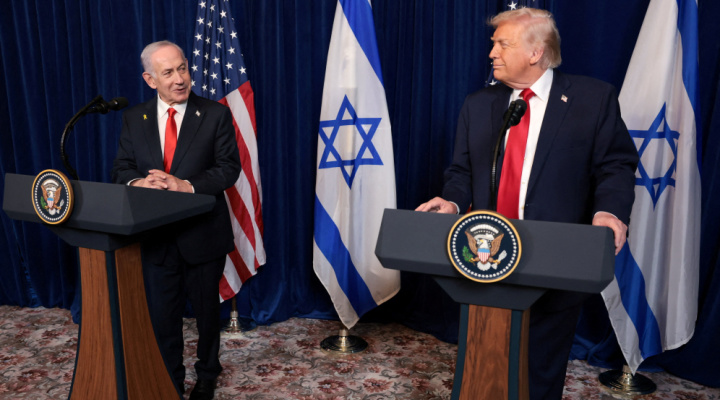




A new book, however, alleges something rather different. Trump’s Peace: The Abraham Accords and the Reshaping of the Middle East by journalist Barak Ravid has just been published in Hebrew. Explosive extracts have been reported in English on the Israeli website Ynet and by Ravid himself on Axios.
Ravid reports Trump’s bitter and profane accusation that Netanyahu was too quick to congratulate Joe Biden on his election as US president, a result that Trump continues to claim was fraudulent.
“He was very early. Like earlier than most. I haven’t spoken to him since. F*** him,” Trump said.
In fact, Netanyahu actually congratulated Biden hours after many other world leaders had done so.
More seriously, Trump reportedly claimed that Netanyahu, not the Palestinians, was the main obstacle to peace in the Middle East. Ravid claims that Netanyahu angered and blindsided Trump by using the unveiling of the president’s 2020 Middle East “Peace to Prosperity” plan to announce the annexation of much of the “West Bank.”
The book claims that David Friedman — then America’s ambassador to Israel — assured the Israelis that the United States would back annexation even though he had never run the idea by Trump and his son-in-law and senior adviser, Jared Kushner.
Ravid claims that this created a terrific row between the Trump and Netanyahu administrations, with Avi Berkowitz, Trump’s Middle East peace envoy, reportedly telling Netanyahu: “The president doesn’t really like you these days. You will take your best friend and turn him into an enemy.”
Friedman, however, has repudiated Ravid’s account. He tweeted: “Not only was the president informed and aware of the sovereignty process, he outlined it in this speech. There were numerous follow-up discussions as well, all of which included me. A book on this subject on which I was never consulted should be taken with a grain of salt.”
Shockingly, Ravid says that Trump told him (referring to Netanyahu by his nickname): “I don’t think Bibi ever wanted to make peace. I think he just tapped us along. Just tap, tap, tap, you know?”
No less shockingly, he lauds Palestinian Authority leader Mahmoud Abbas as being the more likely peace-maker. Ravid writes: “I thought he was terrific,” Trump told me of Abbas, reflecting on their ‘great’ first meeting. He was almost like a father. Couldn’t have been nicer. I thought he wanted to make a deal more than Netanyahu.”
Yet after Abbas cut off co-operation with the United States in 2017, Trump stopped virtually all aid to the Palestinians, shuttered the Palestine Liberation Organization’s diplomatic office in Washington and closed the US Palestinian consulate in Jerusalem. This hardly accords with viewing Abbas now as the real force for peace.
It’s unclear whether Ravid spoke to the players in this drama at whom he levels accusations or whether he merely relied on statements by those with a possible axe to grind. Some who are dismayed by the book have asserted that he has a clear agenda to damage both Trump and Netanyahu.
Nevertheless, Trump did give Ravid an interview at Mar-a-Lago in Florida, from where the jaw-dropping accusations against Netanyahu emanated. Even if Ravid framed his material through a prism of prejudice, it’s unlikely he would have made up or misleadingly reported what Trump said to him.
Accordingly, Ravid’s account has horrified those for whom Trump was the most pro-Israel president in American history. Conversely, it has been received with jubilation by those who hate him — and may hate Israel, too.
However, the notion that Ravid’s account somehow negates Trump’s record is absurd. For what he says has never been as important as what he actually did. And his achievements in promoting justice and security for Israel and opening up the prospects for Middle East peace were huge.
Thus he recognized Jerusalem as Israel’s capital; he pulled America out of the 2015 Iran nuclear deal, thus weakening the Iranian regime and the greatest threat to Israel; and he recognized Israeli sovereignty over the Golan Heights, which are essential to its defense.
Above all, Trump enabled the Abraham Accords — the unprecedented alliance between Israel and the United Arab Emirates, introducing the possibility of an end to the Arab war against the Jewish homeland for the first time in 100 years.
Unfortunately, the debate about Trump is dominated on the one hand by devotees who won’t hear a word against their hero and, on the other, by “Never Trumpers” who won’t hear a word in his favor.
Plenty of people, however, have taken a more balanced view in viewing him as temperamentally flawed but nevertheless politically essential.
Similarly, many who thought Netanyahu had unrivaled and priceless geopolitical acumen nevertheless recoiled from the way he centralized power into himself, as well as the graceless way he clung onto office.
Trump was known to have a thin skin, to be capricious and narcissistic, and to be obsessed by his belief that the 2020 election was stolen from him through systematic fraud. So it’s not unthinkable that he could have lashed out in this wholly disproportionate and unfair way, even against an old ally.
Moreover, Trump is wholly transactional. As Ravid reports, he told him: “My whole life is deals. I’m like one big deal. That’s all I do, so I understand it.”
As Ravid has noted, he accordingly believed that he alone could pull off a peace deal between Israel and the Palestinians. So it’s by no means implausible that he could have been irritated with Netanyahu for believing that the Palestinians remained implacably committed to eradicating Israel as a Jewish state and therefore a two-state solution was impossible.
But such irritation by Trump — however irrational or unfair — doesn’t detract from the fact that his administration was very good for Israel.
Undeniably, there are people who want to tarnish the record of both Trump and Netanyahu.
And unless Ravid’s book is somehow discredited, it’s likely to do just that. It will tarnish Trump’s achievements, dishearten Israel’s friends and give heart to the enemies of the Jewish people in the Middle East and elsewhere.
This is all the more dismaying because of what has come after Trump. The Biden administration, elected as the antithesis to him, has shown itself to be no friend to Israel. It has weakened sanctions against Iran, falling over itself to restore the 2015 deal that would in effect fund Tehran to get its genocide bomb. It is denying Israel until 2024 the refueling aircraft it would need to attack Iran’s nuclear sites.
In the spring, it reportedly leaked that Israel was attacking Iranian oil tankers en route to Syria—a leak that revealed top-secret Israeli information.
It has done nothing to strengthen the Abraham Accords. It even tried in effect to redivide Jerusalem by proposing to reopen its Palestinian consulate there.
In Ravid’s book, Trump reasserts his deep love for Israel. His deeds have reinforced his words. The Biden administration professes to have Israel’s back — but it’s actually sticking its knife into it.
Political leaders should be neither blindly supported nor opposed. But ultimately, their words don’t matter. It’s their deeds that count.
Melanie Phillips, a British journalist, broadcaster and author, writes a weekly column for JNS. Currently a columnist for “The Times of London,” her personal and political memoir, “Guardian Angel,” has been published by Bombardier, which also published her first novel, “The Legacy.” Go to melaniephillips.substack.com to access her work.