



Why We Must Remember the Holocaust Correctly
Error: Contact form not found.

 by Luke Berryman

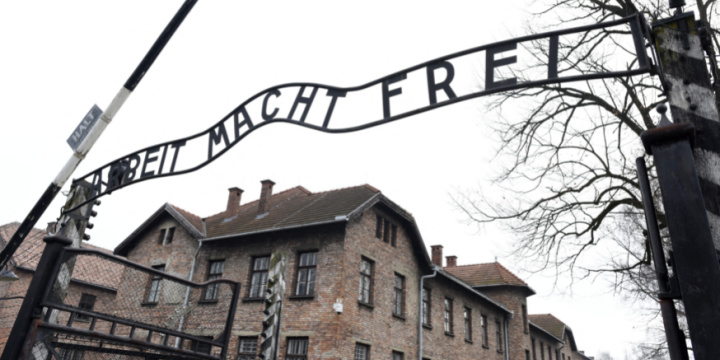
The sign “Arbeit macht frei” (Work makes you free) is pictured at the main gate of the former German Nazi concentration and extermination camp Auschwitz in Oswiecim January 19, 2015. REUTERS/Pawel Ulatowski
Three words loom large in our Holocaust remembrance: Arbeit macht frei, usually translated as “work will make you free.” Ironically, they had little to do with the Holocaust. Unpacking why we think otherwise reveals bigger flaws in the ways we remember it.
Arbeit macht frei was the title of a 19th-century novel about a slacker finding virtue through work. In 1936, the Nazis turned it into a slogan for the gateway to Dachau, their first concentration camp, and a staff training center. Many Nazis cut their teeth there before going to other camps across Germany and Europe. Some took the slogan with them. It appeared at the gateways to Flossenbürg, Gross-Rosen, Auschwitz, and Sachsenhausen, among others.
We don’t know why it stuck in their minds. Tormenting prisoners was certainly a factor. Spitefulness ran through the Nazi penal system. It may have been meant to remind the staff to be ruthless, or to convince the public that the camps were strict but fair. Somewhere in the cocktail, there was also a twist of genuine ideological belief. Arbeit macht frei captured the Nazi principle that death-through-labor would free prisoners from their own degeneracy.
The slogan wasn’t used at the four extermination camps — Belzec, Chelmno, Sobibor, and Treblinka — whose only purpose was to murder Jewish people. Evidently, the Nazis didn’t consider it relevant to that purpose. A photo of Sobibor discovered in 2020 shows a jerry-built gateway that simply says SS Sonderkommando, “SS Special Unit.” The slogan also wasn’t used at the two hybrid camps that conducted extermination and slave labor, Birkenau and Majdanek. And, of the six million Jews murdered in the Holocaust, nearly two million died at the hands of the Einsatzgruppen. These mobile killing units generally shot their victims into mass graves in the remote countryside, far from any kind of camp.
So, whatever else it may have meant, Arbeit macht frei wasn’t a phrase that the Nazis primarily associated with mass murder. But that’s precisely how it’s misremembered today. For example, antivaxxers compare it to Covid-19 mandates, warning about governments trying to fool the public into going to their deaths. This extreme case shows how the Holocaust can fade from memory even while it’s brought into discussion.
Part of the problem is that we think of Arbeit macht frei as a physical object rather than a meaningful phrase. The sign adorns the infamous gateway at Auschwitz-I, built in 1940. (Birkenau, which was built over a year later, is a good mile away.) A replica was put at the entrance after Neo-Nazis stole the original in 2009. The replica has since become a selfie hotspot for tourists.
The United States Holocaust Memorial Museum (USHMM) has a replica on permanent exhibit too. Other replicas have appeared in stranger places. Until recently, it was possible to buy them on eBay. The International Auschwitz Committee awards miniature replicas of the letter “B” from the word Arbeit, to commend work against genocide.
This maelstrom of replicas has helped to turn Arbeit macht frei into a generic symbol whose meaning is determined by who’s wielding it, and in what context. In this respect, it isn’t unique. Much of our Holocaust remembrance has dislocated from the history that it means to remember. This enables the likes of antivaxxers and Capitol rioters to hijack the Holocaust to defend their social and political positions.
And it’s not just the lunatic fringe that’s devaluing historical reality. In Holocaust museums, it’s become vogue to immerse visitors in interactive exhibits that try to simulate what it felt like to be a Jew during the Holocaust. Such exhibits are emblematic of the “post-truth era,” in which feelings and facts are considered interchangeable. They won’t help anyone to understand how or why the Holocaust happened.
Our devaluation of historical reality has serious consequences. Schools, for example, are increasingly likely to teach the Holocaust through activities and reenact
Luke Berryman is the Founder of The Ninth Candle, a nonprofit organization whose mission is to end antisemitism by sharing knowledge.