




Israelis in Ukraine Seek Way Out as Invasion Continues: ‘There’s a Burning Smell in the Air’
Error: Contact form not found.

 by Benjamin Kerstein

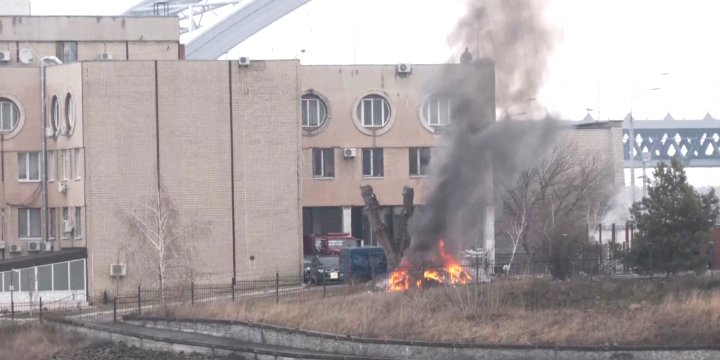
Smoke rises as a fire burns on the premises of the Ukrainian Defense Ministry’s unit in Kyiv, Ukraine, February 24, 2022 in this screen grab taken from a live video. REUTERS TV/via REUTERS
As Russia pounds Ukraine in a massive military operation, many Israelis still in the embattled country are looking for a way out, while others are hunkering down.
The Israeli government has repeatedly called in recent weeks for its citizens to leave Ukraine, but many have stayed.
Hala Abed al-Hai, a medical student in Ukraine’s second-largest city Kharkiv, told the Israeli news site Walla on Thursday, “We’re stuck here now.” Though many are fleeing for the west of the country and even to Poland, she said, the Israeli embassy has indicated that departures are currently closed.
“I’m trying to stay calm and focus on things that need to be done,” she added. “Panic won’t help.”
Natan Ben-Nun, originally from Haifa and head of the Breslov Hasidic community in Uman, told the outlet, “About 180 Israelis who were here left for the border, mainly in the direction of Moldova.” Some 40 Israelis remain in the city, he added.
Russia, he said, is shelling civilian areas and “there’s chaos on the highways. At gas stations there’s long lines. Within the city, the gas stations are closed, but at the gas station outside Uman there are 500-700 cars waiting to fill up.”
Ben-Nun said he will stay in Uman, where Rabbi Nahman of Breslov, the founder of the sect, is buried. “I hope that the whole Haredi world will join up and pray for Uman, and quiet will return quickly, and that on Rosh Hashana we can celebrate here as usual.”
Muhammad Mahamid, who is also a student in Kharkiv, said the hardest thing is that “parents are worried. So, I told them everything is far away.”
“The first time I heard the missiles in Kharkiv, it scared me,” he recounted. “But what can you do? Among us, it’s said that everything is ‘written,’ so I reminded myself of that and it encouraged me, and I tried to calm myself down and calm others down.”
Yehuda Shefsel, who lives in Odessa, said, “The streets are quite deserted. You can see a few people, mainly at ATMs, where there are long lines, and the same at banks and food markets — stocking up on water and essential products.”
“This isn’t trivial,” he added. “There’s a burning smell in the air. There are soldiers everywhere. You can see that the situation is not calm at all.”
Misha Cuzco, who lives in Kharkiv, said, “There are loud booms in the background. Everyone is preparing because they don’t know how long this whole situation will take.”