






Turkey’s Temporary, Souring Relations with Hamas
Error: Contact form not found.

 by Hany Ghoraba

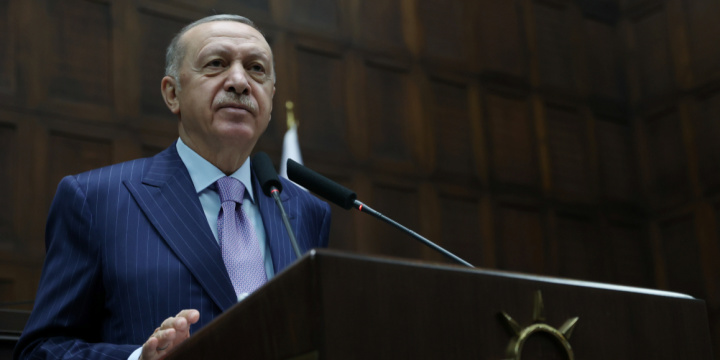
Turkish President Tayyip Erdogan addresses members of parliament from his ruling AK Party (AKP) during a meeting at the Turkish parliament in Ankara, Turkey, October 27, 2021. Murat Cetinmuhurdar/PPO/Handout via REUTERS
While Turkish President Recep Tayyip Erdogan has been mending diplomatic fences lately, he still makes inflammatory statements against Western countries. Last Friday, he accused Finland and Sweden of allowing too many terrorist organizations on their soil.
It’s an odd complaint, given that Erdogan has had no qualms hosting terrorist groups in Turkey.
Until recently, Erdogan’s relationship with Hamas was stellar enough for the group to consider him the Islamic leader to follow.
The situation recently changed, as Turkey announced it would deport a number of Hamas officials, and warned the remaining elements to stop their plotting against Israel. This represents a reversal of policy following years of Turkey providing Hamas with political and economic support.
“The Israelis gave Turkey a list of Hamas members and information about involvement of some of them in ‘military’ [terrorist] activity. In response, the Turks contacted Hamas and told them, ‘You promised you wouldn’t do anything like that here, so now you need to leave,'” an unnamed Palestinian official told Israeli daily Israel Hayom.
It is not yet clear where the deported Hamas members are staying. Hamas has been quiet about being forced out of Turkey, but a spokesman criticized the country’s condemnation of a Palestinian terrorist attack.
“We deplore the statements of the Turkish embassy to the Zionist entity, and the Bahraini Foreign Ministry, which condemned the ‘resistance’ operation in Tel Aviv,” said Hamas spokesman Hazem Qasim.
In that April attack, a gunman killed three civilians at a bar. It was the fourth deadly attack in Israel within weeks of each other. Turkey condemned the shooting and sent “our condolences to the families of those who lost their lives in the said attack, as well as the Government and the people of Israel.”
But Turkish political expert Abdullah Bozkurt believes that Erdogan’s recent moves are simply tactical.
“I don’t think Erdogan is really committed to parting with these groups. He may be limiting his engagement and restricting the movements of these groups in Turkey to extract short-term benefits at the bilateral relations [level], and signal [to] the West that he is on course-correction,” Bozkurt told the Investigative Project on Terrorism.
Erdogan previously said he does not believe that Hamas is a terrorist organization, and has defended it for more than a decade. He describes it as “a political party … a resistance movement trying to protect its country under occupation.”
He repeated that view in 2018:

Given that attitude, why is Erdogan now removing Hamas officials at Israel’s request?
Turkey’s spiraling economic crisis has Erdogan “fighting to survive politically inside Turkey,” Bozkurt said. “He has been failing to deliver on his government promises to the electorate.”
Turkey’s economy has been ailing for the past few years, with the Turkish lira losing 45 percent of its value in the past 12 months alone, amid soaring inflation rates.
Turkey hopes better international relations will lead to economic gains. Turkish exports to Israel are growing, and the two countries are discussing a natural gas pipeline that Erdogan described as “one of the most important steps we can take together for bilateral ties. ”
Erdogan’s move against Hamas isn’t the first time he agreed to deport Islamists for diplomatic gains.
Senior officials of Egypt’s Muslim Brotherhood found refuge in Turkey for years. This support naturally strained Turkish-Egyptian relations, and those media outlets have been shut down and the Brotherhood officials have been deported.
Erdogan visited the United Arab Emirates in February, attempting to smooth relations with a country that he’s shown hostility toward for years, after the UAE pledged to invest $10 billion in Turkey’s economy last November.
“He needs a financial lifeline and economic benefits from the restored ties with a number of countries in the MENA region and to reduce tension with the United States and Europe,” Bozkurt said. “As soon as he feels confident enough, he will resort to old policies.”
Those old policies allowed Hamas to plot attacks on Israeli civilians from the safety of their Turkish refuge. Hamas political leader Ismail Haniyeh made frequent visits to Turkey and held official meetings with Erdogan as recently as December 2019.
At the moment, Hamas leaders are mulling the possibility of moving to Malaysia, which has an Islamist-friendly government and an existing Hamas support network. An unnamed Hamas leader described Malaysia as “the best country to receive Hamas members,” according to the New Arab online outlet. Hamas leader Haniyeh maintains contact with Malaysian officials and counts on Malaysian political support.
Hamas has decided not to “take any hostile stance toward Turkey” over the deportations. That might be one reason why Erdogan still enjoys the image of the global Islamic leader. His tight control over Turkish media also helps.
Should his reputation suffer, Erdogan will find other ways to prop up his image.
“Critical, independent and opposition media was decimated in Turkey,” Bozkurt said. “Over 100 journalists are in jail and over 200 media outlets were shut down, including the nation’s largest circulated Today’s Zaman. So, Turks do not really get the facts and truths, but they are rather exposed to government propaganda day in and day out.”
Economic realities have forced Erdogan to repair some of the damage he has wrought. Critics, like Bozkurt, see the moves as cynical and short-term. Time will tell what the real answer will be.
Investigative Project on Terrorism (IPT) Senior Fellow Hany Ghoraba is an Egyptian writer, political and counter-terrorism analyst at Al Ahram Weekly, author of Egypt’s Arab Spring: The Long and Winding Road to Democracy and a regular contributor to the BBC. A version of this article was originally published by the IPT.


