







Qatar to Host Indirect Iran-US Talks on Reviving 2015 Nuclear Deal
Error: Contact form not found.

 by Reuters and Algemeiner Staff

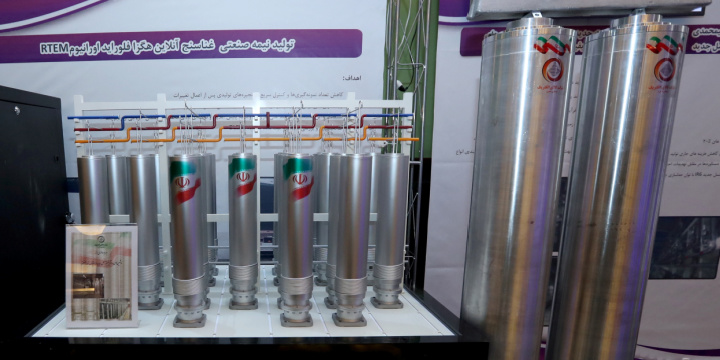
A number of new generation Iranian centrifuges are seen on display during Iran’s National Nuclear Energy Day in Tehran, Iran April 10, 2021. Iranian Presidency Office/WANA (West Asia News Agency)/Handout
Qatar will host indirect talks between Iran and the United States in the coming days, Iranian media reported on Monday, amid a push by the European Union to break a months-long impasse in the negotiations to reinstate a 2015 nuclear pact.
“Iran has chosen Qatar to host the talks because of Doha’s friendly ties with Tehran,” Mohammad Marandi, a media adviser to Iran’s top nuclear negotiator, told the ISNA news agency on Monday.
In March, the pact appeared close to being secured when the EU — which is coordinating negotiations — invited foreign ministers representing the accord’s parties to Vienna to finalize an agreement after 11 months of indirect talks between Tehran and President Joe Biden’s administration.
But the talks have since been suspended, chiefly over Tehran’s insistence that Washington remove the Islamic Revolutionary Guard Corps (IRGC), its elite security force, from the US Foreign Terrorist Organization list.
The European Union’s foreign policy chief Josep Borrell, who traveled to Iran last week, said on Saturday the indirect talks were expected to resume in the coming days in a Gulf country.
While a source briefed on the visit said that “US Special Envoy for Iran Robert Malley is expected to arrive in Doha on Monday and will meet with the Qatari foreign minister,” an Iranian official told Reuters that Iran’s chief nuclear negotiator Ali “Bagheri Kani will be in Doha for the talks on June 28 and 29.”
Iran’s foreign ministry was not immediately available for comment and the Qatari government didn’t comment.
Last week, one Iranian and one European official told Reuters that Iran had dropped its demand for the removal of the IRGC’s FTO sanctions, but still two issues, including one on sanctions, remained to be resolved.
“Nothing is agreed until everything is agreed,” Iran’s Foreign Ministry spokesman Saeed Khatibzadeh said on Monday.
“Iran’s nuclear steps are reversible if Washington fulfills its commitments.”
The 2015 nuclear pact imposed restrictions on Iran’s nuclear activities in exchange for the lifting of international sanctions. Then-President Donald Trump pulled the United States out of the deal in 2018, reimposing tough economic sanctions on Tehran.
Iran’s clerical establishment responded by breaching the pact’s nuclear restrictions, including a 3.67% cap on the level to which it could purify uranium and a 202.8-kg limit on its enriched uranium stock.


