








Jewish Women Take a Stand in the Torah
Error: Contact form not found.

 by Jeremy Rosen

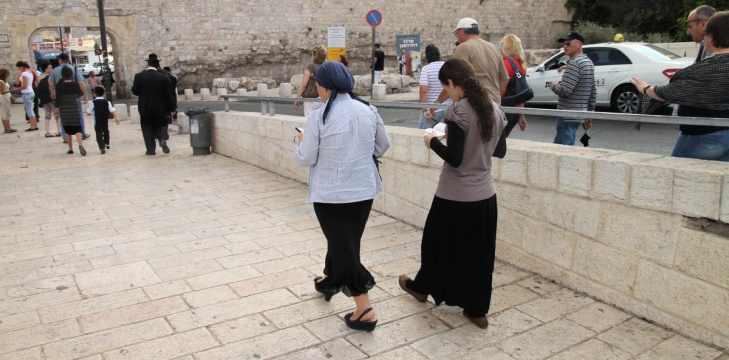
(Illustrative) Two Orthodox Jewish women walking in the Old City of Jerusalem. Photo: Peter van der Sluijs
Halfway through this week’s Torah reading comes the episode of the daughters of Zelofchad.
The five daughters of Zelofchad approached Moses with a claim. Their father had died through no fault of his own and there were no sons. This meant that when the allocation of land was going to be made upon the Jewish people’s arrival in Israel, their father’s family would lose out because the land was given through the males. They argued that they should be able to receive an allocation to ensure that their father’s family would not disappear from the tribal rolls. The daughters were named Machlah, Noah, Choglah, Milcah, and Tirzah. Interestingly Noah and Tirzah are common Hebrew names today, the others are not.
This is one of two examples where Moses was unsure of what to do on a matter of law. It also shows how access to the courts at that stage was available to women, as well as men. Moses refers the case to God, and comes back with his approval of the daughters being granted land rights.
Later, in Chapter 36, there is a challenge to this judgment, because allocations were made per tribe. And if the daughters married outside of their tribe, their allocations would be transferred to another tribe and cause an imbalance in the amount of property a tribe could own. Moses then accepts this argument, and insists that the daughters should only marry within their own tribe. This way each tribe would retain the proportion of the original allocation.
What is implicit in all of this, apart from the rights of women, was that no one should acquire too much or have a monopoly over lands. This is why originally all marriages between tribes were forbidden. Incidentally, the priests were not allocated land so that they could concentrate on community service.
The Talmud always adds extra dimensions to a narrative.
In the Torah, Zelofchad’s daughters are mentioned again by name in the appeal of the male-dominated tribal leaders, but in a different order; Machlah, Tirzah, Choglah, Milcah, and Noah. Rashi says that this is because each one of them was equal to the other in terms of qualities. The Talmud also says that they were equal in wisdom and greatness and merited having their names attached to the laws of inheritance. Others suggest the order had to do with either who married first or who married a more important tribal leader. But I do like the egalitarian reason that enshrines the rights of anyone to plead their case regardless of sex or status.
The daughters are an important symbol because they brought their case with dignity, whereas others in the Bible brought their cases with anger and confrontation. The Talmud (Bava Batra 119) also says they came to the Beit Midrash, the study halls, to plead their case. They wanted to bring about change through the legal structures and the existing system instead of trying to overturn it.
If the Torah this week starts with the example of someone going beyond the law, these women assert the value of working within it.
The author is a writer and rabbi based in New York.