




Egypt and Saudi Arabia Want the World Cup — But Have a Human Rights Problem
Error: Contact form not found.

 by James M. Dorsey

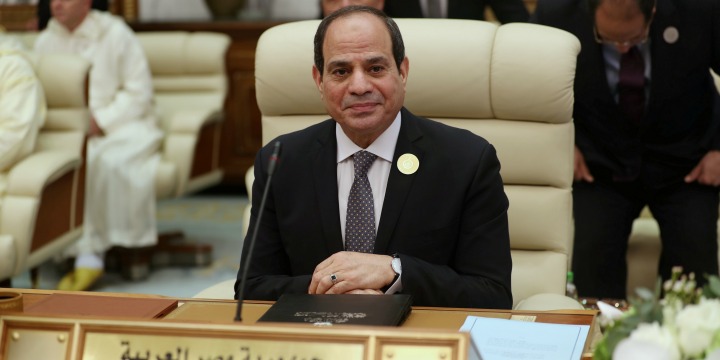
Egyptian President Abdel Fattah al-Sisi attends the Arab summit in Mecca, Saudi Arabia, May 31, 2019. Photo: REUTERS/Hamad l Mohammed/File Photo.
At first glance, a potential bid by Saudi Arabia and Egypt, two of the world’s worst human rights violators, together with Greece, to host the 2030 World Cup sounds like an invitation to a public relations fiasco.
That is undoubtedly true if one looks at Qatar, three months before its World Cup kick-off in November.
Coverage of the Qatar World Cup in the independent media remains harshly critical of the Gulf state’s final preparations for the tournament and migrant worker and human rights record, despite significant legal and material reforms.
Moreover, human rights groups continue to confront Qatar with legitimate demands, such as an improved compensation system for workers who’ve suffered serious harm, including death, injury, and wage theft.
Even so, Qatar’s rough public relations ride over the last 12 years, since it won its World Cup hosting rights, may prove to have been mild compared to what likely awaits Saudi Arabia and Egypt, if and when they submit a formal bid to FIFA, the world soccer governance body. Greece, too is likely to be taken to task for partnering with the two autocracies.
Saudi Arabia has wanted to host a World Cup for some time, as part of a concerted effort to establish itself as a regional sports hub, eclipsing Qatar and the United Arab Emirates. Sports is one pillar of a larger endeavor to position the kingdom as the Middle East’s commercial and political center of gravity. Moreover, as the custodian of Mecca and Medina, Islam’s two holiest cities, Saudi Arabia is already a major religious point of reference.
The sports effort also aims to boost Crown Prince Mohammed bin Salman (MBS)’s creation of an entertainment sector that caters to youth aspirations, contributes to the diversification of the country’s oil export-based economy, and helps project the kingdom as forward-looking and cutting-edge rather than secretive and ultra-conservative, as it was perceived for much of its existence.
By partnering with Greece, Saudi Arabia hopes to enhance its chances of winning the bid in a competition that is likely to be dominated by multi-country proposals. The bid’s strength is that it would be tri-continental — Asia, Africa, and Europe. Other potential contending partnerships include Spain and Portugal; England, Scotland, Northern Ireland, Ireland, and Wales; a North African combination of Morocco, Tunisia, and Algeria; and a joint South American effort by Uruguay, Argentina, Chile, and Paraguay. Romania, Greece, Bulgaria, and Serbia have also expressed interest in banding together.
Partnering could allow Saudi Arabia to circumvent FIFA’s likely hesitancy to award the tournament to a Middle Eastern country as sole host for the second time in a decade. The potential alliance with Egypt and Greece follows an earlier apparently failed attempt to team up with Italy for a World Cup bid.
Saudi Arabia’s willingness to risk the kind of scrutiny that Qatar was exposed to is rooted in a degree of hubris on the part of MBS, and an evaluation of the Qatari experience. MBS has been encouraged by the willingness of leaders like US President Joe Biden, French President Emmanuel Macron, and British Prime Minister Boris Johnson to put behind them the unresolved 2018 killing of journalist Jamal Khashoggi in the Saudi consulate in Istanbul, and the arrest of scores on often flimsy charges.
By the same token, MBS has nothing to fear from non-democratic members of the international community like China and Russia and much of the Global South that either sit in glasshouses, do not want to align themselves with US and European lip service to the defense of human rights, or opportunistically don’t want to get on the wrong side of Saudi Arabia.
Saudi hubris was evident in this month’s sentencing of 34-year-old Leeds University PhD candidate Salma al-Shehab, a mother of two, to 34 years in prison for following and retweeting dissidents and activists on Twitter.
MBS’ willingness to shoulder the risk is likely to be rooted in an analysis of Qatar’s experience that suggests that, on balance, the Gulf state’s hosting of the World Cup will prove to be a success, despite continued negative press in Western media, provided that it pulls off the tournament without significant glitches.
However, Saudi Arabia and Egypt’s human rights records are far more egregious than Qatar’s, which is hardly commendable by any measure. Like the kingdom and Egypt, Qatar is an autocracy with a legal infrastructure that fortifies the emir as the country’s absolute ruler. Like the potential 2030 World Cup bidders, Qatar lacks freedom of the press and assembly, outlaws extra-marital sex, and refuses to recognize LGBT rights.
But unlike Saudi Arabia and Egypt, Qatar’s jails are not populated by political prisoners or offenders of anti-LGBT laws.
Human rights groups estimate that Egypt keeps 60,000 political prisoners behind bars.
Human Rights Watch has repeatedly charged that Egyptian authorities “arbitrarily arrest” LGBT people and “detain them” in inhuman conditions, systematically subject them to ill-treatment including torture, and often incite fellow inmates to abuse them.
Going to extremes, Saudi Arabia, amid a push to encourage tourism, launched “rainbow raids” in late 2021 on shops selling children’s toys and accessories.
Authorities focused on clothing and toys, including hair clips, pop-its, t-shirts, bows, skirts, hats, and coloring pencils “that contradict the Islamic faith and public morals and promote homosexual colors that target the younger generation,” according to a commerce ministry official.
Earlier, the kingdom banned “Lightyear,” a Disney and Pixar animated production, because of a same-sex kiss scene, and Disney’s “Doctor Strange,” in which one character refers to her “two mums.”
The litany of Saudi violations of fundamental rights includes a ban on non-Muslim houses of worship, even though the kingdom has recently emphasized inter-faith dialogue and welcomed Jewish visitors.
Qatar has demonstrated a degree of dexterity in dealing with its World Cup critics, a quality that the Saudi crown prince and Egyptian general-turned-president Abdel Fattah al-Sisi have yet to exhibit.
Dr. James M. Dorsey is an award-winning journalist and scholar, an Adjunct Senior Fellow at Nanyang Technological University’s S. Rajaratnam School of International Studies, and the author of the syndicated column and blog, The Turbulent World of Middle East Soccer.