




Amid Fears of ‘Israel Apartheid’ Resolution, German President Warns World Council of Churches Delegates Against Antisemitism
Error: Contact form not found.

 by Ben Cohen


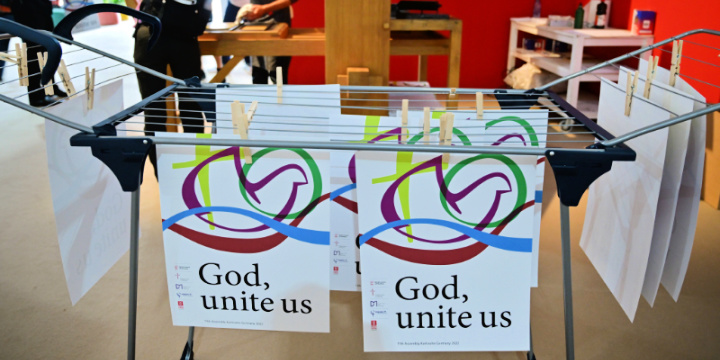
A poster display at the assembly of the World Council of Churches (WCC) in Karlsruhe, Germany. Photo: Reuters/Thomas Lohnes
Amid concerns that the World Council of Churches (WCC) general assembly in Germany will feature antisemitic rhetoric accompanying draft resolutions that are harshly critical of Israel, the German president has issued a warning to delegates regarding the dangers of Jew-hatred.
“It is one of the major current tasks of the Christian churches around the world to fight back against antisemitism,” President Frank-Walter Steinmeier told the opening session of the WCC’s 11th assembly in the city of Karlsruhe.
The group represents hundreds of Protestant and Orthodox church bodies across the world.
“We must be aware that antisemitism can take many forms,” Steinmeier said. “But it always remains a hate ideology with a history of extermination.”
Earlier this week, one German Jewish leader expressed concern that antisemitic tropes would be in evidence at the assembly.
“An antisemitic scandal cannot be ruled out,” Rami Suliman — chair of the Jewish community in the Baden region — said on Monday.
In the wake of those comments, some German church leaders have raised similar worries.
“I assume that there will be clear signals that Israel will be declared an apartheid state,” Annette Kurschus — chair of the Council of the Evangelical Church in Germany (EKD) — told the Welt news outlet, an outcome that was deemed a “no go” by her colleague Volker Jung of the Evangelical Church in Hesse and Nassau.
At least one US church organization part of the WCC is actively pushing for the passage of a resolution at the assembly that would define Israel as an “apartheid state.”
“One of the things the church can do to alter the future is advocate for more peaceful resolution to conflict, both at the interpersonal and at the national level,” Rev. John Dorhauer — general minister and president of the United Church of Christ (UCC) — said in a statement issued on Tuesday.
“There is also a resolution from South Africa calling Israel an apartheid state and asking for justice for Palestinian peoples,” continued Dorhauer, whose organization brings together nearly 800,000 members of Congregational, Calvinist, Lutheran, and Anabaptist congregations around the US. “We will give our full support to that, though I have no allusions (sic) about that passing at the convention.”
Representing 580 million non-Catholic Christians around the world, the WCC is holding its assembly in Germany for the first time. The newly-elected head of the WCC — Rev. Jerry Pillay, a South African cleric — authored a paper in 2016 titled “Apartheid in the Holy Land: Theological reflections on the Israel and/or Palestine situation from a South African perspective.” The paper stated that a “comparison between the Israel-Palestine conflict and the South African apartheid experience is, indeed, justifiable” and described the “Boycott, Divestment and Sanctions” (BDS) campaign targeting Israel in positive terms.
A potential controversy involving antisemitism would come hot on the heels of the serial scandals at Germany’s Documenta festival of contemporary art, where openly antisemitic works were on display. Meron Mendel — the director of the Anne Frank Educational Institute in Frankfurt who has been heavily critical of the Documenta management’s response to the presence of antisemitic art — told Welt that “even if the discussions at the WCC General Assembly cannot be predicted, a development comparable to Documenta is to be feared in the positioning towards Israel.”
Mendel argued that “in the effort to give space to the Global South, anti-Western and, above all, one-sided anti-Israel ideologies can be protected under the heading of ‘anti-colonialism’.”
Disputes over Israel at the assembly could yet be overshadowed by tensions over the presence of a delegation from the Russian Orthodox Church. Despite the Ukrainian Orthodox Church’s decision in May to break with the Russian Church over the invasion of Ukraine, the WCC continues to recognize the Moscow Patriarchate as representing “the WCC communion in both Russia and Ukraine.” Moreover, while a WCC resolution in June condemned Russia’s aggression as an “illegal invasion,” it also criticized the supply of weapons to Ukraine’s armed forces on the part of Western nations.
In his speech to the assembly, Steinmeier excoriated the Russian delegates for “leading their believers and their entire Church on a terrible, downright anti-religious and blasphemous wrong path.”