



‘Four Winters’ Highlights Courageous Jews Who Fought Against the Nazis
Error: Contact form not found.

 by Alan Zeitlin

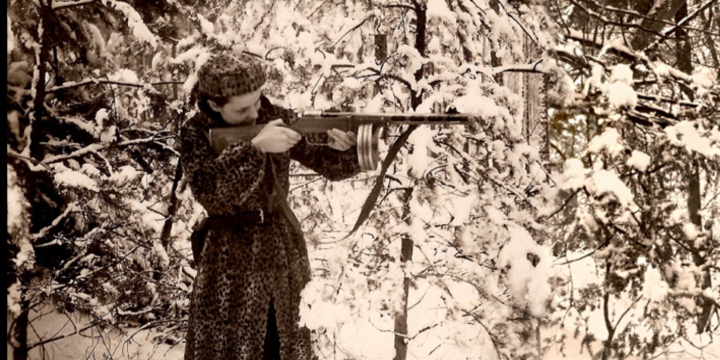
Faye Schulman, one of the Jewish partisans featured in “Four Winters,” aims her weapon. Photo: provided.
The question was horrifically nonchalant: “You’re gonna be killed anyway, why can’t my daughter have your clothes?”
Gertrude Boyarski recalls her mother being asked this by a neighbor in the stirring documentary “Four Winters,” now playing at the Film Forum in Manhattan with other cities to follow.
Boyarski says that her mother declared: “I’m gonna die with my clothes on.”
Written and directed by Julia Mintz, this spectacular documentary tells the true story of how Jewish partisans survived in the forests of Eastern Europe. There is no outside narration. There are no historians. We only hear the voices of the Jewish partisans, and their words are sharp. The images they evoke are vivid and biting, heartbreaking and inspiring, deadly serious, but with moments of humor — you will want to reach through the screen and hug these people.
I could watch an entire documentary on Michael Stoll, who at times breaks into tears. He talks about being on a cattle car and realizing he was on the way to a death camp. When others said they thought they’d be okay, he recalls asking rhetorically if they thought they were “going on a picnic or something?”
Mintz told me that she worked on the film on and off for 10 years, and that it was five years before Stoll agreed to be interviewed.
Jewish partisan Isadore Farbstein is a force of nature, and still looks like he could beat up the camera operator. Faye Schulman says that she wanted to die with her family, until a young man convinced her that she needed to live on. She took photographs and learned to shoot a rifle.
“Defiance” and other movies have told the stories of Jewish partisans, but as big muscle-bound men, who are not easy to relate to.
Here, we see ordinary people who were forced to do the extraordinary or die. I don’t think I could have lasted four weeks in the snow, deep in the forest, with little food or shelter, let alone having to fight Nazis at the same time. These people did just that for four whole years (the movie is named for the four winters they endured fighting the Nazis). It’s hard to fathom how it was possible.
Boyarski talks of the worst night of her life, as family members were shot and a Nazi next to her had been her dancing partner before the war.
Some Jewish fighters were motivated by the anger of losing their loved ones, which diminished their fear of being killed. Luba Abramowitz says that her heart stopped when she smuggled bullets in her bra, and was afraid a Nazi who was near her would discover what she was doing. But she also makes a joke to the camera, saying, “As you know, women have more places to hide weapons than men, yes?”
“The Jewish humor aspect is sort of innate,” Mintz told me in an interview. “It’s sort of part of our humanity and as a director, I wanted to show them as human and as tangible as they are. They’re our grandparents. They’re our people.”
Mintz said that it was crucial for her to preserve and highlight the stories of her subjects, because she knew they were among the last living partisans.
They survived being hunted, being shot, sometimes not eating for six days, and having to live knowing that any second could be their last. In one scene, it is amazing to hear how they attacked a German garrison of 100.
With units called “Nekama,” “Vengeance,” “Death of the Occupiers,” and “Abramov,” it is crucial to know that some Jewish men and women fought back. In the film’s opening, Stoll said Jews aren’t known to be fighters.
Still one to add humor, Boyarski talks about how they had to eat pig to survive, but adds, “Today, I’m kosher.”
Are there a couple of moments that are difficult to watch? Yes, and that is precisely why you should watch them. Mintz said growing up, she didn’t realize the extent of the resistance, and that an estimated 25,000 people were in the woods fighting.
Most movies now are focused on larger-than life superheroes. But these Jewish men and women were real superheroes — and this movie is worth more than all the fake superhero stories combined.
“Four Winters” is showing at the Film Forum in Manhattan, and will soon expand to other cities.
The author is a writer based in New York.