







A Sukkot Guide for the Perplexed
Error: Contact form not found.

 by Yoram Ettinger

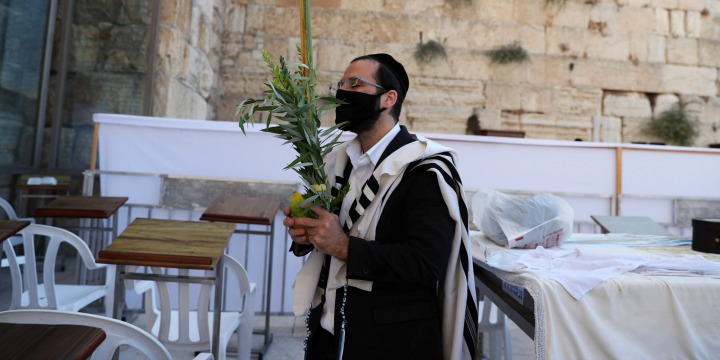
A Jewish worshipper holds the Four Species, used in rituals on the holiday of Sukkot, as he takes part in the priestly blessing at the Western Wall, Judaism’s holiest prayer site, amid Israel’s second-wave coronavirus disease (COVID-19) lockdown, in Jerusalem’s Old City, Oct. 5, 2020. Photo: Reuters / Ronen Zvulun.
Here are seven things you should know about the upcoming holiday of Sukkot:
1. Sukkot is a national Jewish liberation holiday, commemorating the transition of the Jewish people from bondage in Egypt to liberty and sovereignty in the Land of Israel. Sukkot is the third Jewish pilgrimage holiday (following Passover and Shavouot/Pentecost), which highlights faith, reality-based-optimism, liberty from Egyptian bondage, can-do mentality, and the defiance of odds.
2. Sukkot commemorates the Biblical exodus. It derives its name from the first stop out of Egypt — the town of Sukkot — as documented in Exodus 13:20-22 and Numbers 33:3-5. Sukkot was also the name of Jacob’s first stop west of the Jordan River, upon returning to the Land of Israel from his 20-year-work for Laban in Aram (Genesis 33:17). Sukkot underscores the gradual transition from the spiritual state-of-mind during Rosh Hashanah and Yom Kippur, to the mundane of the rest of the year, and from religious tenets of Judaism to the formation of the national, historic, and geographical Jewish identity.
3. The seven days of Sukkot — which are celebrated in the seventh Jewish month, Tishrei — are dedicated to seven supreme principle-driven, national Jewish leaders, who were compassionate and brave shepherds, and who initiated ground-breaking and game-changing initiatives: Abraham, Isaac, Jacob, Joseph, Moses, Aaron, and David.
4. Sukkot features the following four species: the citron (representing King David, the author of Psalms), the palm branch (representing Joseph), myrtle branches (representing the three Patriarchs), and willow branches (representing Moses and Aharon, the role models of humility), which are bonded together, representing the unity-through-diversity of the Jewish people.
5. Traditionally, Sukkot is dedicated to the study of the Biblical Book of Ecclesiastes, written by King Solomon, which highlights humility, morality, patience, learning from past mistakes, commemoration and historical perspective, family, friendship, long-term thinking, proper timing, realism, and knowledge. The late Senator Robert Byrd (D-WV), the longest serving US Senator, often quoted Biblical verses, in general, and Ecclesiastes, in particular. For example, on November 7, 2008, upon his retirement from the chairmanship of the Senate Appropriations Committee, he stated: “To everything there is a season and a time for every purpose under heaven (Ecclesiastes 3:1).”
6. Sukkot emphasizes humility, as demonstrated by the seven-day-relocation from one’s permanent dwelling to the temporary, humble, wooden booth (Sukkah), which sheltered the people of Israel during the exodus.
7. Sukkot expresses the yearning for reality-driven universal peace, highlighting the Sukkah of Peace (Sukkat Shalom).
The author is a commentator and former Israeli ambassador.


