









Mending the US-Saudi Relationship
Error: Contact form not found.

 by Alon Ben-Meir

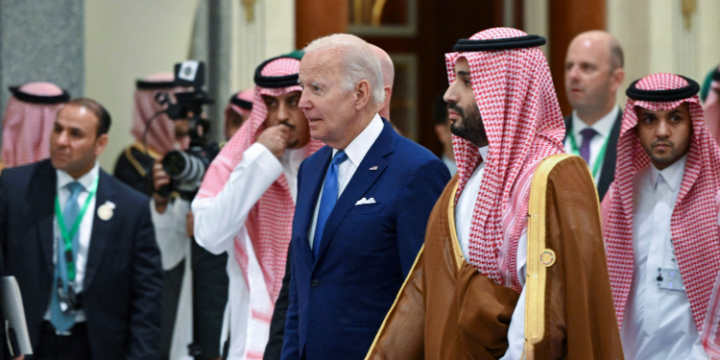
US President Joe Biden and Saudi Crown Prince Mohammed bin Salman arrive for the family photo during the Jeddah Security and Development Summit (GCC+3) at a hotel in Jeddah, Saudi Arabia July 16, 2022. Mandel Ngan/Pool via REUTERS
The US’ misperception of its bilateral relations with Saudi Arabia has contributed dramatically to the present heightened tension between them. It is critical that the two countries recalibrate their relationship and renew their geo-strategic partnership.
Even a cursory review of the US-Saudi Arabia relationship over the past several years suggests that the US has generally misperceived its bilateral relations. The prevailing notion is that the Saudis need the US much more than the reverse, which presumably puts the US in a position to make demands on Riyadh rather than work closely as allies. I maintain that the current heightened tension between the two countries would not have reached its nadir had President Biden been given sounder advice about the nature of US-Saudi relations, both during his campaign for president and since he entered the White House nearly two years ago.
While running for president, he called Saudi Arabia a “pariah,” whose leadership had “very little redeeming value.” And when OPEC decided to cut oil production by two million barrel a day, he threatened the Saudis by stating that “… when the House and the Senate comes back, there’s going to be some consequences for what [Saudi Arabia has] done with Russia.” He added insult to injury when he vowed to never talk to Crown Prince Mohammed bin Salman, known as MBS, the de facto king. And perhaps worst of all, he took over a year from taking office to appoint an ambassador to Riyadh, whose nomination is still pending.
One would think that once he decided to visit the kingdom, primarily to ask for an increase in oil production in the wake of the energy crisis precipitated by the war in the Ukraine, he would make an effort to mend the relationship. In fact, the opposite happened. He insulted MBS by refusing to shake his hand, and lectured the Saudis on their human rights violations. Furthermore, MBS is a new and inexperienced leader who does not necessarily appreciate the importance of the alliance.
Moreover, the Saudis interpreted the US’ steps to reduce its reliance on Saudi oil, and its pivot toward Asia to contain China’s growing influence, as a sign of the US’ abridged interest in safeguarding the geo-strategic partnership.
From the Saudis’ perspective, the US misperception about the country manifests itself in several areas:
Arms sales: When high-ranking Democrats make bold foreign policy statements, as when Senator Richard Blumenthal (D-CT) and Rep. Ro Khanna (D-CA) introduced a bill to “immediately pause all US arms sale to Saudi Arabia” in the wake of the oil production cut, it demonstrates where the party’s position generally lies. Furthermore, Biden has yet to speak against this bill, which shows how flawed the administration’s views are on the entire enterprise of arms sales to Saudi Arabia.
To begin with, selling arms to the Saudis is not a charitable contribution. They pay tens of billions of dollars to buy arms, from which the US military industry greatly benefits financially. It allows the US to have a solid foothold in Saudi Arabia through trainers, logistical support, and military personnel, which serves the US strategic interest throughout the Middle East, all while strengthening the ties between the two countries.
National interests: As the Saudis see it, the US policy approach toward them is based on the premise of what is best for the US. The US has minimized the Saudis’ political interests and often economic considerations, as was manifested by Riyadh’s decision to support OPEC’s oil cut. In particular, the Saudis wanted to keep the price stable especially because of their concern over an impending global recession, and in addition, they want to prepare for the increased oil demands of an uncertain winter. By viewing the relationship in black and white, the Saudis feel shortchanged and constrained which they are no longer willing to tolerate.
Human rights violations: Although there are human rights violations in Saudi Arabia, the question is, if the US wants the Saudis to end or significantly curtail their human rights abuses, would that best be achieved through public chiding or through behind the scenes discussions? The answer is clear; denouncing and humiliating the Saudis publicly about their human rights record serves the opposite of the US’ ultimate goal. Instead, the US can point out in private settings how much the monarchy can benefit if the people feel freer and more creative, and not subject to arbitrary detentions, disproportionate penalties, gender inequality, etc.
What is needed now is the opening of a new chapter in the relations between the two countries, specifically by recognizing Saudi Arabia’s critical role on several fronts:
As a peace maker, the Saudis — who introduced the Arab Peace Initiative in 2002 — remain committed to ending the Israeli-Palestinian conflict while tacitly cooperating with Israel on a host of issues, including intelligence sharing, the purchase of advanced Israeli technology, and more. In addition, the Saudis voted to condemn Russia’s annexation of Ukrainian territories and are continuing its efforts to assist Ukraine, among many other efforts.
Regardless of the US-Saudi conflict, Riyadh remains the largest oil producer ,and given the global energy crisis, the Saudis can make a significant difference. True, the Saudis still want to calibrate the supply and demand for oil and protect their national interest. Nevertheless, the Biden administration should work with the Saudis in addressing the global oil crisis through quiet negotiations, for two reasons. First, on December 5, the EU oil embargo on seaborne Russian crude oil will begin, which can precipitate a new crisis as the winter cold approaches. Second, on December 4, the next OPEC meeting will be held, where the US and the Saudis should reach a mutually beneficial understanding in advance about oil production.
Certainly, there are many other areas where the US and Saudi Arabia can and should fully cooperate. This includes full collaboration in dealing with the Iranian regional threat and its ambition to become the region’s hegemon, potentially equipped with nuclear weapons; working together to bring the war in Yemen to an end and stopping the horrifying death and destruction; and helping mitigate the ongoing civil war in Sudan where thousands of innocent people are dying.
In spite of the ups and downs in US-Saudi relations, the alliance has lasted seven decades and has proven its resiliency and far-reaching geo-strategic importance for both countries. Now is the time to revisit their relationship and renew the commitment to an alliance and friendship that is pivotal for regional peace and stability, at a historic juncture of global turmoil.
Dr. Alon Ben-Meir is a retired professor of international relations at the Center for Global Affairs at NYU. He taught courses on international negotiation and Middle Eastern studies for over 20 years.