



Civil Rights Inquiry Filed Against University of California Over ‘Discriminatory’ Berkeley ‘Ban’ on Zionist Speakers
Error: Contact form not found.

 by Algemeiner Staff

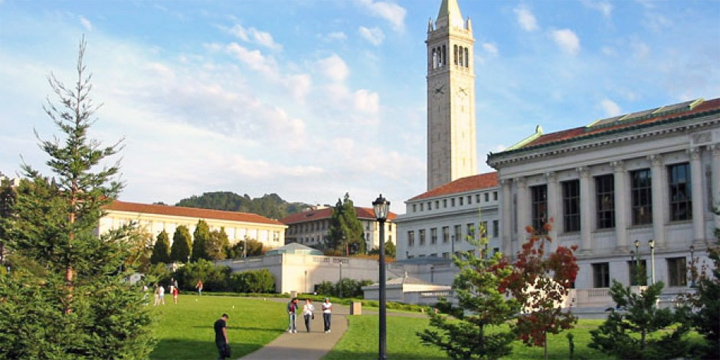
Memorial Glade and Sather Tower on the campus of the University of California, Berkeley. Photo: Gku.
A proposed ban excluding supporters of Zionism from speaking at student-hosted events at University of California, Berkeley is being challenged before the US Department of Education’s Office for Civil Rights.
On Sunday, two lawyers filed a complaint with the federal government against Berkeley Law School over a August 2022 decision of at least 9 student groups to adopt a bylaw excluding Zionist speakers.
The complaint, filed by attorneys Arsen Ostrovsky and Gabriel Groisman, called on the Department of Education to investigate the university for “profound and deep-seated antisemitic discrimination” under violation of Title VI of the Civil Rights Act, which bars discrimination on the basis of race, color, or national origin in federally-funded programs.
“The groups that have implemented this discriminatory policy attempt to hide their discrimination against the Jewish community by excluding “Zionists,” the two lawyers said in a statement Sunday. “This thin veil is completely transparent as Zionism is an integral, indispensable and core element of the Jewish identity.”
The complaint also called on the federal government to compel UC Berkeley to adopt the widely endorsed International Holocaust Remembrance Alliance (IHRA) working definition of antisemitism and requires the university to create a training program, to educate about antisemitism, its history and modern manifestations.
Proposed by Students for Justice in Palestine at Berkeley Law as part of a resolution endorsing the boycott, divestment, and sanctions (BDS) movement, the measure was endorsed by eight other student groups. It has been criticized by lawmakers, Jewish groups and human rights organizations for posing a threat to academic and intellectual freedom.
In October, UC Berkeley law faculty, working with the Academic Engagement Network, a nonprofit that promotes free expression and academic freedom on college campuses issued a statement affirming “the principle of free and open speech at the law school.”
“For many Jews, Zionism is a core component of their identity and ethnic and ancestral heritage,” it said. “As an educational institution we hope that the student groups that have now endorsed a ‘No Zionists speakers’ pledge will engage in dialogue on these issues.”
The October statement was signed by UC Berkeley Law School Dean Erwin Chemerinsky, Koret Professor of Law Peter S. Menell, and Claire Sanders Clements Professor Emeritus Malcolm Feeley.
But Sunday’s complaint alleges that Chemerinsky has not taken “meaningful steps” in response to the proposed ban.
In an op-ed Chemerinsky argued that “a handful of student organizations — fewer than 10 out of over 100 — initially adopted the by the law.”
“But the rest rejected it or ignored it,” Chermerinsky added. “Most importantly, no group has violated the Law School’s policy and excluded a speaker on account of being Jewish or holding particular views about Israel. Such conduct, of course, would be subject to sanctions.”


