





‘The Guardian’ Backs Down After Claiming Israeli Women Can’t Leave Their Homes Without a Male Guardian
Error: Contact form not found.

 by Rachel O'Donoghue

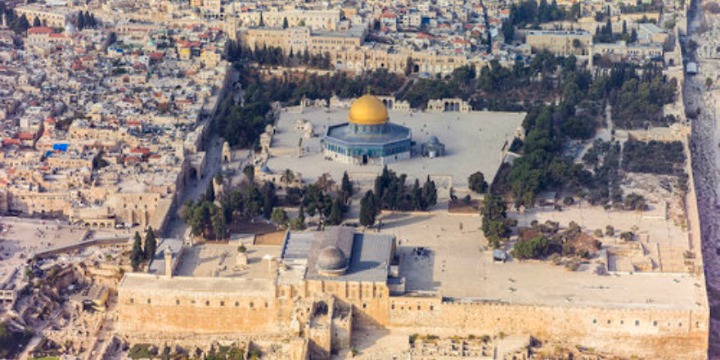
An aerial view of the Temple Mount in the Old City of Jerusalem. Photo: Wikimedia Commons.
According to The Guardian’s website, its mission since its founding has been to deliver “fearless, investigative journalism” that is “free from political and commercial influence.”
Unfortunately, there was little in the way of fearless and objective journalism displayed when the outlet originally published an article that falsely claimed Israel has “rules restricting a woman’s freedom to live, work and study.”
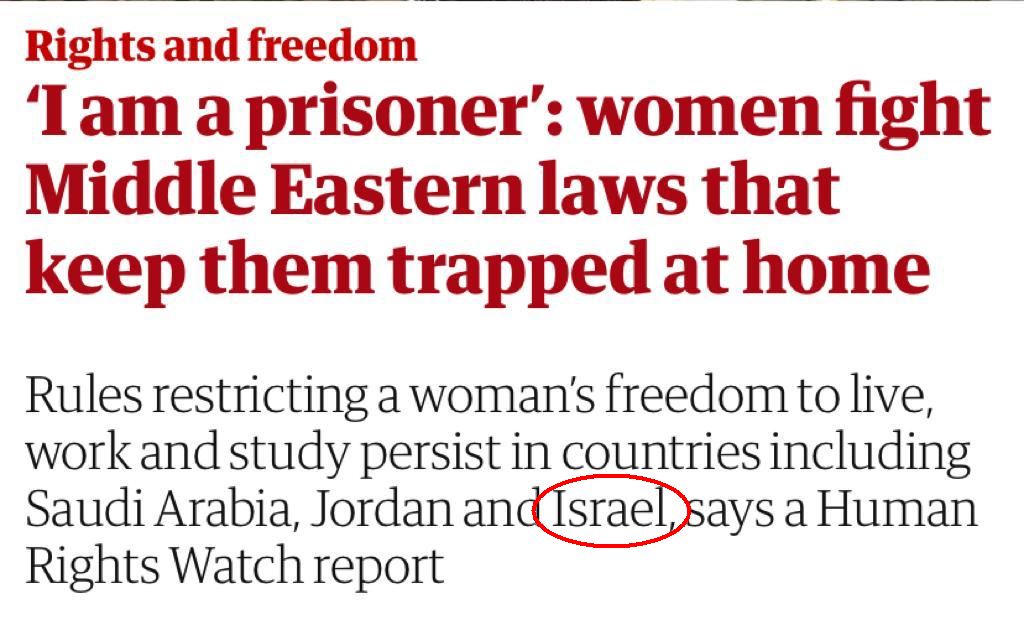
The piece was based on a report by Human Rights Watch (HRW), which includes Israel in a list of countries such as Saudi Arabia, Qatar, and Kuwait, that impose restrictions on women “preventing them from moving freely in their own country and from traveling abroad without the permission of their male guardians.”
Sadly, the international media’s tendency to treat HRW’s word as gospel means outlets like The Guardian all too often ignore the organization’s nakedly anti-Israel agenda and uncritically reprint its most outrageous and verifiably-false claims.
And this is apparently the reason why the Guardian journalists who wrote the piece failed to do a modicum of fact-checking, which might have helped them realize that Israel has no business being mentioned in the same sentence as Saudi Arabia and Jordan when it comes to women’s rights.
The Guardian even went as far as to republish a faulty HRW map that jaw-droppingly included Israel as one of the “15 countries where women can face sanction if they leave the home without male guardian permission.”
Can Israeli women leave their homes without male guardians?
YES
Hey, @guardian. This is what happens when you blindly follow anti-Israel NGOs like @hrw and republish their faulty content without basic fact checking.https://t.co/qXG0D9w9Ww pic.twitter.com/gycX0uTNwn
— HonestReporting (@HonestReporting) July 19, 2023
The Guardian might also have included the succinct statement that the Israeli Foreign Affairs Ministry gave to HRW when approached: “Israel is a modern democracy and therefore the questions are not relevant at all regarding it and its population.”
Of course, Human Rights Watch has never made any effort to disguise its utter contempt for Israel.
From disseminating the apartheid libel to whitewashing Hamas war crimes, it seems that barely a week goes by in which the organization does not smear the Jewish state with some kind of unfounded and unjust accusation.
A quick scan of its latest report reveals HRW cannot back its risible assertion, with the authors instead referencing isolated incidents of sex discrimination that resulted in Israeli women suing in court (ironically, the successful lawsuits actually disprove HRW’s claim of state-sanctioned discrimination in Israel).
In fact, Israel’s inclusion in the report appears to be based on HRW gazing into a crystal ball and prophesizing that some members of the Israeli government might push for legislation that would “permit gender segregation at publicly funded events or public spaces.”
In response to our complaints, The Guardian appended the following to its story:
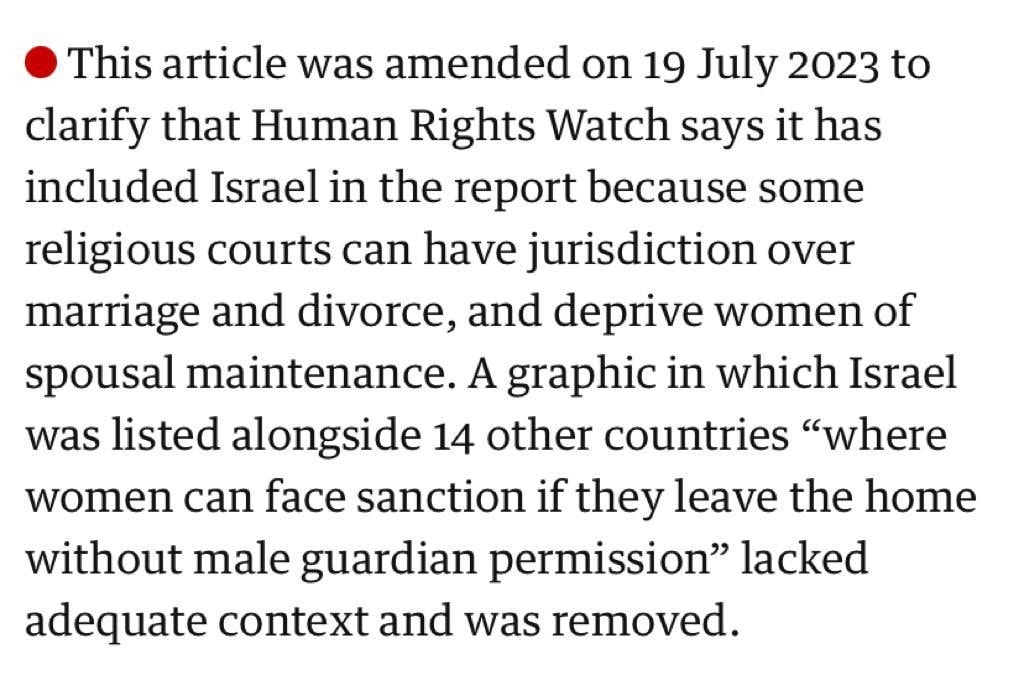
This is as close as The Guardian will get to acknowledging the error without throwing Human Rights Watch under the bus. Nevertheless, the offending map has been removed as has the reference to Israel in the headline’s subheader.
The author is a contributor to HonestReporting, a Jerusalem-based media watchdog with a focus on antisemitism and anti-Israel bias — where a version of this article first appeared.


