




‘They Sing Peace and Rape Our Women:’ Fury in Italy Over Antisemitic Rock Song Penned by Senior Regional Official
Error: Contact form not found.

 by Ben Cohen



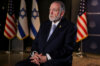
Supporters of the center-left PD Party hold a banner calling for the dismissal of Italian regional official Marcello De Angelis over an antisemitic rock song he wrote. Photo: Reuters/Cecilia Fabiano
Italy’s prime minister is being pressured by opposition politicians to condemn a senior regional official over a virulently antisemitic song he performed while playing with a rock band during the 1990s.
Several parliamentarians from the center-left Democratic Party (PD) called on right-wing Prime Minister Giorgia Meloni to speak out on the controversy centered on Marcello De Angelis, the communications chief for Italy’s Lazio region, which includes the capital Rome.
“Meloni can’t ignore De Angelis’s antisemitism,” PD MP Andrea Casu posted on X, the social media platform formerly called Twitter. “She can no longer pretend not to notice — #DeAngelisresign.”
Casu’s colleague Marta Bonafoni, the PD’s national secretariat coordinator, said separately that the song — titled “Black September,” in tribute to the Palestinian terrorist group of the same name — was “clearly antisemitic.”
The song was initially released in 1995 by 270bis, an ultranationalist rock band founded by De Angelis with a strong skinhead following. Its lyrics denounce Jews as a “race of merchants” who “shout ‘Shalom’ burning our houses, they sing peace and rape our women.” Another passage in the song invokes the “hyenas of Sharon” — a reference to the former Israeli defense minister, the late Ariel Sharon.
De Angelis was appointed to his post by Francesco Rocca, the Governor of the Lazio region, who sits as an independent but is close to Meloni’s ruling Brothers of Italy (FdI) Party.
“In any democratic country, the author of an antisemitic song who has never even apologized for having defined the Jewish people ‘a race of merchants’ could not hold any political and institutional office,” Casu, the PD MP, commented. “Not so in Francesco Rocca’s Lazio Region.”
Condemnation also came from the local youth wing of the center right Forza Italia (FI) Party. A statement described the “Black September” song as “absolutely unbearable and inadmissible for our history and for our political culture. As Forza Italia youth, we have zero tolerance towards any form of antisemitism and this is why we demand that Marcello De Angelis takes a step back and — in the absence of this sensitivity — [we ask] Governor Rocca, in whom we have the utmost esteem and confidence, to intervene with the revocation of the assignment.”
According to the Italian news agency ANSA, Rocca has so far resisted the calls to fire De Angelis.
Italian Jewish leaders also spoke out on the scandal. Victor Fadlun, the president of Rome’s Jewish community, pointed to Black September’s role in carrying out the massacre of 11 Israeli athletes competing at the 1972 Olympic Games in Munich.
“[This song] takes up anti-Jewish stereotypes and distorts historical events, praising Palestinian terrorism guilty of unforgivable atrocities against innocent Israeli athletes in the September 1972 attack on the Olympic village in Munich,” Fadlun said. “We repudiate the clichés of antisemitism and the shameful distortions of historical truth.”
Separately, Tobia Zevi — a Jewish city politician who is responsible for housing policy in Rome — called on Rocca to “fire De Angelis.”
“As a Jew, I know that these antisemitic lyrics are a stain on our institutions,” Zevi said.
Earlier this week, De Angelis released a statement expressing contrition for the song, which he said “dates back to a period of my life in which I don’t recognize myself.”
He continued: “Reading those words again today I feel embarrassment and horror, just as today I would not rewrite other songs wrote in the past.”
However, De Angelis’s detractors remain unmoved by his statement, pointing out that this is the second major controversy involving him only this month.
Earlier in August, De Angelis took to social media to claim that three neo-fascist terrorists convicted of the Aug. 2, 1980 bombing of the central train station in Bologna — one of the worst terrorist atrocities in Italian history — were innocent.
De Angelis claimed that three of the five members of the far right Armed Revolutionary Nuclei (NAR) convicted of the attack — Giusva Fioravanti, Francesca Mambro, and Luigi Ciavardini — had “nothing to do with the Bologna massacre.”
He added that the anniversary of the attack was “always a very difficult day for anyone who knows the truth, which every year is trampled over, even by the highest figures of the state.”


