






The Times Cartoonist Peter Brookes Says He’s ‘Pro-Israel’ … Do His Cartoons Tell a Different Story?
Error: Contact form not found.

 by Rachel O'Donoghue


The Western Wall and Temple Mount in Jerusalem. Photo: Wikimedia Commons.
Peter Brookes is undoubtedly one of the most celebrated cartoonists in the United Kingdom, having been awarded the Cartoonist of the Year prize at the British Press Awards no fewer than five times and recognized with a Lifetime Achievement Award in 2017.
In addition to producing the lead cartoon for The Times since 1992, his work has also been featured in The Spectator, The Radio Times, and The New Statesman.
In a recent interview for The Times to mark his 80th birthday last month, Brookes referenced treading the line between satire and racial insensitivity in drawing caricatures of famous individuals, including touching upon the recent antisemitism controversy that engulfed The Guardian’s cartoonist Martin Rowson.
Admitting that he regularly checks if someone is Jewish before deciding how to draw them, Brookes was then asked whether he sympathized with Rowson after the latter was forced to apologize over his antisemitic depiction of former BBC chairman Richard Sharp:
Did he have any sympathy with the Guardian cartoonist Martin Rowson, who made a tortuous apology after depicting the former BBC chairman Richard Sharp with clearly antisemitic features? He does not want to badmouth other cartoonists, but he thought the portrayal “crass”. So when Brookes draws Benjamin Netanyahu, does some instinct prevent him going too far? “What stops me going that far? Well, I’m not antisemitic. I’m very pro-Israel in many, many ways.”
It is, of course, welcome news that Brookes is pro-Israel, especially in light of the fact that so many other commentators in British journalism take the opposite view.
However, we must also wonder whether his stance is a more recent development when we consider how Brookes has portrayed the Jewish state and the Israeli-Palestinian conflict over the years.
In 2009, one of his most controversial cartoons to date was published in The Times, which showed white phosphorus raining down on the Gaza Strip alongside the caption: “Twinkle twinkle little star. How I wonder what you are, White with phosphorescent glow, Burning children down below.”
Describing it as one of his favorite cartoons of that year, Brookes said the sketch was the result of finding something that made him “hopping mad and trying to say something meaningful about it.”

Peter Brookes, The Times, 16 January 2009
The suggestion that Israel indiscriminately used white phosphorus in the 2009 Gaza War, or targeted civilian children with the chemical is reprehensible, and reminiscent of ancient antisemitic blood libels charging Jews with killing children.
Israel used white phosphorus during the conflict as a smokescreen to provide troop cover in a way that both adhered to international law, and minimized the risk to civilians on the ground.
During the 2014 Gaza War, Brookes produced numerous cartoons on the subject for The Times, including one of Israeli Prime Minister Benjamin Netanyahu referencing airstrikes on schools in Gaza in the style of the famous US Army recruitment poster that shows Uncle Sam pointing his finger and urging men to enlist.

Peter Brookes, The Times 5 August 2014
Remarking on his art during the 2014 conflict, Brookes said: “For instance, my cartoons over the summer about Gaza started off being pro-Israel. If you send rockets into people’s territory, they are going to get pretty angry. Then Israel started bombing UN schools … Of course, I got quite a bit of stick from readers who were pro-Israel and readers who were anti-Israel.”
What Brooks failed to note is why the Israeli forces were compelled to conduct strikes on schools in Gaza: Hamas has and continues to store rockets and other weaponry beneath civilian buildings including schools, hospitals, and mosques.
More importantly, the United Nations actually confirmed that Hamas launched rockets from its schools during the 2014 conflict.
Also in 2014, Brookes waded into the “disproportionate force” row with his depiction of a Palestinian terrorist standing on a small pile of bodies next to an Israeli soldier perched upon a much bigger mound of corpses.
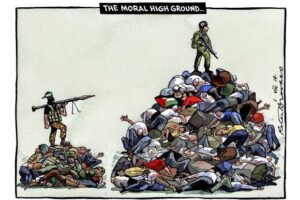
Peter Brookes, The Times, 1 August 2014
But as we have consistently observed over the years, the problem with the international media’s focus on the supposedly non-commensurate loss of life on both sides is that it ignores that international law does not hinge on which side loses the most people or has the most firepower. Proportionality must be gauged by the necessity of military action. So when Hamas fires rockets at Israel from civilian infrastructure, they can technically be seen as legitimate targets for Israeli airstrikes to prevent further terror attacks. There is also the issue of lack of means to carry out attacks; many of Hamas’ rockets fail because of Israel’s Iron Done Defense system and poor construction. Israel has also created barriers to successfully keep out terrorists and suicide bombers, thus reducing its casualty numbers.
Back in 2014, Brookes’ commentary on Israel’s operation in the Rafah camp in Gaza also turned a blind eye to the reality of Palestinian terrorism. The operation was designed to destroy terrorist tunnels, and came after the deaths of nearly a dozen Israeli soldiers in two separate attacks.
Depicting the late Israeli Prime Minister Ariel Sharon as a bulldozer smashing into buildings in Gaza, the cartoon criticized Israel for demolishing civilian homes in the Strip.
A more accurate cartoon would have shown the network of tunnels stuffed with rockets and bombs that snaked underneath the apartment building complex.
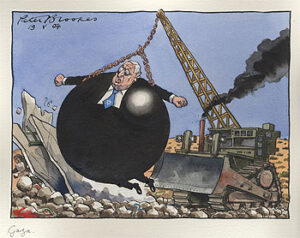
Peter Brookes, The Times, 19 May 2004
While we are pleased that Peter Brookes is proud to call himself “very pro-Israel” today, we can only hope this position will be reflected in his Israel-focused cartoons in the future.
The author is a contributor to HonestReporting, a Jerusalem-based media watchdog with a focus on antisemitism and anti-Israel bias — where a version of this article first appeared.


