



BBC Map of ‘Palestine’ Misrepresents the History of the Region
Error: Contact form not found.

 by Rachel O'Donoghue


The BBC logo is seen at the entrance at Broadcasting House, the BBC headquarters in central London. Photo by Vuk Valcic / SOPA Images/Sipa USA.
A BBC News story that focuses on the period of the British and French Mandates in the Middle East after the fall of the Ottoman Empire, includes a map that only serves to confuse the audience and play into a Palestinian narrative that erases the real history of the region.

The article text devotes an entire paragraph to explaining how the French Mandate “hived off Lebanon from Syria to create a strategic beachhead and imposed new boundaries over the whole territory in the early 1920s.”
So why does the BBC not also explain that Transjordan simply did not exist at the time when the British and French conquered the region from the Ottomans and was similarly hived off from the larger British Mandate?
This is noteworthy, because the 1917 Balfour Declaration had called for the establishment of a Jewish homeland within the region of the entire British Mandate, as seen in the map below, but the vast majority of it went on to become the independent state of Transjordan, later known simply as Jordan — a Muslim Arab state whose population mostly consists of Arab Palestinians.
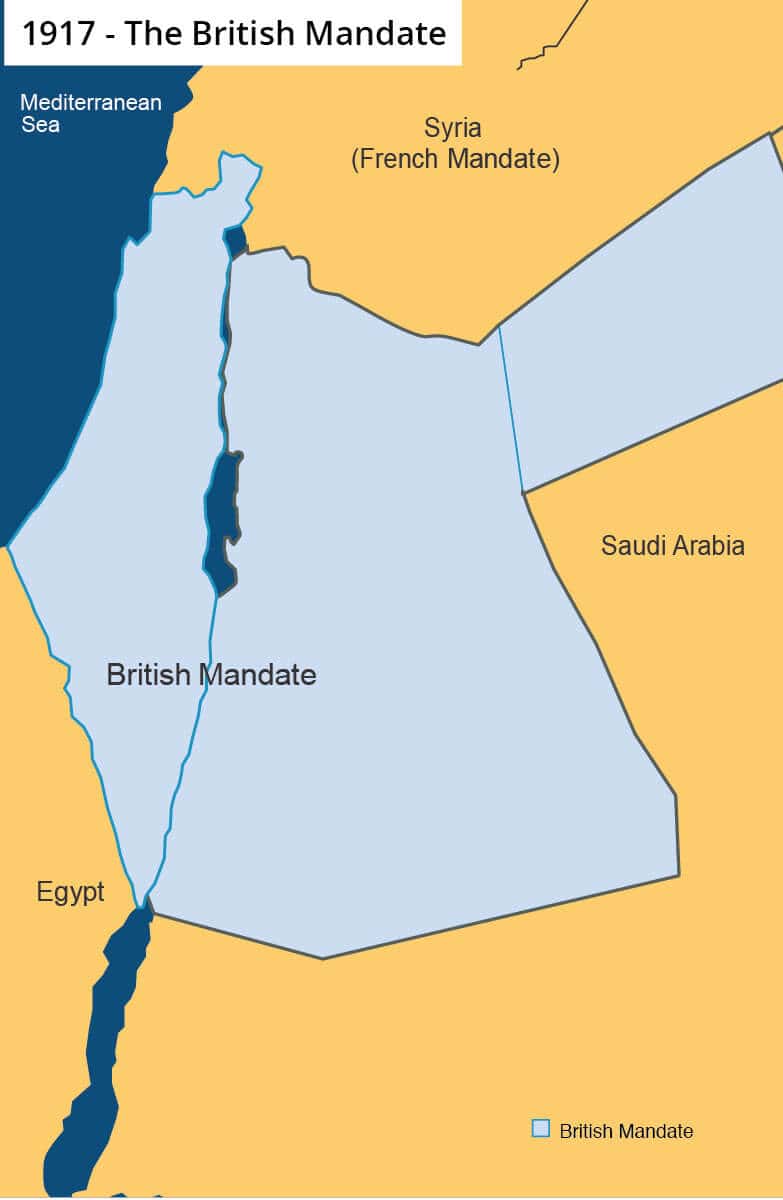
The BBC’s map and failure to explain how the British Mandate came to be split in two erases some significant history.
What the BBC labels as “Palestine” is only a fraction of the land that was originally part of Mandatory Palestine, and ignores the fact that most of the area was given to Arabs some 20 years before the United Nations voted to partition the land again into two states.
The BBC had an opportunity to educate its audience beyond the dominant narrative that only begins with the Israeli War of Independence in 1947-48. But it failed to do so.
By omitting historical context, the BBC is content to let its audience draw its own potentially faulty and confusing conclusions.
Which is exactly what the people who spread maps claiming Israel “stole” Palestinian land in 1948 are happy to see.
Here is what the BBC omitted:
- Pre-1921, the entirety of the area that covers both sides of the Jordan River was a single entity — it was only eight months after the San Remo Conference in 1920 that Britain designated the territory east of the river as the Emirate of Transjordan, under the leadership of Emir Abdullah bin Hussein.
- The name “Palestine,” which was chosen for the land west of the river, was based on the term “Palestina” that was given to the country by the Roman Empire in the second century CE.
- Beginning in 1923, Transjordan had semi-autonomy, with Britain controlling all financial, foreign and military affairs.
- It was only in 1946 that Transjordan actually gained independence from Britain and became the Hashemite Kingdom of Jordan, although its military remained under British command.
These relevant facts would have been helpful for audience, but were omitted by the BBC.


