








Hamas War Fallout: CEO Urges World to Support Israeli Brands as Local Economy Suffers

 by Shiryn Ghermezian


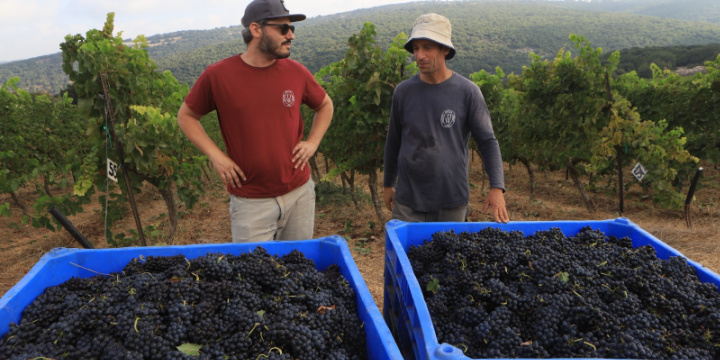
A Dalton wine maker and viticulturalist at the Dalton Winery. Photo: Provided
The British-Israeli president and CEO of Israel’s Dalton Winery is calling on the international community to support the Jewish state beyond the military and political arenas while the country continues its war against the Hamas terrorist organization and the economy suffers.
Alex Haruni and his father Mat established Dalton Winery in 1995. The winery is located in the Galilee in northern Israel, adjacent to the village of Kerem Ben Zimra. Alex spoke to The Algemeiner about being a business owner in Israel amid the current war with Hamas and how the country is “still reeling from the carnage of that fateful Shabbat” when Hamas invaded the Jewish state and massacred over 1,400 Israelis, mostly civilians, on Oct. 7.
“We are still burying and mourning for our dead. Our sons and daughters have all been conscripted to the fronts in both the south and the north. There is not a single family in Israel that has not been touched by these events,” said Haruni, who went on to explain the impact that the war has had on Israel’s usually dynamic economy.
“The country is sitting at home glued to the televisions and their phones. Thousands of families have been displaced from their homes and are living in temporary accommodation,” he explained. “If you remember the first days of the Corona epidemic, we have gone back to that state. No one is going out, businesses that want to work have no staff, restaurants are mainly closed and just helping to prepare meals for soldiers over the country, and while there is a huge communal spirit here, there is very little economic activity.”
Ahead of an expected Israeli ground offensive into Gaza, where Hamas is in control and has dozens of Israeli hostages, Haruni told The Algemeiner he believes the Jewish state has a “long and painful” road ahead as it treks on through the war.
Economically, “it is clear we will need a boost from somewhere,” he said. “I know that everyone abroad wants to help and many are contributing to very worthy causes. But, I would like to suggest a simpler way to help us in Israel, something you can do every day that will come at little or no personal cost: Just buy Israeli products whenever possible.”
Haruni urged people around the world to try to “ensure that every day when you sit down to eat, that you have an Israeli product or two on your dinner table, and if you are drinking wine then it should be an Israeli wine. That is the support we will need in the long run; that is the support we will need to keep our businesses running here and for you to continue to enjoy the brands you have loved for ages.”
Israel’s economy has already lost NIS 4.6 billion ($1.1 billion) as a result of the war, according to an analysis released on Sunday by the Manufacturers Association of Israel (MAI), an umbrella organization that has over 1,800 members who are responsible for over 90 percent of the total industrial output of Israel. The reasons for the drop include employees not coming to work, the shutdown of the country’s education system, closure of traffic routes, widespread recruitment of reservists throughout the country, and overall decreases in production during the war. The estimate does not take into account financial damages, such as direct damage to factories and the cancellation of transactions.
It is also estimated that about 1.3 million employed people did not go to work during the week of Oct. 8. In southern Israel, approximately 85 percent of employees did not attend work, and in other parts of the country the workforce was reduced by 20 percent.
“There is no doubt that the war is a severe economic blow to the economy, and we will have to be strong and united in order to overcome the crisis,” said MAI President Ron Tomer.
According to Haruni, few businesses are running “at full steam,” including his own. At Dalton Winery, some staff members have enlisted in the army, some have moved further south to try to escape the fighting, and some must remain at home to look after their children while schools remain closed or move to remote learning. Other Dalton Winery employees “come to work every day to keep busy and their minds away from the war.”
“We come to work in the morning with a skeleton staff, complete a few necessary tasks and leave, hoping that the artillery fire we hear in the distance doesn’t come any closer,” he said. “Every day we leave the winery in a situation whereby if we are unable to return for a few days then the impact will be minimal.”
Haruni’s nephews are also serving in the army, and he said his 11-year-old son prefers to sleep in a bomb shelter, rather than in his bedroom, out of fear of an attack.
Other Israeli companies have reported working with 50 percent less employees, often having staff members whose loved ones were either killed or taken hostage by Hamas. Some businesses noted that their Palestinian workers have not shown up for work since the war began while others are scared to leave home.