





DEI, Title VI, Post-Colonialism: How to Fight Back Against Hate on College Campuses
Error: Contact form not found.

 by Ben Goldblatt

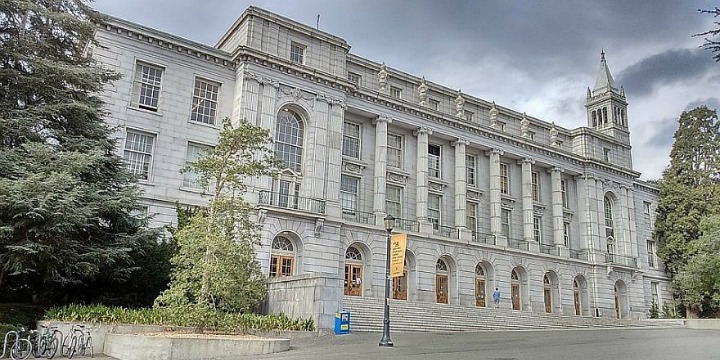
One of the campus buildings at the University of California, Berkeley. Photo: Max Pixel/Creative Commons.
“Jews are the new Nazis,” someone yelled at a student government meeting. A swastika was found on a Jewish student’s dorm room door. A sign in a plaza claimed that Jews are the masterminds behind an international illegal organ trafficking ring. Posters of Jewish events were ripped down and thrown in the garbage.
You might think these events took place recently, but they are actually my recollections from UC Berkeley when I was an undergraduate student from 2009 to 2013.
At the time, I took solace in the belief that UC Berkeley was on the anti-Jewish fringes, relative to other universities around the country. “The rest of America isn’t like this,” I told myself.
But incidents on American campuses since October 7 make it clear that this hatred has spread well beyond places like UC Berkeley. Fortunately, there are several concrete actions leaders can advocate for to combat antisemitism on campus.
First, the Federal government should aggressively investigate exclusionary practices that limit the ability of Jewish students to participate in campus life. These practices have resulted in student government leaders being pushed out of their positions for identifying as Jewish, or Jewish student clubs receiving unequal treatment relative to other groups.
Under Title VI of the Civil Rights Act, the Federal government is already granted authority to investigate these exclusionary practices, and to withhold Federal funds if institutions are found at fault. However, enforcement generally occurs on a case-by-case basis, such as through individual complaints. To tackle the problem quickly and comprehensively, the Federal government should launch a large-scale investigation of several universities who reportedly engage in this exclusionary behavior in place of the current piecemeal approach.
Second, ethnic studies courses should be reworked by school districts, university boards, and state legislatures to teach history, culture, and religion instead of the heavy emphasis on Marxist and Postcolonial ideology.
When I enrolled in Native American Studies at Berkeley, I was excited to learn about the history, culture, and religion of Native American tribes. However, the class itself was mostly dedicated to reading theorists, like Frantz Fanon, who simplifies the world into “colonizer” and “colonized,” while also literally calling for violent revolution against the so-called colonizers.
When conflict between Israel and its neighbors arises, many ethnic studies students see Jews as the white colonizers (even though Jews are not colonizers, and more than 50% of Israeli Jews would be considered BIPOC in America) versus the “colonized” people of color. This stunningly superficial interpretation is then used as rationale to engage in violent actions against Jews.
Going forward, if Post-colonialism and Marxism must be included in courses, these theorists must be balanced with their ideological rivals.
Martin Luther King, Jr., and Mahatma Gandhi, who advocated for social cohesion, peaceful coexistence, and nonviolent resistance, would be a good start.
Third, state legislatures and/or governing boards that oversee universities should mandate regular performance audits of Diversity, Equity, and Inclusion (DEI) teams on campus.
The rise in DEI presence on campus has coincided with an increase in antisemitism. One analysis found that DEI staffing at the University of Michigan more than quadrupled from about 40 in 2002 to 167 in 2021. At worst, these DEI efforts are contributing to antisemitism. At best, they are ineffective at curbing it.
Here is a video of a former DEI official being told that protecting Jewish students did not fall under her mandate because they were “white oppressors,” and her job was to “de-center whiteness.”
Requiring DEI offices to use data, such as campus climate surveys and discrimination complaint trends, to publicly report on the degree to which DEI efforts are reducing antisemitism — and all forms of bigotry for that matter — will hold DEI officials accountable to the values they profess to uphold.
Fourth, university administrators must better coordinate with local law enforcement partners to ensure the enforcement of laws to protect students from physical harm at protests. While the First Amendment includes the right of free speech and the right to peaceably assemble, some universities forget to prioritize other applicable regulations on gatherings, such as laws against physical harassment and blocking buildings/sidewalk access.
While I was a student at Berkeley, protesters from Students for Justice in Palestine blocked an entrance to campus during a protest. When one student in a wheelchair attempted to pass, protestors began to kick him until he retreated. Police officers observed in the distance and did nothing.
Ignoring illegal actions of some students during protests unnecessarily endangers other students and has the effect of chilling speech among those who are understandably afraid of physical altercation.
In addition to the ideas set forth here, combating antisemitism on campus requires leaders who are willing to first call out the problem. While it can be intimidating to call out evil due to fear of appearing biased or becoming a target of vitriol, it is in times of great turmoil where taking a stand is needed most.
To those leaders reluctant to speak out and act, consider Hillel’s famous question: “If not you, then who? If not now, when?”
Ben Goldblatt is a Certified Fraud Examiner and a government oversight expert.