



Media Ignore and Distort Account of Hostage Mia Schem
Error: Contact form not found.

 by Rinat Harash


The mother of Mia Schem holds up a picture of her daughter who was kidnapped into the Gaza Strip, following a deadly infiltration by Hamas gunmen from Gaza, in Tel Aviv, Israel, October 17, 2023. Hamas has released a video of Schem. Photo: REUTERS/Ronen Zvulun
In mid-October, when many Israeli families didn’t yet know whether their loved ones had been slaughtered or kidnapped by Hamas, media outlets rushed to cover the first Gaza hostage video distributed by the terrorist group.
That hostage was Mia Schem.
But when Schem shared her own account of her captivity in local television interviews after being freed, these media outlets ignored or inaccurately reported it.
The result was the omission and distortion of the testimony of a woman who experienced Hamas’ atrocities firsthand, and has been featured through the lens of terrorist propaganda.
Giving Platform to Hamas
Newsweek was one of the media outlets that dedicated lengthy coverage to Schem’s plight when her hostage video was released on October 16:
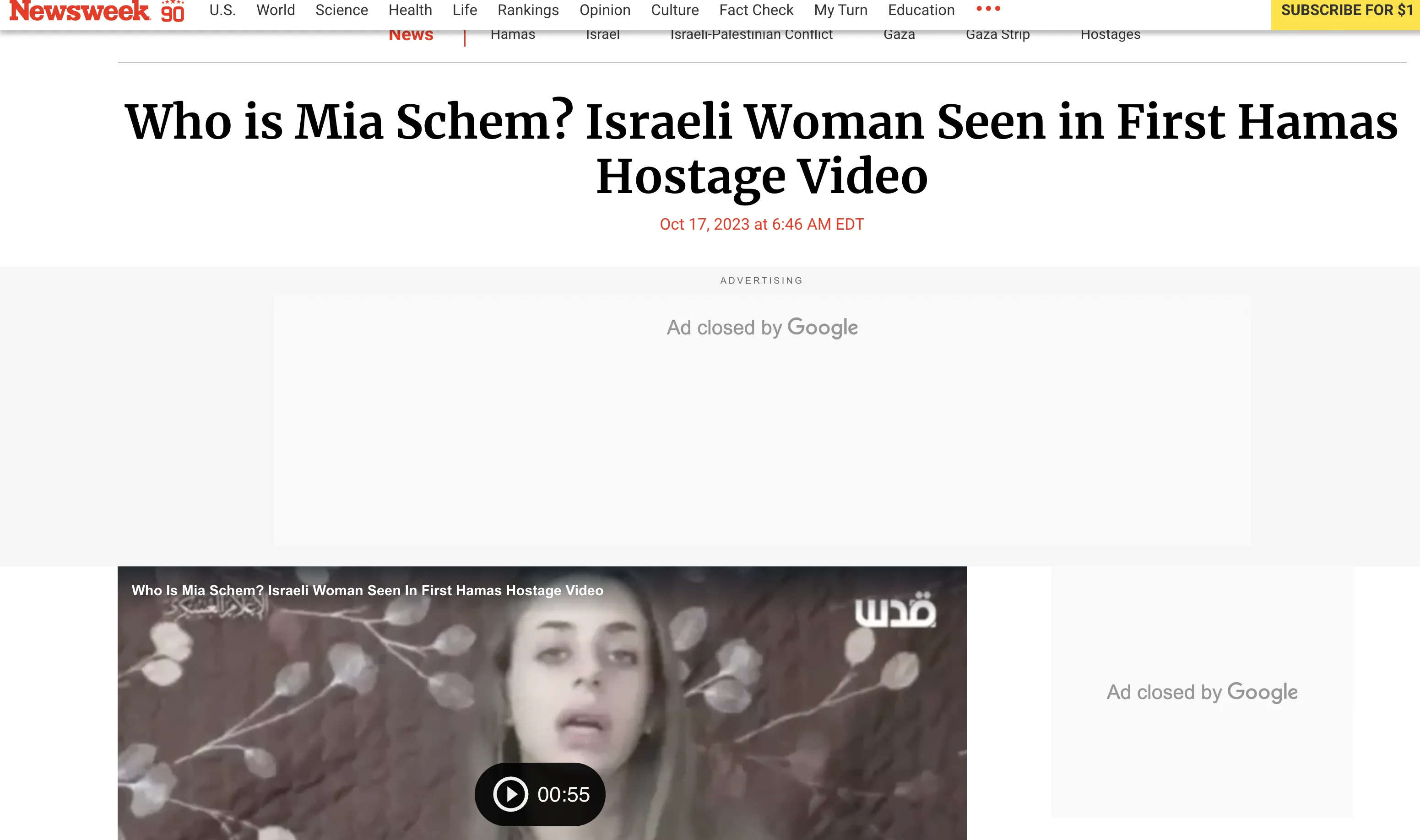
The magazine, like most media outlets, was responsible enough to describe the video rather than show it in full.
But nowhere did Newsweek say that the video may have been taken under duress.
Instead, the magazine parroted Hamas propaganda by mentioning twice in one paragraph that in the video, Schem was being treated for her injury. It also included a direct quote of her plea to return home:
In the 60-second long clip, the woman can be seen being treated for a wound above her right elbow by a person off camera, who’s wrapping her arm in bandages. In the next part of the video, Schem addresses the camera directly, speaking in Hebrew. She says that she’s in the Gaza Strip, where she has been treated for her injury, and that she wants to go home.
“I just ask that I am returned as fast as possible to my family, to my parents, and to my siblings,” she said. “Please get us out of here as quickly as possible.”
Despite mentioning the Israeli army’s criticism of the video, Newsweek failed to take an independent stand that questioned its validity, leaving its audience with what Hamas wanted them to hear.
The Guardian’s report wasn’t better.
Although it included criticism of the video by various officials and added a weak caveat suggesting it was “unclear” whether it had been taken under duress, the outlet gave a wide platform to Schem’s words about receiving medication and being “well treated”:
In the video, the first released by Hamas of a hostage allegedly speaking from captivity, Schem said she was being held in Gaza, was being well treated and appealed for her release.
But all the questions that may have initially arisen about Schem were answered last weekend, when she shared her own account of events on local Israeli media.
In her interviews aired on December 29 on Israeli channels 12 and 13, Schem emphasized that she had been forced to make the video, and that the medical “treatment” in it was a mere show.
She said she didn’t receive any painkillers for her arm injury, and that she had to change bandages by herself throughout her time in captivity.
Yet both Newsweek and The Guardian, which echoed her Hamas-controlled narrative, chose to ignore her story as a free person. Since the outlets didn’t think this merited an update to their original pieces, whoever reads those stories will still gets the false impression that Hamas treats its hostages humanely.
Other media outlets that covered Schem’s hostage video made the right decision to report on her interviews with Israeli channels.
But some outlets, while detailing her harrowing account, either distorted what she had said about her fear of being raped, or omitted it altogether.
AP reported that Schem said she was afraid that her captor “might try to harm her,” when she actually used the word “rape:”
.@AP reports that Israeli hostage Mia Schem was afraid that her captor “might try to harm her.”
Her actual words described her fear of being raped. Not “harmed.”
How, AP, is diminishing the threat of a Palestinian sexual crime acceptable reporting?https://t.co/VAcdCoHGSQ pic.twitter.com/VvQ4XbbZwV
— HonestReporting (@HonestReporting) December 31, 2023
The New York Times did not mention her saying it at all, but it should have highlighted it, especially after the publication of the newspaper’s investigative piece regarding Hamas’ sexual violence during its October 7 massacre in southern Israel.
In her interviews, Schem made several points that deserved to be mentioned — from her injury, to her starvation and constant fear in captivity.
But in light of recent criticism over the blindness to Hamas’ sexual violence, her comments about fear of rape deserved special attention — as they indeed received from Reuters.
When media outlets choose to cover a subject — like the first publication of a sign of life from a Gaza hostage — they should be committed to following up on it. Failing to do so leaves their audience with a partial story, which in Schem’s case was Hamas’ story.
When media outlets distort or omit essential details from a personal testimony, they undermine the witness’ narrative and rob their audience of the full picture.
But the worst is that media, in all these instances, betray their commitment to the truth.


