



Media Accused Israel of ‘Strike’ on Palestinians Who Died in Gaza City Aid Truck Stampede
Error: Contact form not found.

 by Rachel O'Donoghue


An UNRWA aid truck at the Rafah border crossing between Egypt and the Gaza Strip. Photo: Reuters/Amr Abdallah Dalsh
Early on February 29, crowds of Palestinians had gathered in Gaza City ahead of an expected delivery by a convoy of aid trucks.
Witnesses described scenes of pandemonium, as hordes of people trampled each other as they swarmed the vehicles when they arrived at around 4 am.
According to the IDF, which released satellite imagery of the incident, dozens of Palestinians were killed in the stampede, while others died as a result of being hit by the aid trucks in the city’s Rimal neighborhood.
Israeli military officials also said that up to 10 Palestinians died when the IDF was forced to open fire on a group that rushed toward them.
When officials in the Hamas-controlled enclave announced what had occurred, they did what they have done repeatedly since the outbreak of war on October 7 — lied to an international media that they knew would uncritically broadcast the falsehood to millions worldwide.
And that is how it came to be that last Thursday — hours after the incident — the Associated Press failed to do even the bare minimum of fact-checking and announced in a headline that an Israeli “strike on Palestinians waiting for aid in Gaza” had killed and wounded dozens.
This is just a snapshot of how media such as @AP & @France24_en trust Hamas claims and end up spreading falsehoods around the globe with real-life consequences.
Update: IDF probe says Israeli gunfire caused only some 10 casualties out of the hundreds of people allegedly hurt and… https://t.co/TDD6PYHNtq pic.twitter.com/lUzVwYIdfR
— HonestReporting (@HonestReporting) February 29, 2024
The report opened: “An apparent Israeli strike on a crowd of Palestinians waiting for humanitarian aid in Gaza City on Thursday has killed and wounded dozens, according to local hospital officials.”
While the Associated Press later updated its story, the damage was done: countless people saw a headline that accused Israel of striking innocent Palestinians simply waiting for aid trucks.
If @AP relies on unverified information from “Gaza officials,” i.e. Hamas, you get inaccurate and inflammatory headlines like this.
It was no “strike.”
According to the IDF, dozens of Gazans were injured as a result of pushing and shoving as they attempted to loot the aid… pic.twitter.com/cLbk24LC1i
— HonestReporting (@HonestReporting) February 29, 2024
Meanwhile, France 24 also ran with claims of an Israeli strike and rushed off a headline that claimed: “Dozens killed in strike on crowd waiting for aid in Gaza City.”
The effect of the AP — which has partnerships with the world’s biggest media organizations — publishing such a wildly inaccurate claim cannot be understated.
Any inaccuracy by one of the major wire agencies is liable to be repeated by numerous newspapers and news websites everywhere.
The media rushed to report Hamas’ false claim that the IDF had killed dozens in a strike against Palestinians waiting for aid. But what really happened, and who is responsible?@AP @France24_en @haaretzcom pic.twitter.com/V3Ht9OvYLd
— HonestReporting (@HonestReporting) March 2, 2024
When the incorrect stories were eventually updated to more accurately reflect what happened, including removing incendiary claims of an Israeli missile strike, some media outlets still insisted on falsely suggesting that Israeli soldiers firing at innocent people caused most casualties.
The Wall Street Journal, for example, failed to mention the stampede in a headline that simply said Israel had opened fire on Palestinians who were “surrounding” aid trucks.
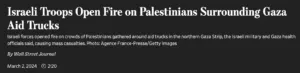
The Wall Street Journal
The Independent even tacitly defended Hamas in a headline that claimed “dozens of Palestinians” were “apparently” shot by the IDF.
It was only in the sixth paragraph of the piece that readers were told that Israeli officials explained that “many of the fatalities occurred in a chaotic crush to reach the food trucks, and that their troops fired because they believed the crowd posed a threat.”
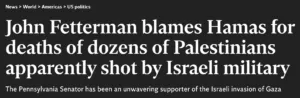
The Independent.
Even though Awadeyah’s personal social media profiles were awash with praise for terror attacks against innocent Israelis, the BBC did not think twice about relying heavily on his testimony.
The most worrying part of the whole Gaza City stampede reporting debacle is how much it echoes the infamous al-Ahli Hospital explosion incident, in which media outlets rushed to accuse Israel of a deadly missile strike that was actually the result of a misfired Islamic Jihad rocket.
Back then, we were told that such mistakes would not be repeated; media outlets insisted they would be careful in the future and not make false and incendiary claims before the facts become clear.
How hollow those assurances have proven to be.
The author is a contributor to HonestReporting, a Jerusalem-based media watchdog with a focus on antisemitism and anti-Israel bias — where a version of this article first appeared.


