






Wrong, New York Times: Israel Is No Metaphor for Apartheid
Error: Contact form not found.

 by Channa Rifkin

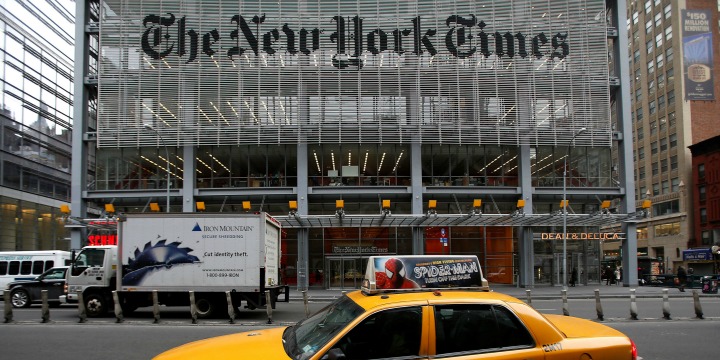
A taxi passes by in front of The New York Times head office, Feb. 7, 2013. Photo: Reuters / Carlo Allegri / File.
South African Apartheid is not a metaphor for the Israeli-Palestinian conflict. For some reason, many attempt to make a despicable conflation between the two, when they could not be more different.
In Lydia Polgreen’s New York Times op-ed “South Africa is not a Metaphor,” she delves into the rise and fall in popularity of the African National Congress (ANC) party among average South Africans since its revolution in apartheid South Africa.
Buried among the personal anecdotes of ex-ANC supporters, are six paragraphs dedicated to arrogantly drawing a false comparison to the Israeli-Palestinian conflict and current Israel-Hamas war. In doing so, Polgreen leaves out necessary context.
It may be subtle but @lpolgreen‘s @nytimes op-ed includes a despicable attempt to conflate South African apartheid with the Israeli-Palestinian conflict.
Here’s some of the context that she missed out. 🧵https://t.co/f5N6ldru3z
— HonestReporting (@HonestReporting) June 2, 2024
Polgreen brings in the International Court of Justice (IJC)’s contentiously misinterpreted January ruling regarding IDF operations in the Gaza Strip, and the “plausibility” of “genocide” against Palestinian civilians.
The court agreed in a decision in January that South Africa’s case was at least plausible,” she says, “and demanded that Israel take greater care to protect civilians and provide aid.
As confirmed by former ICJ president Joan Donoghue, the court did *not* decide that Israel’s war against Hamas could plausibly be considered genocide. @lpolgreen has dangerously misinterpreted the ruling.
Read more here: https://t.co/IW83nfvsOY pic.twitter.com/6CVqFUv1jz
— HonestReporting (@HonestReporting) June 2, 2024
We have seen this time and time again from different reporters, and the ICJ ruling on the IDF’s operation in Gaza does not cease to be reported by the media in a manner that is not only irresponsible, but dangerous.
Words create a ripple effect in real world behavior. Journalists are looked to as vehicles to uncovering truth, and are supposed to be reliable sources of information.
But this op-ed was published long after clarifications were made, including by former ICJ president Joan Donoghue, among others. These corrections and clarifications were blatantly ignored in what appears to be an effort to continue fitting someone’s personal narrative. It’s unfortunate — for Polgreen, The New York Times, and for Jews around the world who inevitably bear the heat of this dangerous reporting.
Polgreen also attempts to mask the Palestine Liberation Organization (PLO), a United States-recognized terror group, as a “left-wing ally,” by explaining its support for the ANC during the fall of apartheid. She then goes on to describe “separation” and “oppression” of Palestinians by Israel, falsely portraying the conflict as a racial one.
However, Israeli military actions are primarily based on security considerations to prevent terrorism, and have no place being compared to racial oppression, segregation, or class systems.
The op-ed then discusses the Boycott, Divestment, and Sanctions (BDS) movement — and the result of that boycott movement as a bright-shared future for “Israel and Palestine.”
But despite the article’s claims, the words “peaceful” do not exactly describe what comes out of BDS efforts or a one-state solution. Both mean the destruction of the Jewish state of Israel. This oversimplification of a nuanced and complicated conflict cannot be compared with South Africa’s revolution against apartheid.
Nevertheless, the most naïve portion of the Israel-South African comparison is the creation of a fantasy, originally by author Mahmood Mamdani. His book, Neither Settler Nor Native, is cited to explain how the Israeli-Palestinian conflict can be solved the same way that South African apartheid was: by wrongly forcing Israelis to admit their role as white colonialist settlers, and painting Palestinians as oppressed and the only natives of the land. Then, he says, the plan is to abolish these labels and roles in order to enact a path for forgiveness and create a new, shared future.
This would not only broaden the conflict between Israelis and Palestinian on the ground, but suggesting this resolution can be applied to resolve the Israeli-Palestinian conflict erases Jewish history and Jews’ presence in the land of Israel for 3,500 years. Polgreen perpetuates a popular libel that Jewish people are white colonialists who illegally established a state.
Polgreen did manage to get one part right — that there are “real limits to comparing South Africa’s transition” and “the possibilities for transformation in Israel and Palestine.” She adds, “they are different places with different histories….”
Yes, they are. So why do it?
Channa Rifkin started her career in broadcast journalism, as producer and correspondent at ILTV and i24NEWS, focusing on Israel, the Middle East, and Jewish world. She studied Communications and Political Science at Bar-Ilan University, and attained a master’s degree in Diplomacy and Conflict Studies at Reichman University in Israel. She is a contributor to HonestReporting, a Jerusalem-based media watchdog with a focus on antisemitism and anti-Israel bias — where a version of this article first appeared.


