






What if the Second Temple Hadn’t Been Destroyed?
Error: Contact form not found.

 by Jacob Sivak

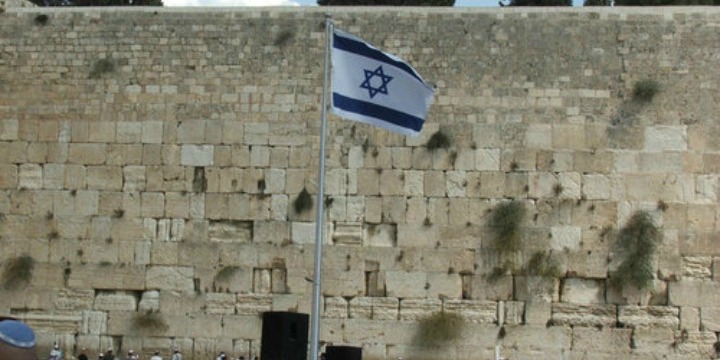
The Israeli flag at the Western Wall in Jerusalem. Photo: Hynek Moravec via Wikimedia Commons.
Tisha B’Av — the ninth day of the Jewish month of Av — is referred to as the saddest day on the Jewish calendar. It marks the destruction of both the First and Second Temples, the first in 586 BCE and the latter in 70 CE.
This Tisha B’Av — 10 months after the October 7 atrocity and the resulting war — finds many Jews worried about our Jewish future. This is true both with respect to the survival of Israel, a country beset by determined enemies, as well as in the context of Jewish life in the Diaspora, with the outburst of antisemitism that has occurred in Europe and North America.
The online Chabad description of Tisha B’Av makes a curious point about the destruction of the Second Temple by the Romans. According to the contemporary Jewish-Roman historian Josephus, the Romans would have preferred to leave the Temple standing to reflect on the glory of Rome. Apparently, its destruction was an accident — a rogue act by a Roman soldier, who threw a firebrand into the Temple. Titus, the Roman commander, tried to put out the fire, but was unsuccessful.
The question of how the Jewish world would have evolved if the Temple had not been destroyed has intrigued René Bloch, Professor of Jewish Studies at the University of Bern.
To my mind, the destruction of the Temple meant the end of Temple Judaism and the ascendancy of rabbinic Judaism, the rabbis being the successors of the Pharisees. Bloch points to a more nuanced history between the Temple and synagogue ritual and services.
For one thing, the Temple was not a central fixture for Jews in the Diaspora, which existed even then. Moreover, synagogues were an established feature in much of the Jewish world, even in Jerusalem. He adds that Temple practices were changing in any case. For example, animal sacrifices would likely have ended if the temple had continued to exist. Bloch quotes the prophet Isaiah saying, “I do not delight in the blood of bulls, or of lambs, or of goats … learn to do good; seek justice, rescue the oppressed, defend the orphan, plead for the widow.”
Moreover, scriptural interpretations and commentary, and the idea of using scripture in religious services, were common before the destruction of the Temple. However, much of the Mishna, written after the destruction, deals with details of Temple service as a means of keeping the memory of the Temple alive.
Without the destruction of the Temple, there would be no Mishna or Gemara and no Talmud, at least not in the form that we are familiar with today. Bloch writes, “If rabbinic Judaism had not emerged or had manifested itself in a much less consequential form, Judaism’s long-term development would have been profoundly affected.”
Bloch also points out that if the Temple was not destroyed, Christianity today would be very different as well, because the destruction of the Temple is central to the Christian concept of supersession, wherein Christianity is seen as the successor to Judaism. To early Christians, the Temple’s destruction confirmed God’s displeasure with the Jewish people for their rejection of Jesus Christ. Without its destruction, the theological underpinnings of Christianity and Judaism might have been more difficult to separate.
The Jewish defeat by the Romans took place irrespective of whether or not the Temple survived. Josephus’ writings point a finger at Jewish disunity and infighting. We do not know if a unified Jewish front would have made a difference. We do know that by the time of the The Bar-Kochba Revolt just 65 years later (132-136 CE), the Jews had learned their lesson. Nevertheless, even though the Jews fought as a united force, this war also resulted in defeat. The only difference was that the Roman victory cost them more.
There are those who worry that history will repeat itself, and that disunity and internal disputes will jeopardize Jewish survival. Perhaps. However, at this point, the important lesson from Jewish history is that a small Jewish State needs the backing of a great power.
Jacob Sivak, a Fellow of the Royal Society of Canada, is a retired professor, University of Waterloo.


