









The Shema Incorporates the Core Values and Identity of Judaism
Error: Contact form not found.

 by Jeremy Rosen

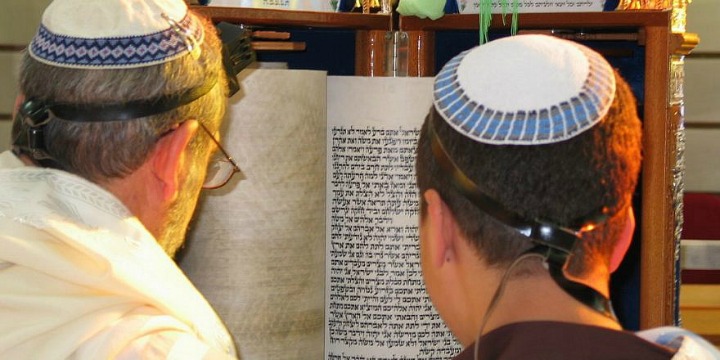
Reading from a Torah scroll in accordance with Sephardi tradition. Photo: Sagie Maoz via Wikimedia Commons.
Apart from the opening statements of the so-called Ten Commandments, there is very little that we would call theology in the Torah. Even descriptions of God are indirect, and there isn’t anything obvious about how to relate to God, other than pure obedience and loyalty.
The first paragraph of the Shema, which we read this week, is a unique and multi-faceted response.
Hear, Israel, HaShem is our God, HaShem is one.
You shall love your God with all your heart and with all your soul and with all your might.
These things that I command you this day should always be close to your hearts.
And you should teach them to your children and talk about them when you are at home and when you are traveling, when you lie down and when you get up.
And bind them as a sign on your hand and a symbol on your forehead.
This is often called an expression, or declaration, of faith. It is our commitment to the God of Israel.
The Shema is recited at least twice a day, morning and night. It was the defiant declaration of Jews martyred by the Romans, like Rabbi Akiva; those burnt at the stake by the Inquisition; and of Jews entering the Nazi jaws of hell. It is also the last declaration made on one’s death bed. It is probably the most significant and well-known part of Jewish liturgy, and the very core of our culture — even for those not particularly religious.
But it is not like a credo that you have to believe to be a Christian, or the Muslim Shahada, which both include other beliefs such as in human beings. Moses is not mentioned.
But it starts with the words “Hear [or understand] Israel.” The invitation to pay attention, to recognize the importance and significance of something is paramount, and “Israel” addresses the people — us. So far, no mention of God but of peoplehood, identity, belonging. And it is inclusive of everyone.
And then we come to God. Yet the words here still do not tell us much about God. It is often said that the Hebrew God is angry and vengeful. But such dishonest polemic ignores that a loving God, Ahavah, is mentioned more often than any other emotion. Although it is often paired with Yira, respect or even awe, here the word love stands out alone and emphasizes the emotional and mystical aspect of Jewish life, before turning to the practical.
It is the practical that truly differentiates Judaism from other religions. Yes, we do have important, fundamental concepts and ideas — but such ideas are very subjective and can be understood by different people with different minds and attitudes. Practice on the other hand is the same for everyone. And whereas in many religions there is a difference between priestly classes and regulations, in Judaism outside of Temple affairs, everyone was expected to adhere to the tradition. We are a nation of priests in that sense.
Perhaps the most important and universal element in the Shema, although mentioned recurring times elsewhere, is the obligation to teach our children. And we are instructed to do this by example, repetition, and showing them what matters in daily life. For this is what has ensured our continuity.
The statements about writing these ideas on the door posts of our homes and binding them to our arm and head have been understood symbolically or metaphorically by different groups such as Samaritans, Ka’arites, and Reform Judaism. The rabbinic oral interpretation was to take them literally. Hence the Mezuzot and Tefillin that play a significant part in Jewish identity.
This very important small paragraph, in its poetic form, incorporates the fundamentals and core ideas of Judaism.
The author is a writer and rabbi, currently based in New York.