









Rabbi Menachem Froman’s Unique Perspective and Enduring Commentary on the Israeli-Palestinian Crisis
Error: Contact form not found.

 by Kylie Ora Lobell

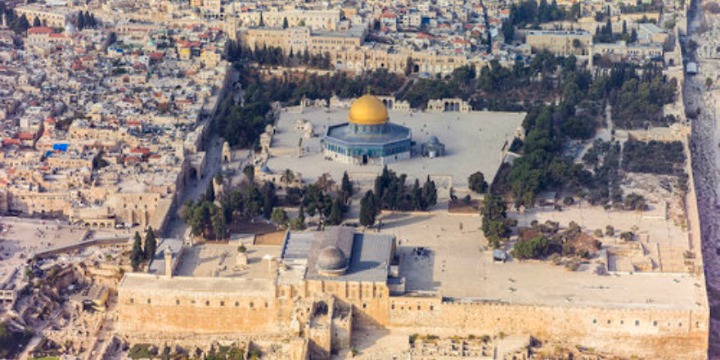
An aerial view of the Temple Mount in the Old City of Jerusalem. Photo: Wikimedia Commons.
Rabbi Menachem Froman (1945-2013) was an Israeli Orthodox rabbi, social critic, and teacher of Jewish mysticism, who served as the chief rabbi of Tekoa in the West Bank.
A former paratrooper in the IDF, and a veteran of the Six-Day War, he became a founding member of Gush Emunim, the movement that spearheaded the settlement of territories that Israel inherited in that conflict. And yet, throughout his public life, he was a prominent and often provocative advocate for peace, who maintained close contact and met with Palestinian civil and religious leaders whose politics were radically different from his own.
In some ways, Froman placed faith over politics, seeking similarities between Jews and Muslims, and emphasizing their mutual belief in one God. He also acknowledged that the Arabs also have ties to the Land of Israel, and accepted the reality that they live in it — and then asked: now what? They were not going anywhere, and neither were the Jews. Instead, they would have to find a way to understand and accommodate each other, and eventually, find a path to peace through their beliefs.
Though Froman was controversial to some, others praised his approach.
Davidi Perl, former head of the Gush Etzion Regional Council, said that Froman was “a huge scholar, with a great soul, who loved people and brought them closer to the Torah.”
A newly published book from Rabbi Froman called Chasidim Just Laugh (Deuteronomy Press), shows that his views on politics and the Israeli-Arab conflict emerged from a much deeper and broader system of thought.
The book contains Froman’s ideas on marriage and relationships, Israeli society, faith, doubt, joy, religion, and ritual.
Translated from the Hebrew original — and featuring a new foreword by Yossi Klein Halevi — the book presents Froman in his own words; through a series of deep reflections, thought-provoking aphorisms, and inspired teachings; along with accompanying commentary and stories about the rabbi. Extensive footnotes also allow the reader to trace the influences he cites on his thought, from classical rabbinic texts, to the Chasidic masters of Breslov and Izhbitz, to French existentialism.
As Chasidim Just Laugh makes clear, in the 11 years since his untimely death, Rabbi Froman’s ideas have become no less original, thoughtful, confrontational, radical, and especially vital in the post-October 7 world.
In the forward to the book, Klein Halevi writes, “I believe [Rabbi Froman] would have been furious at the near-total moral failure of the Muslim world to unequivocally condemn Hamas’ atrocities [on Oct. 7]. And he would have said so from every platform available to him. At the same time, he would no doubt affirm the ongoing urgency of finding Palestinian partners, since neither side is going to disappear from the land. And he would intensify his search for allies in the Muslim world, convinced that we had no choice but to find our place in the region. I imagine he would be earning frequent flier points from trips to Saudi Arabia.”
The following are some of Rabbi Froman’s profound, and at times surprising, thoughts on Israel, Judaism, living with Arab neighbors while sticking to Jewish values — and never giving up the hope for peace.
To Leap and to Dance
When I lived in the Old City of Jerusalem, there was a picture sold in all the shops that was meant to symbolize the Arabs’ national struggle: a schlepper hauling the Al-Aqsa Mosque on his back. When I saw this, I immediately understood why the Jewish people don’t unanimously support the settlement project. We took something so sweet—the mitzvah of settling of the Land of Israel — and turned it into a heavy burden. If that’s how it is, better to schlep just half the Land. Rebbe Nachman offers an alternative to schlepping—to leap, to dance! And for that, you need the spirit.
Settling in the Land to Achieve Peace
People can’t grasp the idea that a call to freedom can be a religious matter. Although our Sages teach that “No one is truly free save for the one who engages in Torah,” [M Avot 6:11] most religious Jews were taught to give up their freedom for the sake of religion.
We see this in many realms. For example, in the political sphere: Most settlers think that the settlements interfere with peace, but they prefer the settlements to peace. They are incapable of believing that the settlements can be for the sake of peace.
Likewise, between man and woman—people think that being free means being single, that getting married means giving up on your freedom for the sake of a wife, marriage, children, a home, etc.
But for me, freedom is the essence of being religious, and my wife is my freedom. It’s like the song: “With you I know, that only with you am I free.”[i]
And with this, he began to sing and cry.
The settlements are the fingers of the hand extended in peace, and are safeguarding the peace.
Here he showed, with his hand, that when people shake hands, each person’s fingers are placed in the palm of the other.
So too the settlements are placed in the heart of the Palestinian community.
There’s No Peace Without Justice
Of all the Biblical judges, Samson the Mighty doesn’t seem like much of a judge. But it is this figure specifically that so fascinated Ze’ev Jabotinsky. This is because Samson expresses the essence of Jabotinsky’s political philosophy. In the novel that Jabotinsky wrote about Samson, he describes how two people came before him seeking justice. Samson tells them, “You have complaints? Scream, fight, get everything off your chest!” Afterwards, they left him, reconciled and whole.
It is precisely when we strive for the penetrating truth that peace becomes possible. I used to always tell Palestinians that there’s no “Salaam” [peace] without “Alaam,” justice. Otherwise, your “Salaam” is just a hello, just a greeting. If we don’t address questions of justice, the most piercing disagreements — we’ll never reach peace. The Palestinian governor of Bethlehem really loves this saying.
I can’t recommend this book highly enough, and I think you’ll find it as relevant now as it ever will be.
Kylie Ora Lobell is a writer and president of KOL Digital Marketing, where she does ghostwriting, marketing, and publicity for clients like authors, brands, and influencers. She has been published in The Washington Post, New York Magazine, Los Angeles Times, The Jewish Journal, and Aish.


