

Biased Science: The Lancet Claims Gaza Casualty Count Underreported
Error: Contact form not found.

 by Rinat Harash


Pro-Hamas demonstrators, many of whom are college students, in New York City on May 11, 2024. Photo: John Lamparski via Reuters Connect
The Lancet has a history of publishing agenda-driven and politicized anti-Israel content that goes way beyond the field of healthcare and medicine.
In July 2024, the medical journal was called out for outrageously claiming that as many as 186,000 Gazans had been killed in the current war. Many media outlets rushed to print dramatic headlines under the imprimatur of The Lancet — a significant error given that the casualty claims came not from a peer-reviewed study but from a letter sent to The Lancet, whose writers included at least one with a history of defending Palestinian terrorism.
Now, The Lancet has published a study claiming that the Gaza death toll may have been underreported by 41%.
While this time claims concerning Gaza casualty figures appear in The Lancet in the form of an actual scientific study, the recent report still has numerous similarities with the previous claims, namely a reliance on faulty Hamas sources and a disturbing lack of impartiality on the part of its authors, including one who justified Hamas’ October 7 massacre.
Faulty Science
Even without delving deeply into the numbers, The Lancet’s study is based on a false premise: the accuracy of Palestinian Ministry of Health casualty figures. Openly stating that its methodology is based on this source is effectively admitting that Hamas provides the numbers:
We used a three-list capture–recapture analysis using data from Palestinian Ministry of Health (MoH) hospital lists, an MoH online survey, and social media obituaries.
Furthermore, experts found faults in the study’s number-crunching as well as it other sources, and published their conclusions online:
Again @TheLancet medical journal published pseudo-scientific Palestinian propaganda, dressed up with graphs, meaningless algorithms & fake data from Hamas/Palestinian sources, UN agencies that parrot Hamas etal, and “Euro-Med Human Rights Monitor” – a notorius Hamas-run NGO… pic.twitter.com/SdfDpRuvND
— Prof Gerald M Steinberg (@GeraldNGOM) January 10, 2025
Who’s Behind the Study?
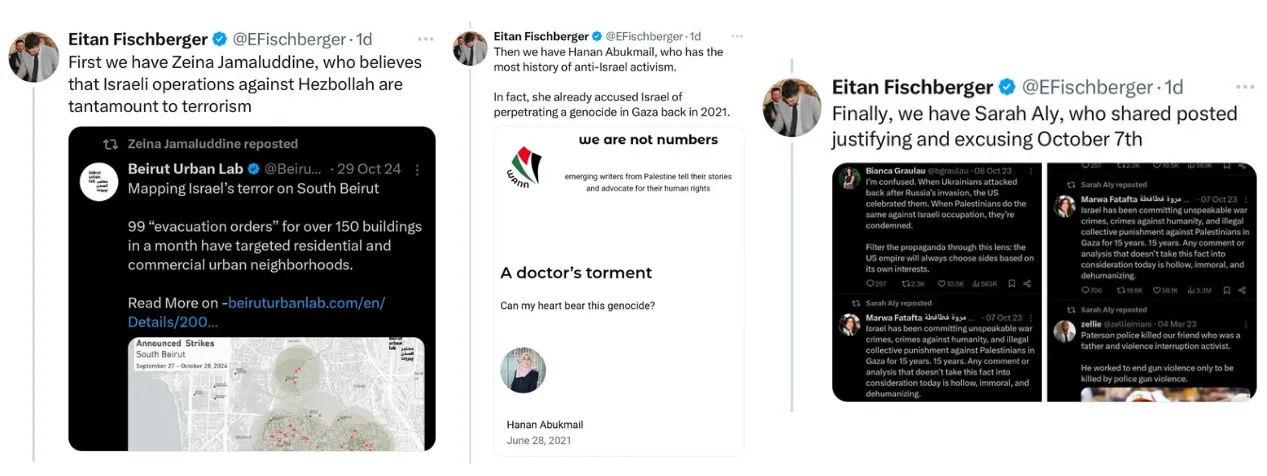
Most disturbingly, the study’s authors were exposed by media analyst Eitan Fischberger. One of them posted about Israel’s “terror” in Lebanon, another accused Israel of committing a genocide, and yet another justified Hamas’ October 7 attack on Israel:
Many media outlets are buzzing about a new @TheLancet study claiming Gaza deaths are undercounted by 41%.
I’ll leave the number-crunching to others, but it’s worth noting that most of the study’s authors are radically anti-Israel—which is already cause to doubt their analysis 🧵 pic.twitter.com/F45XcZvYIh
— Eitan Fischberger (@EFischberger) January 10, 2025
The Media Coverage
Throughout the conflict, the media have unquestioningly republished Gazan casualty figures whose ultimate source is Hamas. They’ve quoted Hamas’ numbers uncritically, while adding caveats whenever Israel has offered its own estimates, particularly concerning the number of dead terrorists.
So it’s hardly surprising that numerous outlets saw fit to cover The Lancet’s study.
Disappointingly, given its previous in-depth coverage of the Henry Jackson Society’s study on inflated Gaza casualty figures, The Telegraph’s report on The Lancet study failed even to mention that the Palestinian Ministry of Health’s data was courtesy of the Hamas-run ministry in Gaza.
The BBC and The Guardian, meanwhile, took the opportunity to blame Israel for not letting foreign journalists into Gaza as the reason why casualty figures could not be independently verified by the media.
These outlets and Reuters did at least include some Israeli reaction (albeit relatively generic), as well as the fact that the study’s figures don’t differentiate between combatants and civilians.
Outlets like CNN and Politico, however, simply parroted the study without any caveat.
For example, here’s Politico’s headline as opposed to the more careful phrasing of Reuters:
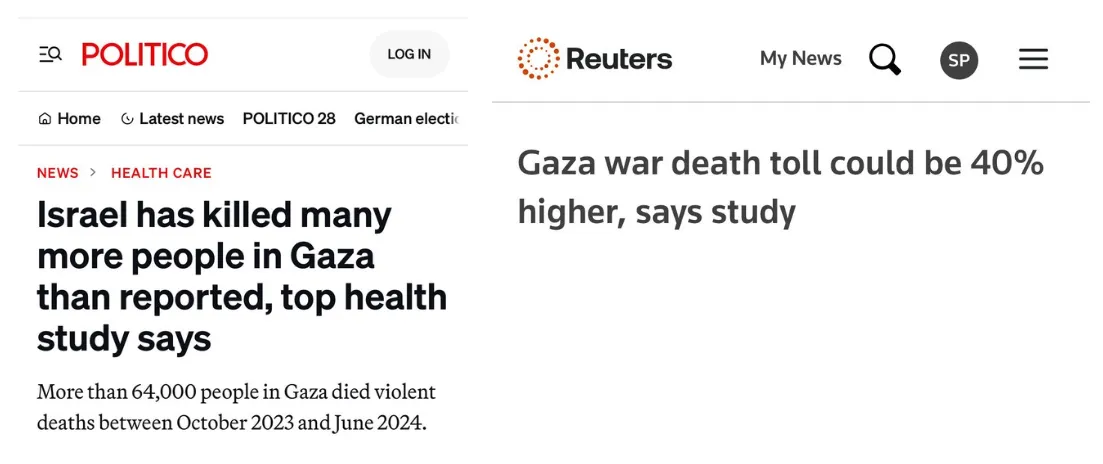
But the fact remains that all these outlets should have been more critical of The Lancet’s study, which was thoroughly debunked on social media. Because, unlike those who did the debunking, journalists still have no issue with relying on sources like the Hamas-run Ministry of Health in their everyday reporting, and nor did they do any due diligence on the study’s authors.
Thanks to The Lancet’s professional (albeit undeserved) reputation and the media’s penchant for reporting a source that it treats as beyond criticism, this latest anti-Israel claim has the potential to become part of a narrative that has already accepted disputed casualty figures as fact.
The author is a contributor to HonestReporting, a Jerusalem-based media watchdog with a focus on antisemitism and anti-Israel bias — where a version of this article first appeared.