









Do the Jewish People Know That Our People Never Actually Left the Land of Israel?
Error: Contact form not found.

 by Jacob Sivak

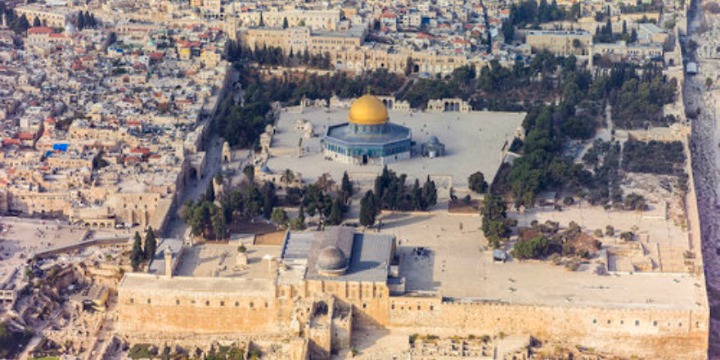
An aerial view of the Temple Mount in the Old City of Jerusalem. Photo: Wikimedia Commons.
Yossi Klein Halevi, senior fellow at the Shalom Hartman Institute, describes how anti-Zionists in academia have systematically challenged the moral basis of the Jewish/Zionist story. He exhorts us, the Jews of the world, to mount a credible defense of our story.
But do we Jews know our own story?
Edward Robinson, a prominent American archeologist of the 1800s, did not think so. Robinson was the first to identify the archeological ruins of Bar’am, a site in northern Galilee near the Lebanese border, as synagogues. The primary structure, built in the third century CE, was still in use in the 13th century.
While Robinson knew the truth 170 years ago, the common understanding, in both the Jewish and non-Jewish worlds, even today, is that the Jews, driven from their home by the Roman capture of Jerusalem in 70 CE, were scattered to all points of the globe, only to truly return to their ancestral home after 2,000 years of wandering.
In that case, who wrote the Jerusalem Talmud? In fact, the writers (including several sages mentioned in the Passover Haggadah) were living in the Holy Land after the destruction of the Temple.
And what about the four additional Jewish revolts that took place after the destruction of the Temple, the last one against Emperor Heraclius in the seventh century CE? How can you have Jewish revolts without Jews?
Moreover, an autonomous Jewish Patriarchate existed until the year 425 CE, more than a century after Christianity became the official religion of the Roman Empire. Rabbi Lee I. Levine, an American-Israeli archeologist and historian, notes that the Jewish Patriarch enjoyed extensive prestige and recognition, equivalent to that of a king.
The ruins of 100 synagogues built after 70 CE are witnesses to continuing Jewish life in the Holy Land. While a majority are in Galilee, they exist throughout the land. Several were imposing structures with elaborate mosaic floors. Huqoq, a recently excavated synagogue site with magnificent mosaics, dates to the fifth century CE. The mosaics survived because a 14th century synagogue was built over the ruins of the earlier one.
In later centuries, the Jewish population increased and decreased as a function of immigration, natural disasters, pogroms, and disease. While many Jews drifted from one exile to another, others stayed on, joined from time to time by returning exiles. In fact, the Jewish people never left the Middle East, and this brings up another part of the Jewish story often ignored — the story of the Mizrahi and Sephardi Jews.
Seventy-seven years ago, North Africa and the Middle East, outside the British Mandate of Palestine, contained almost a million Jews. With the establishment of Israel, however, they were subject to violent persecution and expulsion. Most ended up in Israel, where today they and their descendants make up more than one-half of the 7.7 million Jews in the country.
Then there is the history of the Jews of Iran, who experienced forced conversion and violent pogroms throughout the 19th century and into the 20th. The 1903 Kishinev Pogrom in Russia received worldwide attention. Who knows about the 1910 pogrom in Shiraz, Iran (then Persia), during which 12 Jews were killed, 50 injured, and the entire community of 6,000 robbed and made homeless?
One more aspect of the Jewish story gets little attention — unlike other nationalisms, modern Zionism was, and still is, a rescue mission. Every Zionist leader from Herzl onward was aware that millions of European Jews were in imminent physical danger. The fact that modern Zionism arose in the 1880s, with the onset of violent pogroms in Russia, is not a coincidence.
The Jewish story is one of an oppressed people that never stopped inhabiting its ancestral homeland.
Jews in Israel are not colonizers. They are indigenous to the Land of Israel, and to the Middle East. Israel is not a European colonial entity. It is a diverse society and less than 50% of Israeli Jews are European in origin.
Finally, the development of modern Zionism was not an “option.” It was a necessity, a survivalist imperative, progressively compulsory due to increasingly incendiary antisemitism. In some ways, things haven’t really changed since then.
Jacob Sivak, a Fellow of the Royal Society of Canada, is a retired professor, University of Waterloo.


