


BBC Blasted for Gaza Documentary Hiding Palestinian Interviewees’ Antisemitism, Hamas Ties
Error: Contact form not found.

 by David Michael Swindle

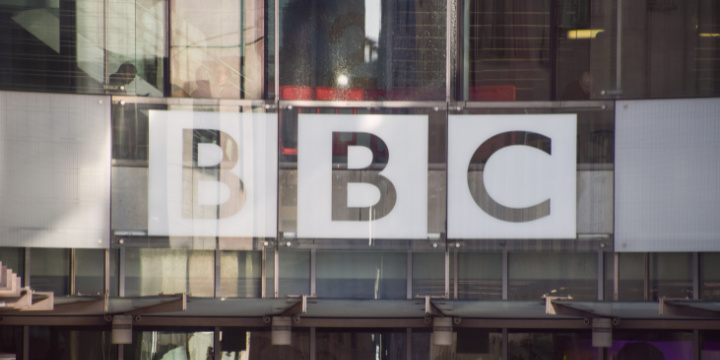
The BBC logo is seen at the entrance at Broadcasting House, the BBC headquarters in central London. Photo by Vuk Valcic / SOPA Images/Sipa USA via Reuters Connect
The BBC chose to remove the documentary “Gaza: How to Survive a Warzone” from its iPlayer streaming platform on Friday pending an internal investigation following a raft of criticisms regarding multiple links to Hamas and inaccurate translations obscuring participants’ antisemitism.
On Feb. 17, the broadcaster debuted the film, which features a 13-year-old narrator (now 14) named Abdullah Al-Yazouri, who viewers identified as the son of Dr. Ayman Al-Yazouri, a man who works as Hamas’s deputy minister of agriculture. Pro-Israel researcher David Collier said that the boy and his father come from the same family as Hamas founder Ibrahim Al-Yazouri.
“The child of Hamas royalty was given an hour on a BBC channel to walk around looking for sympathy and demonizing Israel,” Collier said. “They followed this family for months. There is no way on earth they did not know who this family was. How can the BBC possibly justify trusting anything else in the entire documentary?”
In addition, Hatem Rawagh, a cameraman who worked on the documentary, has praised Hamas and the terrorist group’s Oct. 7, 2023, attacks on southern Israel.
Uncovered by the Arabic division of the Committee for Accuracy in Middle East Reporting (CAMERA), Rawagh wrote online on Oct. 7 in reference to the Yom Kippur war that “whoever missed Oct 6 [1973] in Egypt … Oct 7 is happening [now] in Palestine.” The next day he shared a video from Hamas’s Al-Qassam Brigades which showed a view from a head camera attached to one of the terrorists who shot a rifle and killed an Israeli near the Gaza border. Rawagh wrote, “You are going to come back to this video a million times.”
Amjad Al Fayoumi, another cameraman who worked on the documentary, has likewise advocated for Hamas, posting a salute to the Oct. 7 attacks and sharing “resistance” videos which featured terrorists, rockets, and Israeli funerals.
The cost of the documentary has also come under criticism. “The BBC needs to account for every penny spent on this documentary — £400,000 is a lot of licence-fee payers money,” said Danny Cohen, former director of BBC television. “They should be transparently told where their money went and whether any of it reached the hands of Hamas.”
The documentary has further received backlash for its mistranslations of “Jew” and omissions of “jihad.” The Telegraph reported that on at least five occasions the Arabic word for “Jew”— “Yahud” or “Yahudy” — received the translation “Israel” or “Israeli forces” or was removed altogether.
At four minutes into the film, a woman says, “The Jews invaded our [area],” but the subtitles say, “The Israeli army invaded our area.”
Later in the documentary, the subtitles describe a woman as saying “we’re used to seeing flashes of lightning in the sky. But now it’s real missiles. We’re happy that for once the rockets aren’t falling on us.” However, according to CAMERA, she really said that “at first, when we would see these [flashes], they would be flares, by the way. From the Jews. But now they turned out to be [real] missiles.”
In an interview with another woman, the documentary claims she described the Oct. 7 terror attacks as the “first time we invaded Israel — it was always the other way round.” CAMERA noted that the correct translation of her statement is “we were invading the Jews for the first time.”
Near the film’s conclusion, a woman discusses the death of Hamas leader Yahya Sinwar, that “his face was covered and his weapon was ready, prepared for battle.” The correct translation of her statement is reportedly “ready for jihad.” She later says, according to the subtitles, that “the video shows that he was fighting and resisting Israeli forces. He wasn’t hiding.” CAMERA said that the accurate translation of her words is “he was engaging in resistance and jihad against the Jews. Not underground.”
Alex Hearn, the co-director of Labour Against Anti-Semitism, said that “it is this whitewashing that keeps viewers ill-informed about the nature of Hamas, and promotes sympathy for their deadly ideology. This documentary signifies the institutional failure behind the BBC”s reporting of the Israel-Hamas conflict.”
Orly Goldschmidt of the Israeli embassy in the UK said that the mistranslations do not allow “viewers to see how children, and Palestinians at large, have been taught to hate ‘Jews’ from a very young age.”
A spokesperson for the BBC said in a statement that “Gaza: How to Survive a Warzone” features “important stories we think should be told — those of the experiences of children in Gaza. There have been continuing questions raised about the program and in the light of these, we are conducting further due diligence with the production company. The program will not be available on iPlayer while this is taking place.”
Investigators are supposed to deliver a report about the documentary to the BBC on Thursday, the results of which will be made public that day or on Friday.