





What’s Been Happening in Gaza This Month — and What’s Next for Israel
Error: Contact form not found.

 by Eado Hecht


Palestinians protest to demand an end to war, chanting anti-Hamas slogans, in Beit Lahiya in the northern Gaza Strip, March 26, 2025. Photo: REUTERS/Stringer
While the fighting in Gaza has been renewed, diplomatic efforts to end the war have not abated. The Egyptians and the Emiratis in particular are trying to work out options for ending the war. The Emirati direction is closer to that taken by President Trump and Israel (the removal of Hamas from Gaza plus the evacuation of a portion of the Gaza population, at least temporarily), while the Egyptians are attempting to find a solution that is closer (though not identical) to the demands of Hamas (a non-Hamas government, but with Hamas remaining present in the Strip). The first Egyptian proposal was apparently dismissed out of hand by the US.
The official Hamas red line is its disarmament. Whether it directly governs Gaza or controls it from behind a front of supposedly independent technocrats seems, at present, to be less important to the group.
Hamas and Palestinian Islamic Jihad fired 20-25 rockets at southern Tel Aviv, Ashkelon and Beersheva from locations across the Gaza Strip (the exact number of rockets is not clear because there were some false alarms). At least one rocket fell inside the Strip. One salvo of 10 rockets aimed at Ashkelon injured nine people. Put together, the salvos wounded about 30 people, almost all through falls they suffered while rushing to shelter.
The rockets were fired from different areas. In one case, the launchers were placed right next to a humanitarian safe zone in Beyt Lahia.
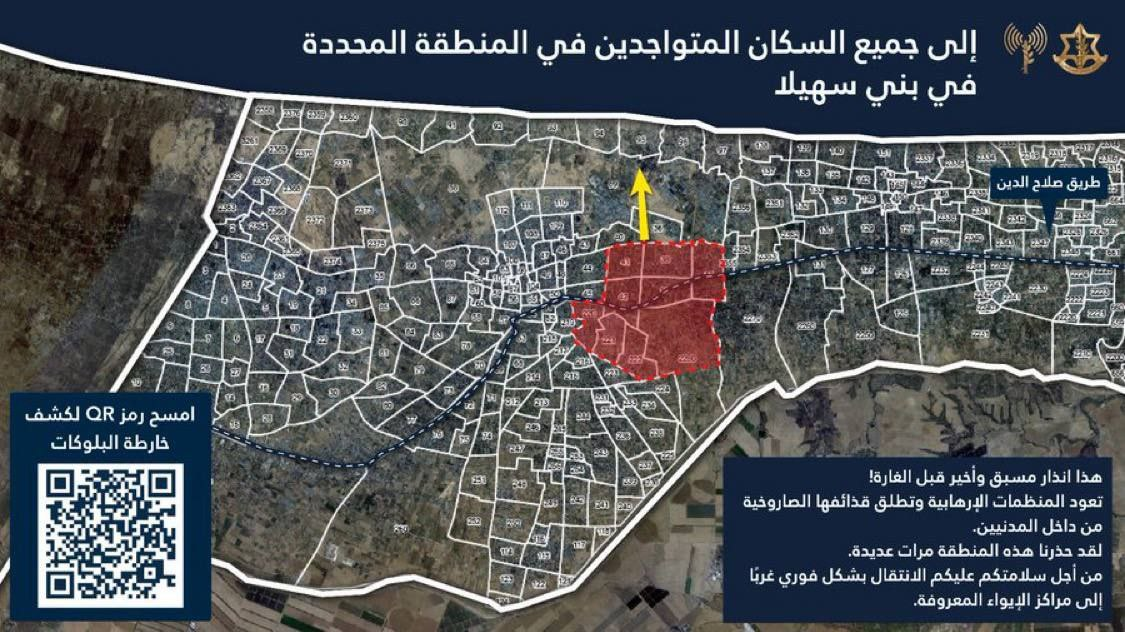
After each launch, the population of the area from which the rockets were launched received orders from the IDF (leaflets, social media messages, etc.) to evacuate. The messages included maps showing which areas to leave and where to go. This was in addition to evacuation orders from areas the IDF ground forces were reentering. UNRWA claims that about 400,000 Palestinians have evacuated the areas as ordered by the IDF.
Israeli airstrikes on identified targets and Hamas senior and mid-level officials and military commanders continue, with more than a dozen killed so far. Among those killed were the Hamas prime minister (he was hiding in a hospital, and a small guided munition was fired into the room) and Hamas’s equivalent of a defense minister.
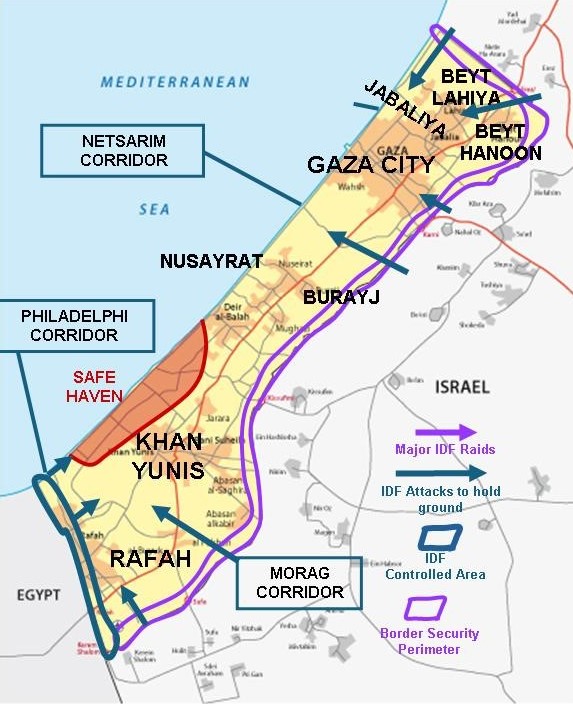
Israeli ground troops entered the Strip in various locations, increasing the depth of the 1-kilometer perimeter Israel has held since withdrawing during the ceasefire to several kilometers:
- From the northern border, Israeli forces are moving closer to Gaza City, especially along the coast (the same direction they originally entered Gaza in late October 2023)
- South of the city of Gaza, the IDF returned to the Netzarim Corridor, which separates northern and central Gaza. The IDF has not yet completely blocked the corridor. The coastal area is still open for travel
- In the south, the IDF moved back into two areas around the city of Rafah from which it had withdrawn. Another force advanced north along the coast, closer to the al-Muwasi humanitarian area declared by the IDF last year
- A new corridor, called Morag, is being taken north of Rafah, separating it from the rest of the Gaza Strip
The Hamas Ministry of Health, which had published numbers of killed including the missing, has gone back to its previous pattern of not including the missing. Its latest casualty update (24 March) is 50,810 killed and 115,700 wounded. Hamas still does not differentiate between combatants and non-combatants. According to the IDF, the killed include a verified total of more than 20,000 Hamas personnel and at least 3,000 personnel of other terrorist organizations. The number of wounded terrorists is not known but is probably at least similar to the number killed.
Whereas most Western countries have denounced Israel’s renewed offensive, the US government has declared unqualified support.
The humanitarian issue is again being trumpeted by Hamas, which claims that the stopping of supply convoys is threatening the population of Gaza with starvation and a lack of medical supplies. Israel responded that about 25,000 truckloads (enough for 50 days) entered Gaza during the ceasefire and Hamas is hoarding most of their contents – including supplies that arrived prior to the ceasefire – in its own warehouses and is selling them to the population at exorbitant prices to fund its activities.
In Gaza there have been increasing protests demanding that Hamas surrender and leave the Strip and complaining about Hamas not distributing the supplies that have arrived. These protests have been small in scale so far, but the number of participants is gradually increasing as is the spread. Initially, the protests were occurring only in northern Gaza, but they have taken place in central Gaza as well and have recently spread to southern Gaza.
It is still too early to tell if these protests are harbingers of change or just the expressions of a small minority. At first, Hamas did not respond with violence, instead trying to pass off the protests as directed against Israel. Hamas media and Al-Jazeera ignored the statements being made against Hamas and quoted only the demands that the ceasefire be renewed. But after a few days, Hamas began to capture and even kill some of the protesters. This diminished the number of protests but did not halt them entirely. In one case, the clan of a protester killed by Hamas security forces retaliated by killing the Hamas police officer who had shot their family member. There have been a few other skirmishes between clans and Hamas security forces.
There have also been many more posts on social media by Gazans saying they would leave Gaza permanently if only they were allowed to do so. While these posts are increasing in number, they are still relatively rare, and we cannot know how deep this sentiment really is — are they exceptions, or do they represent the feelings of a much larger proportion of the population?
Dr. Eado Hecht, a senior research fellow at the BESA Center, is a military analyst focusing mainly on the relationship between military theory, military doctrine, and military practice. He teaches courses on military theory and military history at Bar-Ilan University, Haifa University, and Reichman University and in a variety of courses in the Israel Defense Forces. A version of this article was originally published by The BESA Center.