




‘14,000 Babies Will Die’: How the UN Invented a Blood Libel — and the Media Ran With It
Error: Contact form not found.

 by Rachel O'Donoghue


Trucks carrying aid move, amid a ceasefire between Israel and Hamas, in Rafah in the southern Gaza Strip, Feb. 13, 2025. Photo: REUTERS/Hussam Al-Masri
The New York Times. NBC News. TIME Magazine. The Guardian. ABC News. The Independent.
All these outlets are supposedly reputable news organizations. And all of them published, uncritically, one of the most grotesque and easily disprovable claims made during the war between Israel and Hamas — that 14,000 babies in Gaza would die within 48 hours.
The claim came from Tom Fletcher, the UN humanitarian chief, who said on BBC Radio 4’s Today program: “There are 14,000 babies that will die in the next 48 hours unless we can reach them.”
It was an outrageous statement — one that the BBC, to its credit, at least challenged. Fletcher’s defense? That the UN had “strong teams on the ground” in Gaza. No methodology. No data. Just dramatic moral panic, wrapped in the thin veneer of credibility that comes with a UN badge.
The BBC then followed up with the UN Office for the Coordination of Humanitarian Affairs (UNOCHA), which claimed the number referred to an IPC (Integrated Food Security Phase Classification) report.
There was just one problem: the IPC report says no such thing. It projected that 14,100 children in Gaza could experience acute malnutrition between April 2025 and March 2026 — a year-long period. Not two days. And not imminent death.
BBC journalists acknowledged this discrepancy, stating clearly in a subsequent piece: “The IPC report says this could take place over the course of about a year — not 48 hours.”
UNOCHA spokesperson Jens Laerke was pressed again at a news conference. He offered no figures, no data — just a vague reassurance that “there are babies who are in urgent life-saving need.” Which, while possibly true, is not what his colleague actually claimed.
And yet, despite having verified the 14,000 figure was false, the BBC continued to reprint it across its coverage — in headlines, video segments, and social media posts.
A clip of Fletcher’s interview remains live on the BBC website, without correction, clarification, or context. It even includes a denial from Hamas that it steals humanitarian aid — presented as merely an “Israeli accusation,” despite mountains of documented evidence to the contrary.
The UN’s humanitarian chief claims, without providing evidence, that 14,000 Gazan babies could die in the next 48 hours.
That would be some 27% of the total alleged death toll for this entire war. All babies. All within 48 hours.
This is how anti-Israel libels are spread. https://t.co/io5FJ80Eew pic.twitter.com/FlVqbNXnNh
— HonestReporting (@HonestReporting) May 20, 2025
In its Newshour radio program, the BBC went further, summarizing the story with the line: “14,000 babies in Gaza could die within the next two days without urgent aid” — linking this to Israel’s restrictions on aid to “pressure Hamas.” But of course, the BBC omitted the reason for such pressure: Hamas continues to hold Israeli hostages and refuses to disarm.
While the BBC asked follow-up questions, its acknowledgement that the figure was not supported by evidence was buried.
Other media outlets didn’t even go that far.
The New York Times included the figure in its reporting, with the faint disclaimer that the UN later “appeared to walk back” the claim. But that’s not accurate. The UN didn’t walk anything back. The individual in question doubled down by falsely linking its figure to the IPC report.
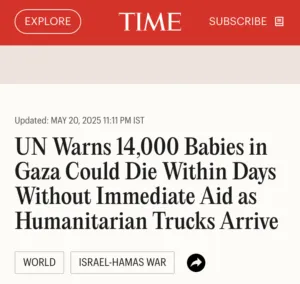
TIME Magazine ran the number as a headline, and even linked to the BBC article that had already proven it false. The contradiction? Not mentioned.
ABC News reported the number and misleadingly tied it to Israel’s expanded “assault in Gaza” — falsely implying that Fletcher or the IPC blamed Israel for mass infant deaths.
NBC News took the grotesqueness up a notch. They linked Fletcher’s remark to a controversial comment from Israeli politician and former IDF general Yair Golan, subtly implying the 14,000 babies were about to be killed by Israeli forces.
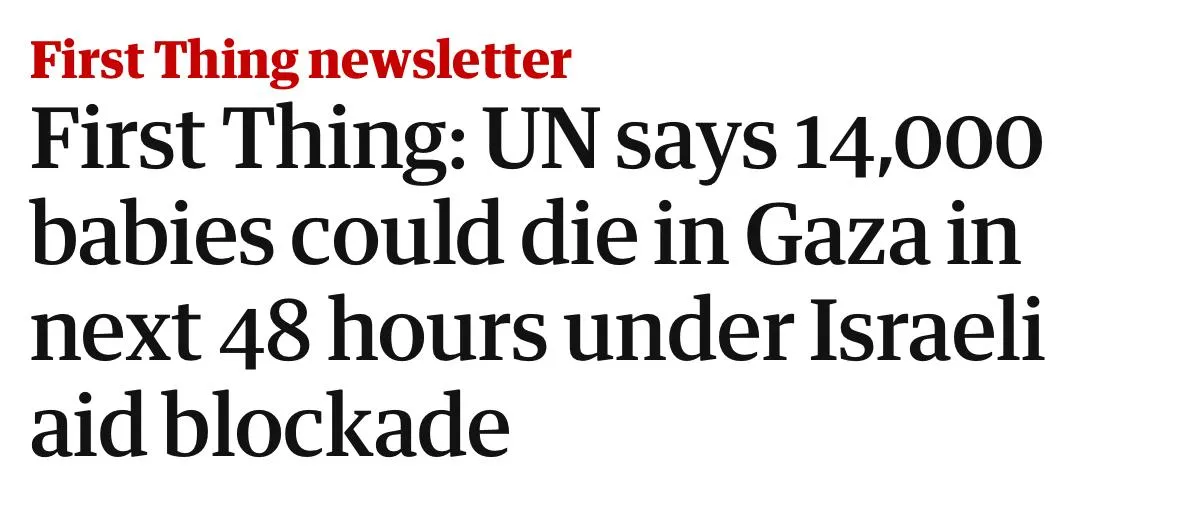
The Guardian included Fletcher’s incoherent defense but still ran the figure in headlines — in its First Thing newsletter and as a breaking news alert.
The Independent managed to publish two separate pieces on the claim, but only hinted that the number lacked any evidentiary basis. One article even included Fletcher’s remarks paraphrased in such a way as to give them an air of legitimacy: “Asked how the UN worked out that 14,000 babies may die within 48 hours … Mr Fletcher said teams on the ground have been working hard in places such as medical centres and schools to assess need.”
Australia’s 7 News didn’t even bother with attribution. It simply declared: “Gaza crisis threatens 14,000 babies as aid fails to arrive.”
No mention of where the number came from. No verification. Just a headline tailored for outrage.
View this post on Instagram
Let’s be clear: this wasn’t a misunderstanding. It was a grotesque smear — a UN official suggesting, without evidence, that Israel was about to kill 14,000 babies.
And instead of exposing the lie, the world’s most influential media outlets repeated it, amplified it, and headlined it — even after the number was disproven.
This wasn’t journalism. It was narrative laundering — where facts are optional, but outrage is essential.
And it reveals something darker: when the target is Israel, truth becomes negotiable. Lies become headlines. And media accountability is non-existent.
The author is a contributor to HonestReporting, a Jerusalem-based media watchdog with a focus on antisemitism and anti-Israel bias — where a version of this article first appeared.