




More Americans Should Take a Lesson From Israel and Find True Purpose on Memorial Day
Error: Contact form not found.
 by Kenneth Brander

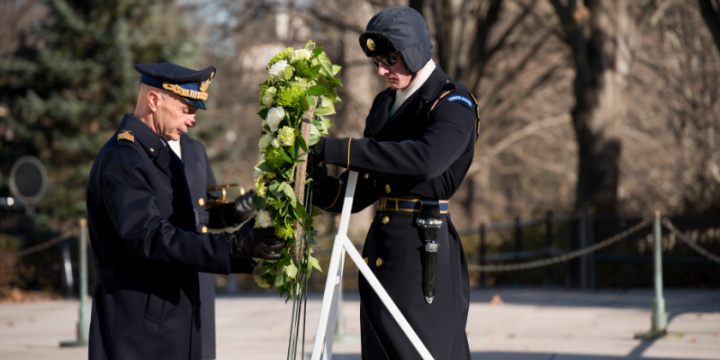
Lt. Gen. Enzo Vecciarelli, chief of staff of the Italian Air Force, places a wreath at the Tomb of the Unknown Soldier in Arlington National Cemetery, Feb. 13, 2017, in Arlington, Va. Photo: Wikimedia Commons/U.S. Army photo by Rachel Larue/Arlington National Cemetery/released.
As we prepare to mark Memorial Day, many Americans are looking forward to barbecues and sales. “To Americans, Memorial Day weekend marks the unofficial beginning of summer,” reads a description of the day posted on the websites of US embassies around the world.
That description goes on to say, “But at its heart, Memorial Day is a day when Americans reflect on the sacrifice of those who have given their lives in military service.”
The truth, however, is this latter framing of Memorial Day is mainly relegated to military families and towns that are home to military bases. For most others, remembering those who lost their lives for our country is not more than an afterthought.
For years, as an American, I admit that I almost always didn’t give this a second thought. It was just the way it was. Most major or existential military conflicts happened far away (not a few hours from home) and decades in the past, and even the wars in Iraq and Afghanistan only required a tiny portion of Americans to serve and fight — meaning few have a personal connection to loss or even to military service, or are acutely conscious of its importance.
However, as an American who now lives in Israel, my perspective on Memorial Day, and how we mark it in the United States has shifted dramatically— and not only due to my personal stakes and tragic losses in Israel’s current war. My son is a soldier in the IDF — as are thousands of the students and alumni from the network of educational institutions that I oversee. Sadly, since the war began on Oct. 7, 2023, we have lost 20 alumni and 38 first-degree relatives of our students and faculty, including many men with wives and families who were serving reserve duty.
This personal connection to service and loss is not unique. Because Israel is a country of only about 10 million people, military service is a requirement for much of the population — and especially due to the ongoing war, most people know someone who has been killed in service to the country.
But putting aside the aspect of personal connection, the day is monumental because of the solemn way Israel marks it; even visitors feel the emotions of the day. Shops and restaurants are closed. Names of the dead are read aloud in public places for hours on end, and at two different points, sirens ring out across the country, and everyone comes to a stop to remember the fallen.
The day is heavy and difficult, but it is also infused with meaning. The knowledge that so many have died — whether recently or decades ago — so that life can continue, is motivating, helping people recognize their talents, opportunities, and blessings. There is also a communal aspect of the day, with the awareness that these sacrifices affect everyone’s ability to live safely and securely, helping create bonds in society, and reducing loneliness in general.
It is this feeling of community and having people they can count on that — year after year — leads to Israel being ranked high in the global happiness index, despite the difficulty of daily life.
This meaning, purpose, and communal aspect of the day is something that we can all learn from, especially in the US, where many suffer from lack of purpose, and loneliness is considered a public health emergency.
Leaders, communities, schools, and even individual families in the US should consider taking small steps to help bring back meaning to Memorial Day.
This can, of course, be done through memorial ceremonies or learning more about the fallen in schools. But it would be most effective if such efforts met most of the public where they will be on Memorial Day — at malls, parks, and on the road to take advantage of the day off from work. Holding a moment of silence or hanging up posters with stories and photos of the fallen would go a long way in reminding people about the true purpose of the day.
Being more aware of these sacrifices could, in turn, be the reminder that many Americans need to appreciate our opportunities despite the clear challenges in our society. It could also be a reminder that we as individuals are not alone, giving us the strength to do our best and continue improving our own lives along with our communities and country. This, after all, is why more than 600,000 Americans have paid the ultimate price since World War I. We must remember that — at the very least on Memorial Day.
Rabbi Dr. Kenneth Brander is the President of Ohr Torah Stone, an international network of 32 religious educational, leadership, and social action programs including the Ohr Torah Interfaith Center. He was previously Vice President of Yeshiva University.