






Guy Christensen: The Gen-Z TikTok Star Inciting His 3.4 Million Followers to Murder ‘Zionists’
Error: Contact form not found.

 by Rachel O'Donoghue


Yaron Lischinsky and Sarah Lynn Milgrim who were shot and killed as they left an event at the Capital Jewish Museum, pose for a picture at an unknown location, in this handout image released by Embassy of Israel to the US on May 22, 2025. Photo: Embassy of Israel to the USA via X/Handout via REUTERS
You may not have heard of Guy Christensen — but perhaps you should have. Not because he has anything remotely insightful to offer (he doesn’t), but because millions of Gen Z users do hear him, every day.
And understanding Guy Christensen helps explain why so many American college campuses have become incubators for an anti-Israel movement that is less “progressive” than it is unapologetically pro-Islamist.
Born in 2005, Christensen is part of a growing cohort of American influencers who discovered both their political awakening — and their monetizable moment — in the wake of Hamas’ October 7 massacre. Before then, his Instagram resembled that of any ordinary teenager: fishing trips, photos of his girlfriend, the typical adolescent blend of leisure and self-regard.
But like many others, Christensen sensed an opportunity. The fusion of performative compassion for Palestinians and the algorithmic rewards of antisemitism proved irresistible. And so, in May 2025, he posted a video so brazen and grotesque that it achieved precisely what he seemed to desire: outrage, attention, and media coverage.
In the now-deleted post — eventually taken down by TikTok and Instagram — Christensen, who frequently appears on camera draped in a keffiyeh, openly endorsed the murders of Israeli embassy staffers Yaron Lischinsky and Sarah Milgrim. The couple was gunned down outside the Capital Jewish Museum in Washington, D.C., on May 21.
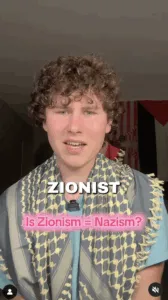
Guy Christensen on Instagram
We are not reproducing the footage. But Christensen’s words are worth documenting — if only to illustrate the depths to which online “activism” has sunk.
“I do not condemn the elimination of the Zionist officials who worked at the Israeli embassy last night,” he declared. He urged his followers to “support Elias’s actions,” referring to Elias Rodriguez, who has since been charged with two counts of murder. “He is not a terrorist. He’s a resistance fighter,” Christensen insisted. “And the fact is that the fight against Israel’s war machine, against their genocide machine, against their criminality, includes their foreign diplomats in this country.”
Rodriguez reportedly told police at the scene: “I did it for Palestine. I did it for Gaza.” After his arrest, he was witnessed chanting “Free Palestine.” Federal prosecutors are treating the attack as an act of terrorism. Rodriguez could face the death penalty. He also said he supported a genocide against white people.
Christensen, meanwhile, may face some type of investigation, with Department of Justice civil rights attorney Leo Terrell stating that he intends to “review all leads.” But the likelihood of real legal consequences remains low. Christensen is a US citizen — and in today’s climate, incitement to murder “Zionists” online exists, as we have seen, in a murky legal gray zone.
The Christensen saga — from teenage TikTok trends to online advocacy for antisemitic violence — is a textbook example of real-time online radicalization. What began as vague, aestheticized “anti-war” rhetoric swiftly mutated into explicit incitement. And millions of young people watched it happen.
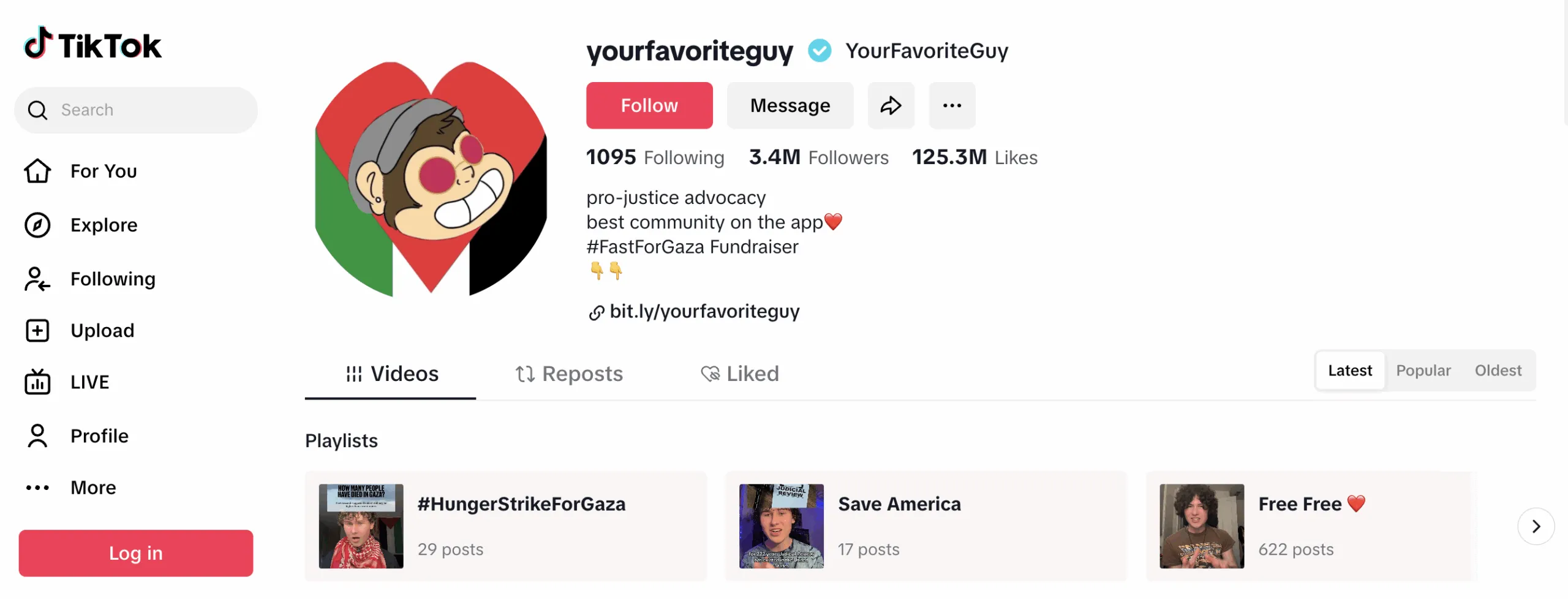
In a November 2024 interview with the World Socialist Web Site, which introduced him as a “pro-Palestinian activist” who has “educated many young people [about the] genocide in Gaza,” Christensen explained how it began.
According to him, he already had a large following “prior to October 7th,” when his feed began to fill with “pro-Israel posts about Gaza and Hamas.” He admits: “I knew absolutely nothing about Israel or Palestine.”
“I was seeing all these videos, and I had no idea what they were talking about,” he said. “The idea I got was that Hamas was terrible, that the Palestinians were terrible human beings — and it was a little weird to hear this because it was borderline hateful.”
Then, he says, a pair of comments appeared on his TikTok feed: “Google Nakba” and “Google open air prison.” He did — and, as he puts it, “What I found took me down a path that changed my whole entire life.”
That path, notably, began not with a book, a class, or a conversation — but with two pieces of highly ideological terminology. The first, Nakba — Arabic for “catastrophe” — is the term used to describe the very existence of the State of Israel. The second, “open-air prison,” is an oft-repeated but absurd phrase for a territory that, prior to the current war, saw Hamas leaders living in opulence, amassing enormous wealth, and building a vast arsenal of rockets to fire at Israeli civilians.
As simplistic as Christensen’s radicalization story may seem, it is instructive. It reveals how uninformed young creators can be swept up — and swiftly weaponized — in a digital ecosystem flooded with bot activity, algorithmic amplification, and moral absolutism.
Pro-Palestinian bot networks have been documented spamming platforms like TikTok and Instagram, mass-reporting pro-Israel content while boosting anti-Israel messaging. It’s not far-fetched to suggest that high-follower Gen-Z influencers like Christensen were both targeted and elevated by such manipulation.
The result is that TikTok stars like Christensen are now promoting a worldview that merges antisemitism, anti-Americanism, and political violence — rebranded as “anti-Zionism,” repackaged for a young social media audience, and delivered at viral scale.
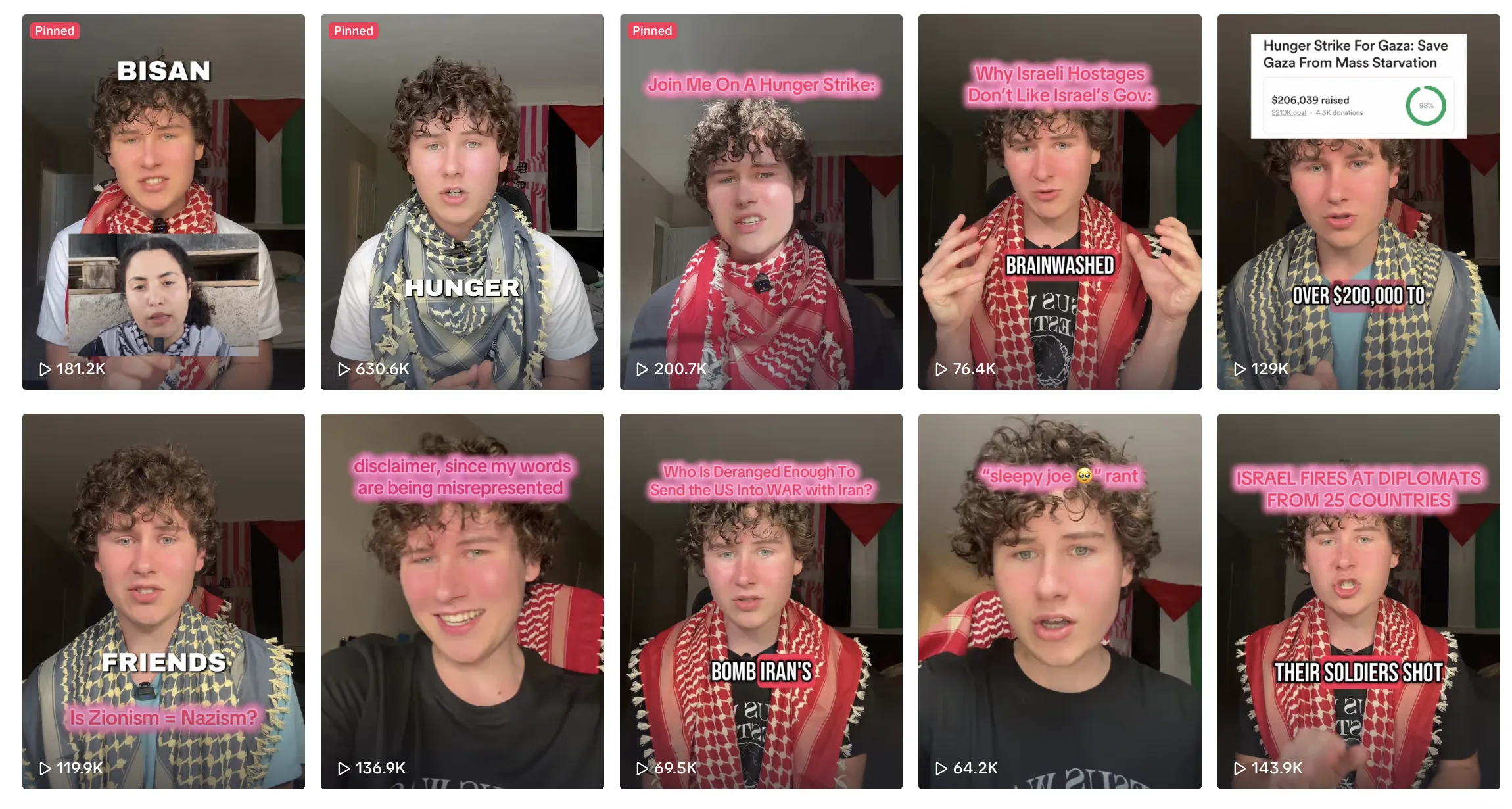
Guy Christensen’s TikTok feed
At a minimum, colleges and universities must stop pretending this is merely youthful dissent. If a student openly glorifies murder, why should they be welcomed on campus and rewarded with a degree?
And employers, take note: do you want your brand associated with someone who advocates violence against Jews?
Most urgently, social media companies must be held to account. The murders of Yaron and Sarah are not abstract tragedies. Their deaths are the irreversible consequence of a culture that rewards incendiary content and enables its spread.
Though Instagram and TikTok eventually removed the specific video in which Christensen applauded the killings, the rest of his content — much of it laced with the same veiled incitement — remains online, racking up likes, shares, and impressions.
Since October 7, content like Christensen’s hasn’t merely persisted — it has flourished. His follower count has soared. Bots flood hashtags. Pro-Israel voices are drowned out. And the platforms, far from restraining this trend, continue to profit from it.
It is not enough to remove a single video after the damage is done.
It’s time to stop rewarding hate with reach. It’s time to stop monetizing murder.
The author is a contributor to HonestReporting, a Jerusalem-based media watchdog with a focus on antisemitism and anti-Israel bias — where a version of this article first appeared.