



President Trump’s Iran Attack Did Not Increase Deterrence on the World Stage
Error: Contact form not found.

 by Lev Stesin


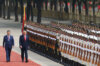
Russian President Vladimir Putin and Iranian President Masoud Pezeshkian attend a documents signing ceremony in Moscow, Russia, Jan. 17, 2025. Photo: REUTERS/Evgenia Novozhenina/Pool
The US strike on Iran was a surprising military and political development. It went completely against President Trump’s long held beliefs and publicly declared intentions about staying out of international conflict — even if it made good on his promise to stop Iran from obtaining a nuclear weapon.
It is still too early to ascertain whether the action achieved its immediate goal — the destruction of or a substantial delay in Iran’s nuclear program — and it will take months, or perhaps even longer, to confirm the results one way or another.
There was, however, another dimension to the US’ decision to attack Iran. Iran is just one participant in the “Revanchist” coalition, consisting of China, Russia, Iran, and North Korea, that is challenging American world hegemony. The strike, intent on physically destroying Iranian infrastructure, was meant to send a clear and unequivocal message to other coalition members as well: the US was back as a power player, ready to exercise its strength to preserve its power and achieve its strategic goals. Did the message reach the addressees and did the recipients read it correctly?
The strikes delivered by the US against Iran’s nuclear sites were carefully calibrated and extremely cautious. The bravado coming from the White House and the Department of Defense is artfully obfuscating this uncomfortable fact — yet Beijing and Moscow were paying attention. The US may not be a “Paper Tiger” as some have suggested, but neither is it a crazy beast many American officials try to portray the country as after the attack.
The strike generated no deterrence vis-a-vis Russia. In the weeks that followed, Russia has dramatically intensified its air attacks against Ukraine’s civilian infrastructure, and has increased the pressure along the entire front in Eastern and Southern Ukraine as part of its well advertised summer offensive.
A serious phone conversation between President Trump and Putin produced zero results, leading President Trump to finally admit in public that his Russian counterpart does not desire peace.
It is absolutely clear that American strikes in Iran have not changed Russia’s strategic calculus in Ukraine or towards the US. Putin still thinks he holds all the cards.
The strike, however, did produce a visible negative consequence for Russia. It exposed Russia’s limitations as a global power. After much noise about the friendship with Iran, and Russia being the main buyer of Iranian drones and ballistic missiles, Russia did absolutely nothing to defend its ally or minimize the damage from the war. Russia looked absolutely helpless as Israel decimated Iran and then the US delivered its bunker busters at the nuclear sites. Short of a few sentences of criticism directed at the US (and Israel) and of encouragement to Iran, Russia provided no help at all. That military and political impotence has not escaped the attention of Russia’s “friends” in Africa and Latin America. And the rest of the world took notice as well.
Nor does China seem bothered by America’s show of power. Its support of Russia has not changed. As recently as last week, its foreign minister, during the meeting with the EU officials, admitted that China cannot afford letting Russia lose its war in Ukraine. China’s negotiating position as it pertains to the tariffs has not changed since the strike. Its military build up continues and the threats against Taiwan grow more ominous by day.
If the strike against Iran’s nuclear facilities had more broad strategic goals, then that part of the mission turned out to be a failure. Iran’s nuclear program has suffered a setback — though it is unclear how severe and for how long. So far the strikes have not led to any political resolution or even more productive negotiations with Iran. And even though President Trump has proved he is not afraid to act, America’s foes are still not considering his newly acquired aggressiveness to be a threat to their nefarious designs.
The author lives and works in Silicon Valley, California. He is a founding member of San Francisco Voice for Israel.