



They Spent Years Justifying Violence — Now They Mourn Charlie Kirk
Error: Contact form not found.

 by Channa Rifkin


Charlie Kirk speaking at the inauguration of Donald Trump in January 2025. Photo: Brian Snyder via Reuters Connect
The assassination of conservative activist Charlie Kirk sent shockwaves across the world. Tributes poured in from world leaders, including Israeli Prime Minister Benjamin Netanyahu, US President Donald Trump, and UK Prime Minister Keir Starmer.
Kirk was gunned down at a campus event in Utah — a chilling reminder of the growing threat of political violence in America. His death has already sparked debates about the state of free speech, the dangers facing polarizing figures, and the country’s ongoing battle over gun rights.
Those discussions may feel inevitable in the wake of such a murder. But there is one aspect of Kirk’s legacy that deserves special recognition — especially from those who care about Israel and the Jewish people.
For years, Kirk stood on the front lines of America’s campus culture wars, fearlessly challenging lies about the Jewish State. He didn’t shy away from hostile rooms. He didn’t dilute his message. He made Israel’s case where it most needed to be heard — in classrooms, lecture halls, and student auditoriums where anti-Israel narratives are too often allowed to flourish unchallenged.
Kirk’s political views divided many. But his unwavering defense of Israel, his refusal to allow falsehoods to go unopposed, and his willingness to stand shoulder-to-shoulder with Jewish students under fire are something that deserves appreciation. He was, in every sense, a friend of the Jewish State.
And yet, in the hours since his murder, tributes have emerged from some of the very voices who bear responsibility for poisoning the public sphere with anti-Israel hatred.
Figures who once called to “globalize the intifada” — rhetoric that glorifies violence against Jews and Israelis — now strike a mournful tone over Kirk’s death. Journalists, activists, and politicians who have trafficked in antisemitic tropes or winked at violence against Zionists are suddenly against political violence when it takes the life of a man they spent years vilifying.
Take, for example, Democratic nominee for New York Mayor Zohran Mamdani. He has infamously refused to condemn the slogan “globalize the intifada” — a phrase that openly romanticizes violent uprising against Jews and Israelis. Only after fierce backlash did Mamdani claim he would avoid the phrase in the future. Yet in the immediate hours after Kirk’s murder, Mamdani rushed to X to declare himself “horrified,” insisting that “political violence has no place in our country.”
I’m horrified by the shooting of Charlie Kirk at a college event in Utah.
Political violence has no place in our country.
— Zohran Kwame Mamdani (@ZohranKMamdani) September 10, 2025
Similarly, Democrat Congresswoman Ilhan Omar (D-MN) — who has smeared Jewish students as “pro-genocide” and repeatedly trafficked in antisemitic tropes — joined the chorus. “Political violence is absolutely unacceptable and indefensible,” she wrote, urging Americans to “pray for no more lives being lost to gun violence.” The same politician who has vilified Jewish students for their Zionism now demands the moral high ground on political violence.
And then there is former MSNBC commentator Mehdi Hasan. He used Kirk’s death not to reflect on his own rhetoric, but to settle personal scores — pointing out that Kirk had once called him “a lunatic” and “a prostitute,” and had demanded his deportation. Hasan sought to appear magnanimous: “Nothing, nothing, justifies killing him, or robbing his kids of their dad.”
But this is the same Hasan who has defended the chants for an “intifada,” insisted it is merely “an uprising,” and said Israelis are supportive of genocide. Earlier this year, he was accused of mocking the September 11 terror attacks with a tweet reading: “Make American Planes Crash Again.”
Other tributes were posted and reposted by Democrat former Congresswoman Cori Bush (D-MO), creative director and activist Alana Hadid, and others — all figures with long records of demonizing those who disagree with them politically.
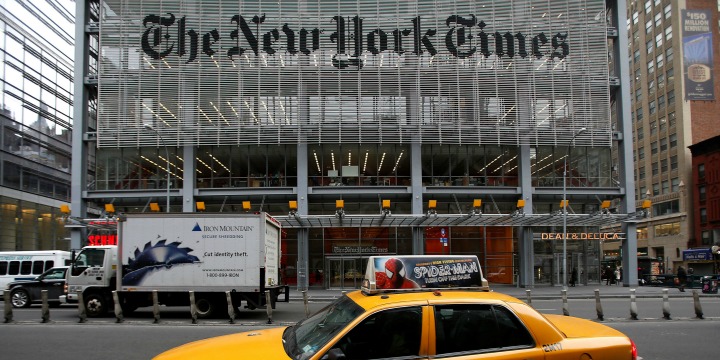
Charlie Kirk was *murdered* by a sniper. He did not simply “die.”
Like Israeli and Jewish victims of terror, add Kirk to the list of murder victims @nytimes cannot sympathize with, therefore treating their deaths with passive headlines. pic.twitter.com/GzTSWWzcRj
— HonestReporting (@HonestReporting) September 11, 2025
On the other end of the political spectrum, Candace Owens considered herself to be a friend of Kirk’s. Owens, however, is a serial spreader of antisemitic and anti-Israel incitement. In a series of short, heartbroken tweets, Owens begged her followers to “pray” for Kirk and his family. But while she may be emphasizing her utter shock, Owens fails to recognize that her own brand of hateful and conspiratorial rhetoric about the pro-Israel community and Jewish people is a net contributor to an atmosphere of encouraging political violence, irrespective of whether it comes from the left or the right.
The hypocrisy is staggering. You cannot spend years mainstreaming rhetoric that endorses violence against Jews, Zionists, and pro-Israel voices — and then act shocked when that same rhetoric metastasizes into real bloodshed.
Violent language toward Jews and Israel has become disturbingly normalized in American discourse. Now, some of its loudest promoters want to draw neat moral lines when it suits them. But their sudden appeals to civility ring hollow.
This commentary on Charlie Kirk’s murder is not about speculating on motive. It is about the danger of legitimizing rhetoric that dehumanizes opponents and flirts with violence. Words have consequences. And those who excuse or glorify violence against Israel cannot wash their hands when that culture of hostility inevitably corrodes the wider political sphere.
The author is a contributor to HonestReporting, a Jerusalem-based media watchdog with a focus on antisemitism and anti-Israel bias — where a version of this article first appeared.