



Rabbi Ammiel Hirsch: Local Pulpits Hold the Key to Jewish Leadership After Oct. 7 Attack
Error: Contact form not found.

 by David Taragin

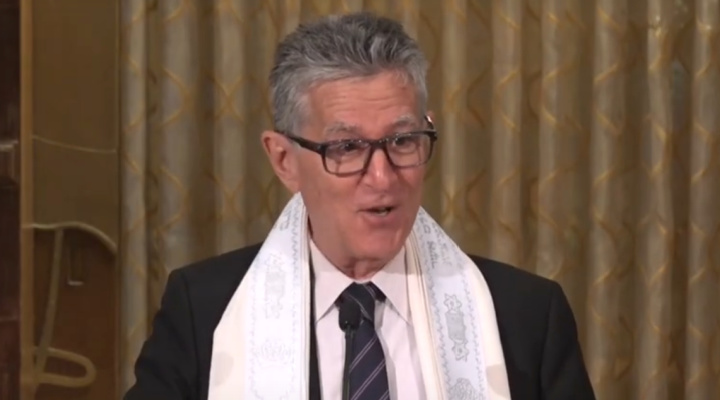
Ammiel Hirsch, senior rabbi of Manhattan’s Stephen Wise Free Synagogue, in September 2025. Photo: Sceenshot
Ammiel Hirsch, senior rabbi of Manhattan’s Stephen Wise Free Synagogue, argued in a recent interview that the future of Jewish influence lies in the pulpit rather than in national institutions.
Speaking on The Algemeiner‘s “J100” podcast, Hirsch explained why he returned to congregational life after leading ARZA, the Reform movement’s Zionist association.
“The real influence now in the American Jewish community is on the local level,” he said. “National organizations are experiencing what all national institutions in Western life are experiencing — polarization and paralysis. The energy and the potential influence that you have, the freedom to say what you want to say and to do what you want to do, is much greater on a local level. And if you can create that, it has national resonance.”
Hirsch connected this shift to the aftermath of Hamas’s Oct. 7, 2023, invasion of southern Israel, describing the massacre as a turning point for Jewish leaders.
“If you are a Jewish leader and Oct. 7 didn’t shake your agenda, you are not meeting the historical demands of the times,” he said.
The comments came as rabbis across the country prepared for the High Holidays, when synagogue sermons traditionally set the tone for the year ahead. Hirsch called the sermon “an art form,” noting that his weekly preparation includes hours of study and reflection. “A 12-minute sermon can take 12 hours to write — and 35 years of experience,” he said.
The senior rabbi emphasized that sermons, once confined to the sanctuary, now reach much wider audiences through digital platforms. For Hirsch, this makes the pulpit an even more powerful tool for shaping Jewish identity and guiding communities through crisis.
Throughout modern Jewish history, synagogue sermons have played a decisive role — from rallying American Jewry against Nazism in the 1930s to mobilizing support for Soviet Jewry in the 1970s. Hirsch suggested that today’s rabbis must summon the same clarity as they confront antisemitism, division within the Jewish community, and Israel’s ongoing war with Hamas.
“The stakes are higher than ever,” Hirsch said. “It is our responsibility as rabbis to state the truth clearly and passionately. Many more people resonate with this message than the noisy minority opposed to Israel.”
“J100” host David Cohen, CEO of The Algemeiner and a former pulpit rabbi, emphasized the idea of a noisy minority with an analogy:
“When a tzedakah [charity] box is full and you shake it, it doesn’t make a lot of noise. But when there’s only a few coins inside, it can make a whole racket,” he said.
Hirsch underscored that the pulpit remains a place where words can influence not only a local community but also the broader trajectory of Jewish life.


