



Sukkot 2025: Life Is Temporary, So We Must Find the Joy and Appreciate the Moment
Error: Contact form not found.

 by Jeremy Rosen

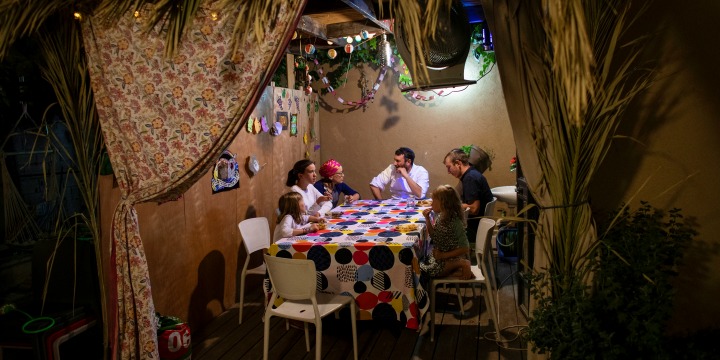
The Stanleigh family sit inside their sukkah, or ritual booth, used during the Jewish holiday of Sukkot, in their yard, in Jerusalem, Oct. 14, 2019. Photo: Reuters / Ronen Zvulun.
The Talmud gives three explanations for why we construct and live in the Sukkah on this festival of Sukkot. The most important element is the roofing, the Schach, comprising leaves, reeds, wattles, slats, and branches cut from the ground. The Talmud opens with the statement that dwelling in the Sukkah we should be aware of the Schach and therefore it should not be beyond the range of our vision. It establishes minimum and maximum dimensions and three opinions to justify why.
The first explanation is Raba’s: “So that your future generations will know that I caused the children of Israel to reside in Sukkot when I took them out of the land of Egypt” (Vayikra 23:43). This is an intellectual awareness of our religious and national past and present, referencing the Exodus. In a Sukkah up to 20 cubits high, a person is aware of residing in a Sukkah. His eye catches sight of the roofing and realizes its significance. However, in a Sukkah that is more than 20 cubits high, a person is not aware of residing in a Sukkah because his eye will not notice the roof at that height.
The second explanation is pragmatic. The Sukkah is, in general, a useful construction. R. Zeira said, “And there shall be a Sukkah for shade in the daytime from the heat, and for refuge and cover from storm and from rain” (Isaiah 4:6). Farmers built booths out in the fields while they watched over their crops in the summer heat. This idea extends to our homes, where we live in comfort protected from the elements. In a Sukkah up to 20 cubits high, a person is sitting in the shade of the roof, the essential part of a temporary dwelling, rather than in the shade of the walls. Shade from the sun is the metaphor for Divine protection.
Rava says, “You shall live” in a Sukkah for “seven days” (Leviticus 23:42). The Torah wants us to leave our comfortable permanent residences and live in a temporary one, so we can experience what it is like to be in an impermanent state.
Forcing us out of our comfort zones of stable house and home, the crucial aspect is realizing the impermanence of life, not to take things for granted. Not to assume inevitable or guaranteed security. A Sukkah that is too big and tall defeats the idea of an impermanent building.
The Talmud, as is its wont, then goes on to argue for each position, concluding of course that it’s a combination of all these ideas.
On the one hand, Sukkot is the festival of nature. Hence the Biblical command to take the four kinds of plants and fruit and wave them in a symbolic rite that emphasizes how much we need water and rain for the natural world to thrive and provide for us. The Biblical Prophets introduced a series of other laws that deal with praying for rain. This is a reminder of our ecological responsibility, something few human beings bothered to think too much about until recently.
Most of all, it is this impermanence that makes Sukkot so significant — and particularly relevant today.
We were slaves and nomads, and were given historical opportunities to establish ourselves as a peaceful, ethical nation, an example of how things should be. But time and again, we betrayed our covenants and suffered exile, impermanence, and instability.
Being pursued, hated, and exiled is not new. And now, after a generation of relative quiet — even if Jew hatred always lurked beneath the surface — more than at any time in my lifetime, I experience a sense that things might not last, and a sense of uncertainty about the future and our place within it.
Yet I cannot hep feeling sad that so many Jews ignore this festival, and focus only on the awe and seriousness of the High Holidays. Sukkot is a joyful follow up — a response to despondency.
Of all the festivals, Sukkot is the one where the Torah commands us to rejoice, to look on the bright side of life, and to not give up when things do not go our way.
Sukkot warms me and comforts me — it gives me reason to rejoice and thank God for the good years. It reminds us that we are survivors, that there is beauty as well as pain in this world, and that we should try our best to make it better.
Happy Festival. Chag Sameach.
The author is a writer and rabbi, currently based in New York.