






Growing Danger: Why Iran’s Nuclear Defiance Demands a New Strategy
Error: Contact form not found.

 by Amine Ayoub

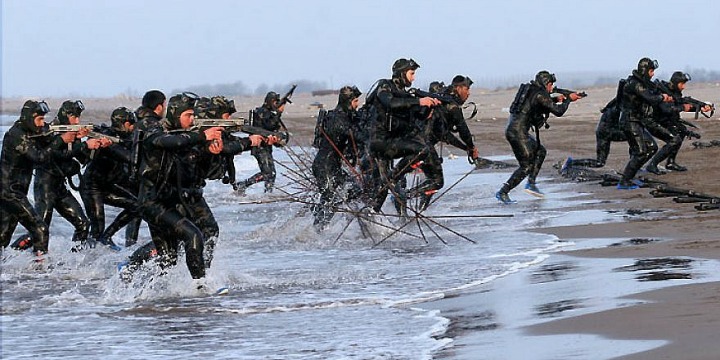
Navy forces of the Army of the Guardians of the Islamic Revolution commandos and missile boats in Great Prophet IX Maneuver in the general area of Strait of Hormuz, Persian Gulf. Photo: Sayyed Shahab Odin Vajedi/Wikimedia Commons.
The International Atomic Energy Agency (IAEA) confirmed this past week that Iran has not allowed its inspectors access to the nuclear sites bombed by Israeli and American forces in June. This sustained, deliberate obstruction has persisted for five months, rendering the verification of its nuclear material inventories long overdue.
Iran’s action is no mere technical violation; it is the creation of strategic ambiguity. Iran is actively denying the international community the ability to pinpoint the location and status of the 440.9 kilograms of uranium it had enriched to 60 percent purity, a quantity the IAEA itself assesses as potentially sufficient for 10 nuclear bombs if further refined.
The gravest threat is not just the volume of material, but the intentional collapse of verification. By keeping the IAEA blind, Iran ensures that any future military action will carry exponentially higher risks of striking a facility closer to weaponization than previously verifiable. Tehran is deliberately hedging its bets, creating a permanent deterrent shield of uncertainty.
The Synchronized Strike: Nuclear Threat Meets Naval Aggression
This nuclear defiance is not occurring in isolation. It is strategically synchronized with Iran’s kinetic threats in vital waterways.
The seizure of a Marshall Islands–flagged oil tanker in the Strait of Hormuz last week by the Islamic Revolutionary Guards Corps is a clear act of economic and military blackmail. This move directly targets a vessel operated by British and German interests, sending a hostile message to the E3 nations — France, Britain, and Germany — that any diplomatic pressure, like the new anti-Iran resolution they are planning at the IAEA, will be met with immediate, tangible military retaliation in the Persian Gulf.
Iran is attempting to dictate the diplomatic price of its own proliferation. It is leveraging its strategic nuclear advantage and its tactical naval aggression simultaneously. When the E3 countries threaten diplomatic action, Tehran responds not with words but with seized ships. This is an integrated campaign designed to impose asymmetric costs on the West, forcing economic decisions to override security principles.
The Allied Betrayal and the Failure of Pressure
The deepest source of vulnerability lies in the exposure of systemic differences within the allied camp itself. The US Treasury sanctions announced last week exposed a critical failure: entities operating within key allied countries — specifically Turkey — are actively running procurement networks that supply Iran’s ballistic missile and UAV programs.
This exposure is a profound betrayal of the maximum pressure campaign. It proves that, despite diplomatic assurances, allied nations are prioritizing transactional gains over the existential security of the international community. Iran’s ability to exploit the financial systems of NATO members and crucial Gulf partners confirms that the campaign against Tehran is critically compromised by internal sabotage and greed.
This internal compromise is what gives Iran the confidence to engage in its dual-domain aggression. When Turkey insists on maintaining its Russian S-400 system, defying US security mandates, and simultaneously enables Iran’s missile growth, it is acting as a strategic liability, not a partner.
The Mandate for Decisive Action
Israel, with the full backing of the United States, cannot afford to wait for the consensus-driven paralysis of the United Nations. The current diplomatic landscape offers little comfort: Russia and China are actively undermining the US-led stabilization plan for Gaza, and Saudi Arabia is holding normalization hostage to impossible political demands. The enemy is exploiting the West’s focus on internal squabbles.
Iran is at the 10-bomb threshold and actively preventing the verification required to pull it back; Iran is using military seizures to retaliate against diplomatic pressure; and allied nations are enabling Iran’s most destructive weapons programs.
Diplomatic pressure should be immediately paired with credible joint military deterrence in the Strait of Hormuz to secure the free flow of commerce. Furthermore, Washington must enforce strict accountability on its allies, making it clear that funding Iran’s missile program is an act of geopolitical sabotage that will incur severe and immediate penalties.
The window for a diplomatic solution is closing rapidly. If the current trend of non-compliance and synchronized defiance continues, the world will soon have to face the fact that Iran’s pursuit of nuclear capability has crossed the point of no return.


