






Why Bernie Sanders Is Beyond Wrong on Blocking Aid to Israel
Error: Contact form not found.

 by Rinat Harash


US Sen. Bernie Sanders (I-VT) and US Rep. Alexandria Ocasio-Cortez (D-NY) are seen before a press conference on Capitol Hill in Washington, DC, on March 21, 2024. Photo: Craig Hudson/Sipa USA via Reuters Connect
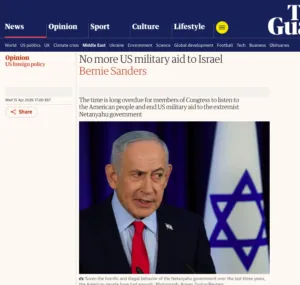
Senator Bernie Sanders (I-VT) opens his recent op-ed in The Guardian by invoking moral authority. “I am a proud Jewish American,” he writes, before recounting his family’s history in the Holocaust. It is a powerful introduction, but it is also a pre-emptive defense — one that insulates what follows from scrutiny.
Because what follows is not a coherent policy argument. It is a one-sided case to block US arms sales to Israel, built on sweeping claims and selective framing.
Sanders acknowledges that “Israel had the absolute right to respond to the Hamas attack,” referring to the massacre of October 7, 2023. But he immediately pivots, arguing that Israel is waging an “all-out war of enormous destruction against the entire Palestinian people – in what experts have correctly concluded is a genocide.”
There is no examination of who these “experts” are, nor any engagement with the legal standard for genocide, which requires demonstrable intent to destroy a people – not simply a civilian casualty figure deemed too high in the course of a war.
Competing legal assessments are ignored. The charge is asserted, repeated, and then used as the foundation for policy.
Sanders then builds his case through numbers. Israel, he writes, has killed “more than 72,000 Palestinians in Gaza” and destroyed “almost all of Gaza’s infrastructure.” The figures are presented in isolation. There is no mention of how those numbers are compiled, no distinction between civilians and combatants, and no acknowledgment of Hamas embedding its military operations within civilian areas, which is a central fact shaping the battlefield.
The same op-ed notes, in a single line, that Hamas “killed more than 1,200 innocent men, women and children and took hundreds of hostages.” But this is treated as background, not cause. The massacre that triggered the war is acknowledged, then effectively set aside, as if Israel’s response emerged in a vacuum.
From there, Sanders moves to policy. He announces that he will “force the Senate to vote on two Joint Resolutions of Disapproval” to block arms sales to Israel. One targets “$151.8m in 1,000-pound bombs.” The other blocks “$295m in bulldozers.”
“These are not defensive weapons,” he argues. “They are the instruments of ethnic cleansing.”
This framing is nothing short of a gross misrepresentation. The same munitions Sanders condemns are standard in modern warfare and are used precisely because they allow for targeted strikes against the very fortified positions that Hamas operates from.
Sanders does not grapple with the reality of the US-Israel alliance — one that extends beyond sentiment into intelligence-sharing, missile defense, and joint technological development. Nor does he address what it means, in practice, to restrict an ally’s access to weapons in the middle of an ongoing war.
Blocking arms sales to Israel does not isolate Israel. It weakens a key US ally in a volatile region. It signals to adversaries that American commitments can be reversed under political pressure, and it undermines deterrence at a moment when it is most needed.


