






Mediators Still Seek to Bridge US, Iran Gaps Despite No Face-to-Face Talks
Error: Contact form not found.

 by Reuters and Algemeiner Staff

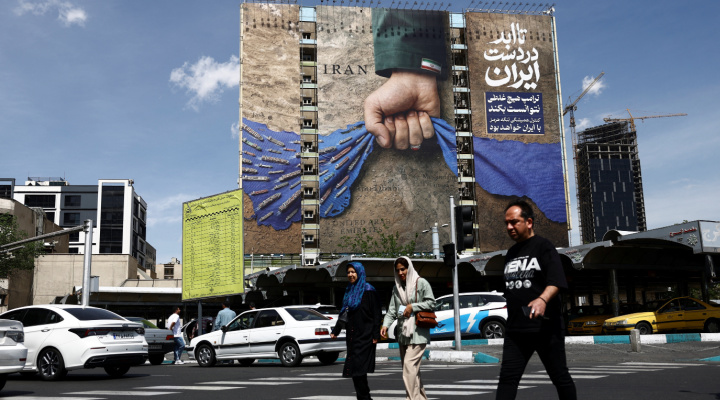
People walk past a billboard with a graphic design about the Strait of Hormuz on a building, amid a ceasefire between US and Iran, in Tehran, Iran, April 27, 2026. Photo: Majid Asgaripour/WANA (West Asia News Agency) via REUTERS
Work has not halted to bridge gaps between the United States and Iran, sources from mediator Pakistan said, despite the absence of face-to-face diplomacy after President Donald Trump called off a trip by his envoys over the weekend.
Iranian sources disclosed Tehran’s latest proposal on Monday, which would set aside discussion of Iran‘s nuclear program until the war is ended and disputes over shipping from the Gulf are resolved. That is unlikely to satisfy Washington, which says nuclear issues must be dealt with from the outset.
Hopes of reviving peace efforts have receded since the US president scrapped a visit on Saturday by his envoy Steve Witkoff and son-in-law Jared Kushner to Islamabad, the Pakistani capital, where Iranian Foreign Minister Abbas Araqchi shuttled in and out twice over the weekend.
Araqchi also visited Oman over the weekend and went to Russia on Monday, where he met President Vladimir Putin and received words of support from a longstanding ally.
OIL PRICES RISE AGAIN
With the warring sides still seemingly far apart on issues including Iran‘s nuclear ambitions and access through the crucial Strait of Hormuz, oil prices resumed their upward march when trade reopened on Monday. Brent crude was up around 3.5% at around $108.8 a barrel by 1500 GMT.
“If they want to talk, they can come to us, or they can call us. You know, there is a telephone. We have nice, secure lines,” Trump told “The Sunday Briefing” on Fox News.
“They know what has to be in the agreement. It’s very simple: They cannot have a nuclear weapon; otherwise, there’s no reason to meet,” Trump said.
Araqchi expressed a different perspective, telling reporters in Russia that Trump requested negotiations because the US has not achieved any of its objectives.
ISLAMABAD REOPENS AFTER LOCKDOWN TO HOST TALKS
Senior Iranian sources, speaking on condition of anonymity, told Reuters the proposal carried by Araqchi to Islamabad over the weekend envisioned talks in stages, with the nuclear issue to be set aside at the start.
A first step would require ending the US-Israeli war on Iran and providing guarantees that Washington cannot start it up again. Then negotiators would resolve the US blockade and the fate of the Strait of Hormuz, which Iran aims to reopen under its control.
Only then would talks look at other issues, including the longstanding dispute over Iran‘s nuclear program, with Iran still seeking some kind of US acknowledgment of its right to enrich uranium for what it says are peaceful purposes.
In a sign that no face-to-face meetings are planned any time soon, streets reopened in Pakistan’s capital Islamabad, which had been locked down for a week in anticipation of talks that never took place. The luxury hotel that had been cleared out to serve as a venue was again taking reservations from the public.
Pakistani officials said negotiations were still taking place remotely, but there were no plans to convene a meeting in person until the sides were close enough to sign a memorandum.
SHIPPING SNARLED BY BOTH SIDES
Although a ceasefire has paused the US-Israeli strikes on Iran that began on Feb. 28, no agreement has been reached on terms to end a war that has killed thousands and driven up oil prices. Both sides could be settling in for a test of wills.
Iran has largely blocked all shipping apart from its own from the Gulf through the Strait of Hormuz since the war began. This month, the United States began blockading Iranian ships.
Six tankers loaded with Iranian oil have been forced back to Iran by the US blockade in recent days, ship-tracking data shows, underscoring the impact the war is having on traffic.
Between 125 and 140 ships usually crossed in and out of the strait daily before the war, but only seven have done so in the past day, according to Kpler ship-tracking data and satellite analysis from SynMax, and none of them were carrying oil bound for the global market.
With his approval ratings falling, Trump faces domestic pressure to end the unpopular war. Iran‘s leaders, though weakened militarily, have found leverage with their ability to stop shipping in the strait, which normally carries a fifth of global oil shipments.
However, experts have warned that the Iranian economy is on the verge of collapse, especially if the US blockade continues to slash Iran’s oil exports.