



North Africa Signals New Openings for Jews as Morocco Weighs Citizenship Reform, Tunisia Sees Pilgrimage Return
Error: Contact form not found.

 by Ailin Vilches Arguello

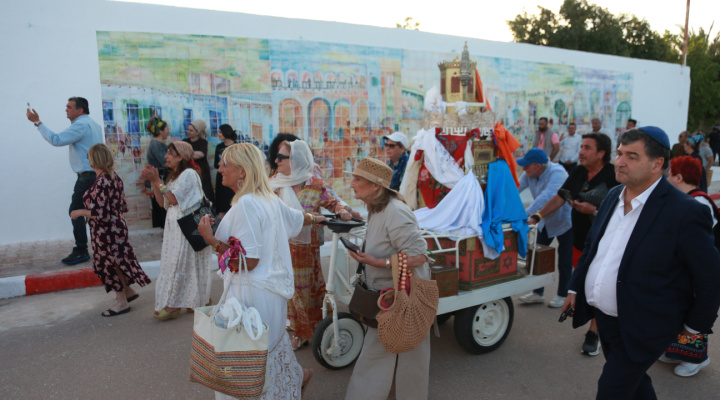
Jews from Tunisia and other countries of the world complete the annual Jewish pilgrimage to the El Ghriba Synagogue, which is considered one of the oldest Jewish places of worship in Africa and has a history of approximately 2,400 years, in Djerba Island, Tunisia on May 4, 2026. Photo: Hasan Mrad/ZUMA Press Wire via Reuters Connect
Jews are seeing cautious but notable signs of renewed inclusion in North Africa, as Morocco advances a landmark citizenship proposal for descendants abroad while pilgrims begin returning to Tunisia’s historic religious sites under tight security.
Last week, a Moroccan citizen submitted a legislative petition to the country’s House of Representatives to grant citizenship to the children and grandchildren of Moroccan Jews living abroad, marking a renewed push after a similar 2024 effort failed to secure enough support.
Supporters of the initiative argue that many Moroccan Jews emigrated for economic, religious, or other reasons, gradually losing their citizenship over generations even as they preserved strong cultural ties, underscoring that Jewish identity remains deeply embedded in Morocco’s history and monarchy.
Opponents of the proposal argue that Jews are already Moroccan citizens with equal rights regardless of religion, adding that existing legal frameworks sufficiently guarantee access to nationality without the need for new legislation.
Among the most vocal opponents, Jacky Kadoch, president of the Jewish Community of Marrakech — a major city in western Morocco — told Sky News Arabia that descendants of Moroccan Jewish emigrants face no real obstacles in obtaining citizenship or passports, and dismissed supporters of the initiative as “simply trying to stir chaos.”
Under current law, individuals of Moroccan Jewish origin can claim citizenship through lineage up to the fourth generation, reinforced by a 2011 constitutional amendment recognizing Judaism as a core component of the country’s heritage.
The newly introduced proposal focuses on simplifying the application process by establishing dedicated services and launching a national online portal to manage applications, while promoting the integration of descendants into Morocco’s economic, political, cultural, and social life.
The measure also seeks to strengthen ties with the diaspora by allowing Hebrew to be used alongside Arabic and Amazigh, creating an independent national body for Jewish religious affairs, and introducing safeguards to protect Moroccan Jewish communities from discrimination or attacks.
While Morocco’s Jewish population today numbers around 2,000, an estimated 500,000 to 1 million people of Moroccan Jewish descent live in Israel, where they form one of the country’s largest ethnic groups.
Meanwhile, Tunisian authorities are expecting a gradual return of international pilgrims to the island of Djerba for the annual Jewish pilgrimage, under heightened security and an atmosphere overshadowed by memories of violence.
In the past, the pilgrimage to the El Ghriba Synagogue — one of the oldest synagogues in North Africa — drew thousands of visitors from Europe and beyond, serving as both a religious and cultural attraction.
However, since the 2023 deadly attack on the synagogue that killed two worshippers and three police officers, attendance has dropped significantly and authorities have imposed tighter restrictions on the event.
Perez Haddad, who oversees the synagogue, noted that while religious services have continued, public celebrations remain suspended as fear still keeps many from returning, and in memory of the victims of the terror attack, whose loss is still deeply felt.
René Trabelsi, the pilgrimage organizer and former tourism minister, said confidence is slowly returning as more visitors arrive from abroad despite regional tensions.
“This year, there has been a marked return of pilgrims to the island. We estimate that around 200 people have come from abroad,” Trabelsi said in a statement.
This year, the gathering is being held from April 30 to May 6, marking the Lag B’Omer festival, observed 33 days after the start of Passover.
Tunisia is home to one of the largest remaining Jewish communities in the region outside Israel, with about 1,500 Jews living in the country, most of them in Djerba.
About 850,000 Jews were forced to flee or expelled from Middle Eastern and North African countries in the 20th century, primarily in the aftermath of Israel’s declaring independence in 1948.